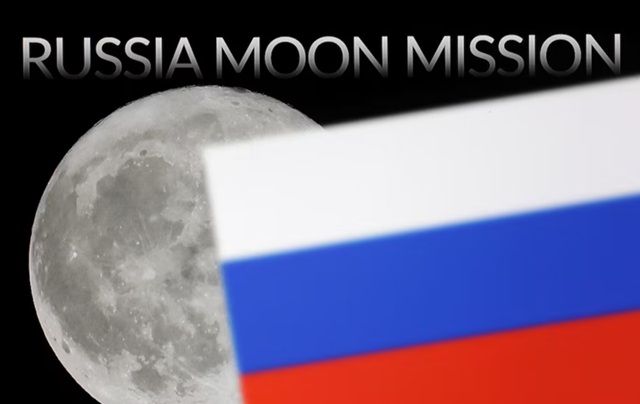
Russia has announced plans to construct a power plant on the Moon within the next decade to support its lunar exploration ambitions and a joint research base with China, as global powers intensify competition to establish a long-term presence on Earth’s only natural satellite.
Russia’s state space agency Roscosmos said it aims to complete the lunar power facility by 2036, signing a contract with the Lavochkin Association to carry out the project. The energy installation is intended to supply electricity for Russia’s lunar programme, including robotic rovers, a scientific observatory and infrastructure for the International Lunar Research Station, a joint initiative with China.
Roscosmos described the project as a shift from short, one-off missions toward permanent scientific operations on the Moon, calling it a critical step toward sustained exploration.
Implied Nuclear Technology
While Roscosmos stopped short of explicitly stating that the lunar power plant would be nuclear, it confirmed that the project involves Rosatom and the Kurchatov Institute, strongly suggesting the use of nuclear technology to generate power in the Moon’s harsh environment.
Roscosmos chief Dmitry Bakanov said earlier this year that deploying a nuclear power plant on the Moon was among the agency’s strategic goals, alongside renewed ambitions to explore Venus, often described as Earth’s “sister planet.”
Reasserting Space Ambitions
Russia has long prided itself on its space heritage dating back to Yuri Gagarin, who became the first human to travel into space in 1961. However, Moscow’s standing in space exploration has slipped in recent decades, as the United States and China have surged ahead with ambitious lunar and deep-space programmes.
The setback was underscored in August 2023, when Russia’s unmanned Luna-25 spacecraft crashed into the Moon during a landing attempt. At the same time, commercial launch innovations led by Elon Musk have transformed space access, eroding an area once dominated by Russian expertise.
A New Lunar Race
The Moon, located about 384,400 kilometres from Earth, plays a crucial role in stabilising Earth’s axial tilt and driving ocean tides. As interest grows in using the Moon as a staging ground for deeper space missions, major powers are increasingly focused on building sustainable infrastructure — including reliable power sources — beyond Earth.
If realised, Russia’s lunar power plant would mark one of the most ambitious off-world energy projects ever attempted, signalling Moscow’s determination to reassert itself in the emerging global race for lunar exploration.