The disclosure that the United States has conditioned tariff relief for Indonesian exports on the purchase of American-made maritime surveillance drones marks a significant escalation in the use of trade policy as a geopolitical tool. The move underscores how economic leverage is increasingly intertwined with Indo-Pacific security strategy, particularly amid intensifying competition in the South China Sea and growing focus on Indonesia’s North Natuna Sea.
According to a confidential Indonesian government document dated October 10, 2025, Washington has proposed reducing punitive tariffs on Indonesian goods from 32 percent to 19 percent—potentially saving Indonesian exporters billions of US dollars—on the explicit condition that Jakarta acquire and publicly announce the procurement of US unmanned aerial systems for maritime surveillance. The demand effectively reframes defence procurement from a sovereign decision into a transactional element of trade negotiations.
The proposal aligns closely with President Donald Trump’s second-term “America First” doctrine, which has aggressively leveraged tariffs to extract strategic concessions from partners. Indonesia, Southeast Asia’s largest economy and a central maritime state in the Indo-Pacific, has emerged as a key test case for whether middle powers can preserve strategic autonomy under mounting great-power economic pressure.
Indonesia Responds with Caution
Indonesia’s official response has been deliberately measured. Brigadier General Rico Ricardo Sirait, Head of the Information Bureau at the Ministry of Defense’s General Secretariat, stated that there has been no specific discussion or decision regarding the purchase of maritime surveillance drones. He emphasized that defence procurement decisions are guided by national needs, fiscal capacity, and government policy—not the interests of foreign parties.
This cautious stance reflects President Prabowo Subianto’s balancing strategy since assuming office in late 2024. While accelerating military modernisation, his administration continues to uphold Indonesia’s long-standing bebas aktif (free and active) foreign policy doctrine, which prioritises non-alignment, strategic flexibility, and resistance to formal security entanglements—particularly those that could provoke retaliation from China.
Why the North Natuna Sea Matters
The strategic stakes are amplified by Indonesia’s contested maritime geography. The North Natuna Sea lies within Indonesia’s exclusive economic zone but overlaps with China’s expansive nine-dash line claims, creating persistent friction. These tensions have already resulted in repeated confrontations between Indonesian patrol vessels and Chinese fishing fleets operating under coast guard escort.
Analysts warn that Washington’s insistence on a visible hardening of Indonesia’s maritime posture could turn surveillance procurement into overt geopolitical signalling. Intelligence firm Stratfor has noted that the US is effectively demanding Indonesia purchase US-made drones and deploy them in ways that publicly reinforce its South China Sea posture vis-à-vis China—potentially recalibrating regional threat perceptions overnight.
Trade Pressure Meets Security Alignment
The economic implications are substantial. The threatened tariffs affect key Indonesian export sectors, including nickel, palm oil, textiles, footwear, and electronics, within a bilateral trade relationship valued at approximately US$300 billion annually. This places Indonesia at a crossroads between economic vulnerability and strategic coercion.
The confidential document reportedly outlines demands extending well beyond drones, including expanded bilateral security cooperation, restrictions on Chinese technology in critical infrastructure, and mandatory consultations with Washington before Indonesia enters certain digital trade agreements. Collectively, these conditions would represent a deep intrusion into sovereign policymaking.
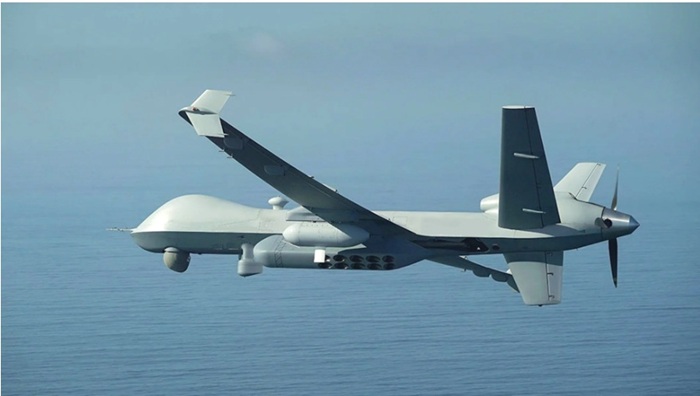
Although the specific drone model is not named, defence analysts widely believe the General Atomics MQ-9B SeaGuardian is the likely platform. The system offers more than 40 hours of endurance, high-altitude operation, and advanced multi-sensor capabilities optimized for maritime surveillance. Similar platforms are already operated by India and the Philippines, enhancing regional maritime domain awareness.
By linking such advanced ISR capabilities directly to tariff relief, Washington effectively collapses the distinction between trade negotiation and defence alignment, raising serious questions about Indonesia’s long-standing diversified procurement strategy.
Strategic Risks and Regional Consequences
Indonesia’s Ministry of Defense has continued to use carefully calibrated language, signalling neither acceptance nor rejection of the proposal. Officials acknowledge that maritime surveillance remains a capability gap, given Indonesia’s vast archipelagic jurisdiction spanning more than six million square kilometres. However, past concerns over cost and integration—particularly during stalled MQ-9B discussions in 2023—have reinforced Jakarta’s caution toward high-cost, single-source systems.
Experts warn that accepting security-linked trade concessions could have far-reaching consequences. Muhammad Zulfikar Rakhmat of the Center of Economic and Law Studies cautions that visible alignment with US security demands could strain Indonesia’s relations with China, undermine its strategic autonomy, and heighten instability in the South China Sea.
China’s potential responses could range from diplomatic protests and economic retaliation to increased maritime pressure and intensified grey-zone operations. Such dynamics risk transforming Indonesia from a stabilising middle power into a frontline state in the US-China rivalry.
At the regional level, Indonesia’s decision could also affect ASEAN unity. Analysts warn that accepting security-linked trade conditions could set a precedent, increasing intra-ASEAN polarisation and weakening collective efforts to manage South China Sea disputes through diplomacy.
A Defining Choice for Jakarta
Economically, tariff relief could bolster Indonesia’s projected 5.2 percent GDP growth in 2026. However, a squadron of MQ-9B SeaGuardian drones is estimated to cost around US$500 million, excluding long-term maintenance and integration expenses—placing additional strain on an already stretched defence budget.
Indonesia retains alternative options, including diversifying export markets, deepening ties with non-aligned partners, and continuing its multi-vector defence procurement approach.
How Jakarta navigates this dilemma will not only shape its role in the South China Sea but may also serve as a defining test for middle-power autonomy in an era where trade, technology, and security are increasingly inseparable.