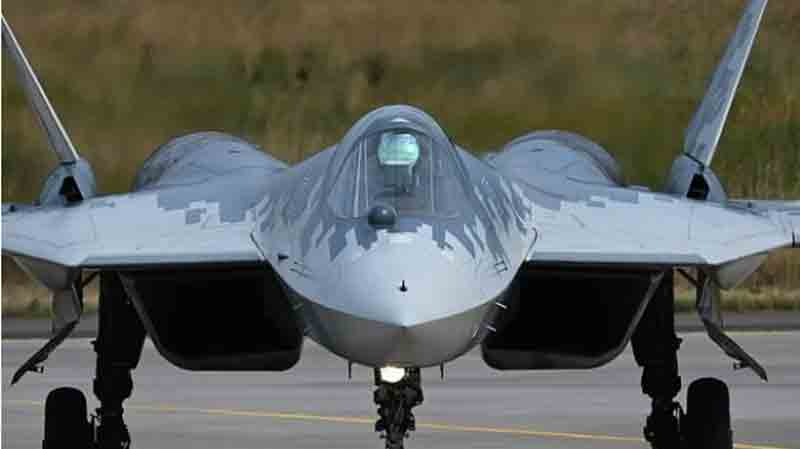
India is once again flirting with Russia’s fifth-generation fighter dream—and once again, the risks are almost as large as the promise.
New Delhi is weighing local production of the Su-57E, Russia’s export variant of its stealth fighter, at a time when the Indian Air Force (IAF) is facing an uncomfortable reality: shrinking squadron strength, delayed indigenous programmes, and a rapidly modernising Chinese air force anchored by the expanding J-20 fleet. The question is not whether India needs a fifth-generation fighter—but whether the Su-57E is the answer, or a strategic distraction.
A Crisis Driving the Conversation
The IAF today operates fewer than 30 fighter squadrons, well below the sanctioned strength of 42. That shortfall directly weakens India’s deterrence posture against both China and Pakistan. Meanwhile, Beijing is racing ahead—not only fielding stealth aircraft at scale but also laying the groundwork for sixth-generation combat aviation.
Against this backdrop, Russia’s offer looks tempting: rapid access to a fifth-generation platform, local production, and—most unusually—full technology transfer. For an air force staring at a capability gap that could last more than a decade until India’s indigenous AMCA matures, the Su-57E appears to promise a shortcut.
But shortcuts in defence procurement have a long history of turning into dead ends.
Russia’s Big Pitch—and India’s Lingering Doubts
Moscow is expected to submit a detailed technical and financial assessment by late January 2026, outlining what it would take to manufacture the Su-57E in India. Russian officials claim that Hindustan Aeronautics Limited (HAL) already possesses around 50% of the required industrial capacity, largely thanks to decades of Su-30MKI production.
They argue that HAL’s Nashik facility would need less than 30% retooling, with infrastructure upgrades estimated between USD 960 million and USD 1.2 billion—figures that appear manageable on paper.
Yet Indian planners have heard this story before.
From the Admiral Gorshkov aircraft carrier refit to the lifecycle costs of the Su-30MKI fleet, past Indo-Russian programmes have repeatedly suffered from cost overruns, delays, and opaque sustainment economics. The institutional memory inside India’s defence establishment is not forgiving.
The Technology Transfer Trap
Russia’s headline offer—access to avionics source codes, stealth materials, sensor fusion architectures, and possibly even engine technology—is virtually unheard of in Western fifth-generation deals. On paper, it aligns perfectly with India’s “Make in India” ambitions and long-term aerospace sovereignty.
But this is also where skepticism deepens.
Technology transfer is only as valuable as the maturity of the technology being transferred. Russia currently operates a very limited Su-57 fleet—around 20 aircraft, with reported combat use largely confined to standoff missions rather than deep penetration in contested airspace. That raises uncomfortable questions: is India being offered a proven fifth-generation ecosystem—or early access to a platform still evolving?
Absorbing immature technology could complicate, rather than accelerate, India’s own AMCA programme.
Capability Boost or Strategic Hedge?
Supporters argue the Su-57E would give India a near-term stealth counterweight to China’s J-20s, especially if integrated with long-range missiles and advanced infrared search-and-track systems. They also see it as a “technology bridge,” helping Indian engineers and pilots adapt to fifth-generation concepts before AMCA arrives.
Critics counter that this bridge may lead nowhere.
They warn that Russian systems often appear cheaper upfront—unit costs for the Su-57E are estimated at USD 80–100 million, far below Western stealth fighters—but become expensive over time due to maintenance complexity, spare parts dependence, and upgrade uncertainty.
The Rafale Shadow and a Strategic Divide
The Su-57E debate cannot be separated from India’s parallel MRFA competition, where the Rafale remains a strong contender, backed by a proposed second production line in Nagpur.
At its core, this is not just an aircraft choice—it’s a philosophical divide:
- Rafale offers proven performance, reliability, and geopolitical reassurance, but limited technology transfer.
- Su-57E promises deep industrial access and strategic autonomy, but with higher developmental, financial, and geopolitical risk—including potential CAATSA sanctions exposure.
Choosing Russia again would test India’s careful balancing act between Washington and Moscow at a time when global fault lines are hardening.
A Decision Bigger Than a Fighter Jet
Russia is positioning the Su-57E not merely as an aircraft, but as a strategic partnership tool—even floating the idea of India becoming a future export hub for the platform. If realised, that would dramatically reshape India’s aerospace ambitions.
But ambition alone does not guarantee success.
For India, the Su-57E decision is ultimately a referendum on risk tolerance: whether New Delhi is willing to gamble on an unproven fifth-generation ecosystem today to avoid a dangerous capability gap tomorrow.
As the Russian assessment lands, one truth is unavoidable—the choice will define India’s airpower trajectory for decades, and there will be no easy course correction once the path is chosen.