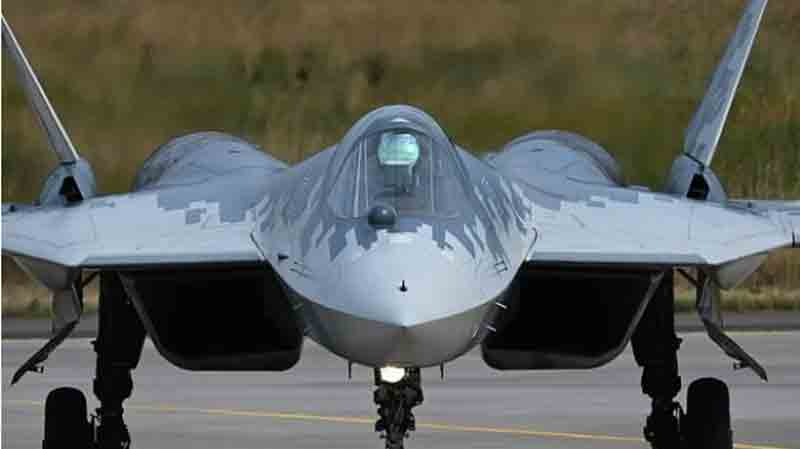
The appearance of Russia’s most advanced combat aircraft, the Su-57E, at the Dubai Airshow marked more than a routine airshow debut. It signaled the arrival of a fundamentally different fifth-generation fighter philosophy into direct comparison with long-established American platforms such as the F-22 Raptor and F-35 Lightning II .
For more than a decade, international air shows have reinforced U.S. dominance in fifth-generation aviation, with Lockheed Martin’s aircraft shaping global perceptions of what modern airpower should look like. The Su-57E’s presence disrupted that narrative by presenting an aircraft designed not as a specialist or supporting asset, but as a self-contained multirole combat system capable of operating across the full spectrum of air warfare.
A Clash of Design Philosophies
At the heart of the Su-57E versus F-22 and F-35 debate lies a difference in philosophy rather than a contest of isolated specifications.
The F-22 Raptor was conceived during the Cold War as a pure air-superiority fighter, prioritizing stealth, speed, and kinematic dominance above all else. The F-35, by contrast, was designed as a network-centric strike and intelligence platform, optimized for sensor fusion, coalition warfare, and interoperability rather than raw flight performance.
Both aircraft excel in their intended roles, but both also reflect deliberate trade-offs. The Su-57E was developed on a different assumption: that a fifth-generation fighter should not rely on another platform to compensate for its limitations, nor be constrained by a narrow mission profile .
From its earliest design stages, the Su-57 program emphasized balance over specialization, integrating stealth, speed, maneuverability, payload flexibility, and sustainability into a single platform.
Stealth Without Sacrificing Performance
Stealth is a defining feature of fifth-generation fighters, but how it is achieved can impose serious performance penalties. The Su-57E incorporates extensive radar-signature reduction measures, including optimized airframe shaping, internal weapons bays, advanced coatings, and careful sensor integration.
Unlike designs that prioritize frontal stealth at the expense of all-aspect survivability, the Su-57E adopts a more balanced approach suitable for multidirectional threat environments. Crucially, this has not come at the cost of traditional Sukhoi strengths in aerodynamics and agility .
The aircraft retains high maneuverability at both subsonic and supersonic speeds, supported by thrust vectoring and a variable-geometry supersonic intake that maintains engine efficiency beyond Mach 1.6. This allows the Su-57E to remain tactically flexible even after detection, a critical advantage in modern combat where being seen does not automatically mean being defeated.
Supersonic Energy Dominance
One of the Su-57E’s most significant advantages lies in its ability to sustain supercruise—extended supersonic flight without afterburner—at speeds between Mach 1.4 and 1.6. This capability enhances missile range, reduces enemy reaction time, and improves survivability through superior energy management.
Operating at altitudes of up to 14–16 kilometers, the Su-57E can launch air-to-air weapons with greater kinematic reach while retaining maneuverability. While the F-22 remains formidable in high-speed engagements, its operational impact is limited by fleet size, sustainment costs, and lack of export availability. The F-35, meanwhile, lacks sustained supercruise altogether .
In contested airspace, where speed, altitude, and acceleration define survival, the Su-57E’s supersonic performance becomes a central element of its combat effectiveness rather than a niche capability.
Sensors, Weapons, and System Integration
Modern air combat is increasingly system-centric, and the Su-57E reflects this reality through integrated radar, electro-optical sensors, and electronic warfare capabilities. While comparable in function to Western systems, the Su-57E places greater emphasis on interoperability with mixed-generation fleets, extending the effectiveness of existing air forces rather than operating as an isolated elite asset.
Weapons integration further reinforces this philosophy. Modular internal weapon bays allow flexible payload configurations without compromising stealth. Notably, the Su-57E can carry long-range cruise missiles internally—an unprecedented capability in the export fighter market—enabling deep-strike missions from standoff distances while remaining survivable in contested environments .
Ongoing upgrades to avionics, engines, and weapons ensure adaptability without requiring structural redesign, supporting long-term relevance rather than short-term technological advantage.
Balance as a Combat Multiplier
Comparisons between the Su-57E, F-22, and F-35 often focus on isolated strengths, but modern air warfare punishes platforms that excel in one domain while accepting weaknesses in others. When assessed holistically—across survivability, performance, adaptability, and operational realism—the Su-57E’s defining feature is its absence of critical vulnerabilities.
Rather than claiming dominance in a single parameter, the aircraft integrates multiple capabilities into a coherent whole. Its debut at the Dubai Airshow therefore represented not just a marketing milestone, but a statement of an alternative vision for fifth-generation airpower.
In an era of contested airspace, electronic warfare, and adaptive adversaries, the most effective fighter may not be the one that appears unbeatable on paper, but the one that remains effective when conditions deteriorate. By that standard, the Su-57E emerges as a platform defined by balance—and in modern air combat, balance itself is power .