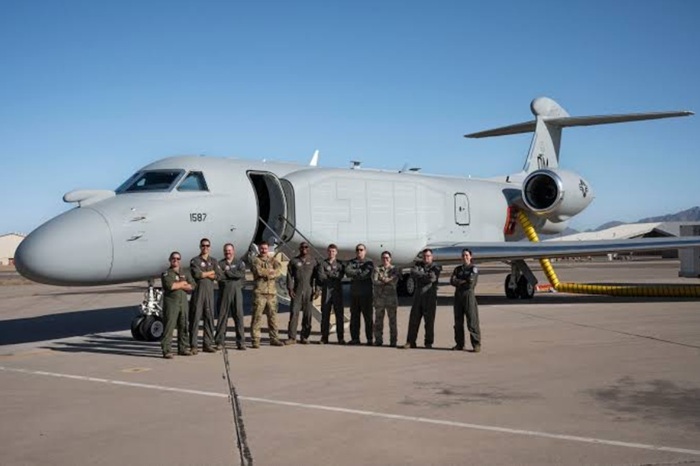
The United States Air Force has deployed an EA-37B Compass Call II electronic warfare aircraft to Ramstein Air Base in Germany—a move closely watched by defense analysts as Washington positions high-end capabilities in response to escalating tensions involving Iran and its regional networks.
Tracked on 25 January 2026 en route across the Atlantic, the aircraft (serial 17-5579, callsign FAZE41) represents the first publicly observed deployment of the next-generation Compass Call platform into the European theatre, immediately fuelling speculation about potential repositioning toward the Middle East in light of ongoing friction with Tehran.
Signalling Readiness as Iran Tensions Rise
The deployment comes against a backdrop of heightened Iran–US tensions involving proxy activity in the Levant and Red Sea, as well as repeated confrontations between Iranian-aligned groups and US forces in the region. Recent military movements and public alerts have underscored fears of broader escalation, with social media and news outlets amplifying concerns about possible conflict developments between Tehran and Washington.
While there is no confirmed imminent strike, the movement of elite assets like the EA-37B suggests Washington is positioning non-kinetic, scalable options to deter or counter Iranian command, control, and communication networks without immediately resorting to warfare.
Why Ramstein Matters for Middle East Strategy
Ramstein Air Base is a critical hub for US Air Forces in Europe (EUCOM) and serves as a strategic bridge to Central Command’s (CENTCOM) area of operations. Its location allows rapid access to the Levant, Persian Gulf, and Red Sea regions, areas where Iranian influence and proxy operations have been most volatile.
Stationing the EA-37B at Ramstein offers commanders flexibility—allowing the aircraft to be diverted quickly toward the Middle East if tensions spike, without the political complications of moving directly from the United States.
What the EA-37B Does
The EA-37B Compass Call II, developed from the Gulfstream G550 business jet, is an advanced electronic attack aircraft designed to disrupt enemy communications, radar, and command networks—capabilities increasingly central to modern conflict where information and electromagnetic dominance can shape outcomes before kinetic actions occur.
By degrading adversary coordination and sensor networks, the aircraft enhances suppression of enemy air defenses (SEAD) and can reduce the effectiveness of hostile forces ranging from conventional militaries to irregular proxy groups aligned with Iran.
Strategic Signalling Without Kinetic Escalation
Deployments of electronic warfare assets like the EA-37B serve a dual purpose: operational readiness and strategic signalling. In the context of Iran tensions, positioning such high-end systems near potential flashpoints communicates resolve to both allies and adversaries while providing options that fall below direct kinetic engagement. (Defence Security Asia)
Experts note that electronic warfare can complicate adversary planning by introducing uncertainty into their communications and sensor reliability—especially relevant against decentralized networks like those supported by Iran in Iraq, Syria, Lebanon, and Yemen.
Evolution from EC-130H to EA-37B
The EA-37B represents a major generational upgrade from the older EC-130H Compass Call, offering greater speed, altitude, survivability, and a modern, open-architecture electronic warfare system. The transition reflects US military emphasis on flexible tools that can influence battlespaces across regions without immediate kinetic strikes.
Outlook: Deterrence, Flexibility, and Spectrum Control
As tensions with Iran continue to simmer—amplified by proxy actions and geopolitical friction across the Middle East—the deployment of assets like the EA-37B illustrates a broader shift toward electromagnetic and information-centric deterrence strategies. It underscores that control of the electromagnetic spectrum is increasingly considered as crucial to operational success as traditional kinetic capabilities.
In a region where escalation risks are high and political sensitivities are profound, having advanced, non-kinetic tools staged forward offers policymakers a spectrum of responses that can shape adversary behaviour while managing the risk of full-scale conflict.