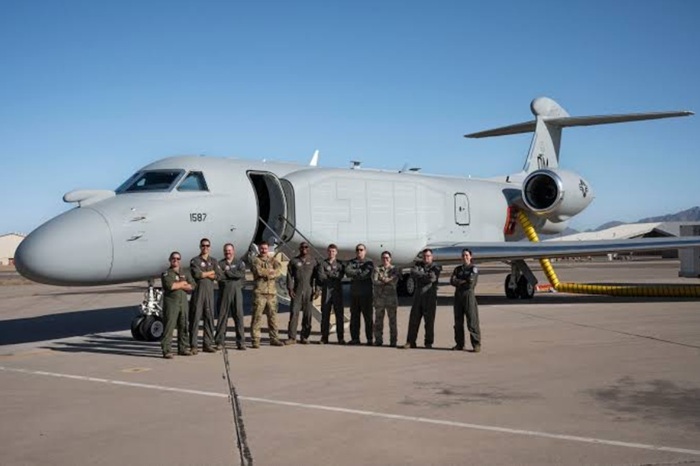
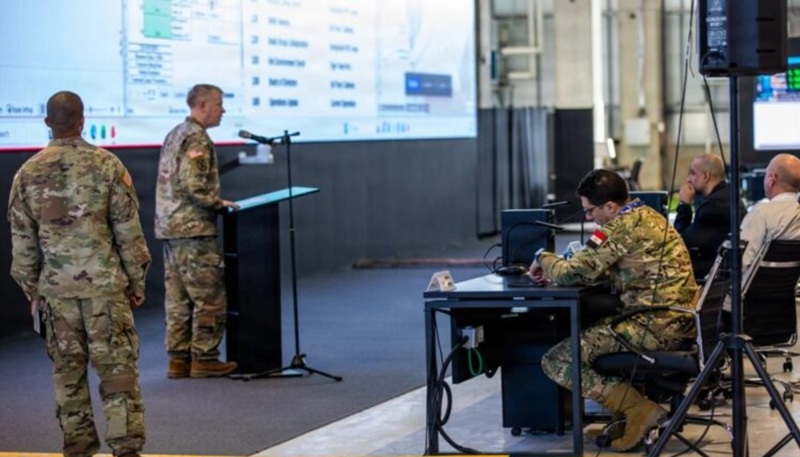
A brief and quickly retracted release by U.S. Central Command (CENTCOM) has unintentionally revealed a highly sensitive reality of Middle East security diplomacy: the operational presence of Egyptian military officers inside an Israel-based, U.S.-led Gaza Civil-Military Coordination Center (CMCC) .
The incident, involving photographs and video footage published and then deleted in January 2026, offered the first public visual confirmation that Egyptian officers are physically embedded within a coordination hub on Israeli soil—an exposure that immediately triggered diplomatic concern in Cairo due to its profound domestic and regional political implications .
Why the Images Were Politically Explosive
According to reporting outlined in the document, Egyptian authorities swiftly contacted U.S. counterparts, warning that the footage could create a “bad impression” at a time when Cairo must carefully balance quiet security cooperation with Israel against its public posture of unwavering support for Palestinian civilians in Gaza .
While Egypt has long maintained discreet military coordination with Israel—particularly on Sinai security, border control, and Gaza ceasefires—visible imagery of Egyptian officers operating inside Israel crosses a long-standing political red line for Egyptian leadership, which remains acutely sensitive to domestic opinion and Islamist opposition narratives.
What Is the Gaza CMCC?
The Civil-Military Coordination Center (CMCC) is located in Kiryat Gat, Israel, and was established in mid-October 2025 following a Gaza ceasefire that took effect around October 10, 2025 .
The center was formalized through a declaration signed in Sharm el-Sheikh on October 13, 2025, alongside U.S. President Donald Trump and leaders from Turkey, Qatar, and Egypt, forming part of Washington’s effort to internationalize Gaza’s post-war stabilization framework .
Operationally, the CMCC:
- Monitors ceasefire compliance
- Coordinates humanitarian aid flows averaging 800+ trucks per day
- Oversees approval of reconstruction materials
- Hosts multinational working groups on security, engineering, and governance
The facility is structured as a three-story building, with separate floors for Israeli personnel, U.S. forces, and international delegations—designed to enable coordination while minimizing political friction.
Egypt’s Role: Essential but Politically Invisible
The images confirmed what regional analysts have long suspected: Egypt is not merely a mediator but an embedded operational stakeholder in Gaza’s post-war security architecture .
Egypt’s value to the CMCC lies precisely in its dual identity:
- An indispensable security partner for Israel and the U.S.
- A publicly distanced Arab actor that must avoid normalization optics
This duality allows Cairo to:
- Enforce border security and restrict arms smuggling
- Pressure Hamas behind the scenes
- Retain credibility as a ceasefire mediator
However, that balance depends entirely on deniability and discretion, both of which were threatened by CENTCOM’s brief publication.
CENTCOM as Political Buffer
CENTCOM’s leadership of the CMCC provides political insulation for Arab participants by placing coordination under an American umbrella rather than direct bilateral Egyptian-Israeli mechanisms .
Yet the incident exposed a structural tension: U.S. military transparency norms clash with regional partners’ preference for strategic ambiguity.
The rapid deletion of the imagery demonstrated how even carefully curated disclosures can destabilize sensitive coalitions when domestic political realities outweigh operational logic.
Israeli and Regional Reactions
The exposure also fueled internal Israeli criticism, with hard-line figures such as Finance Minister Bezalel Smotrich reportedly arguing that the CMCC undermines Israeli sovereignty and should exclude states perceived as insufficiently aligned with Israel’s security priorities .
By contrast, U.S. officials see multinational participation—particularly Egypt’s—as essential to:
- Sharing political risk
- Sustaining humanitarian access
- Preventing Gaza instability from spilling into Sinai
The disagreement underscores the fragility of the CMCC’s legitimacy across multiple political audiences.
Why Egypt Reacted So Quickly
Egyptian President Abdel Fattah el-Sisi governs amid:
- Economic pressure
- Persistent public discontent
- Islamist narratives framing cooperation with Israel as betrayal
Visible proof of Egyptian officers operating on Israeli soil risked becoming a rallying symbol for opposition groups and could have weakened Egypt’s regional standing amid competition with Qatar, Türkiye, and Iran for influence over the Palestinian issue .
The phrase “bad impression” thus encapsulated fears of street backlash, social media mobilization, and erosion of mediator credibility.
A Lesson in Middle East Power Politics
The CENTCOM imagery incident illustrates a core reality of Middle Eastern security cooperation:
The most consequential alliances often function only when they remain unseen .
While the CMCC remains central to Gaza’s ceasefire management, humanitarian access, and reconstruction planning, its effectiveness depends on controlled invisibility rather than public acknowledgment.
As long as Gaza’s future rests on fragile truces and contested governance frameworks, U.S.-facilitated coordination among Egypt, Israel, and regional partners will remain essential—but politically combustible.
In this environment, a single image can be as destabilizing as a battlefield failure.