Nearly a decade after Washington openly took sides in a Gulf dispute, a new and potentially more consequential rift has emerged between two of America’s closest Middle Eastern partners: Saudi Arabia and the United Arab Emirates.
Unlike the 2017 blockade of Qatar, when then-President Donald Trump publicly backed Riyadh and Abu Dhabi, Washington has so far remained conspicuously quiet as tensions escalate between the former allies.
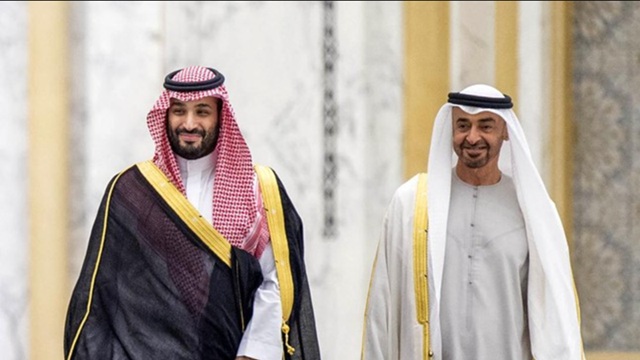
The dispute now stretches across multiple theatres—from Yemen and Sudan to Libya and the Red Sea—highlighting a widening strategic divergence between Crown Prince Mohammed bin Salman and President Mohammed bin Zayed.
From Yemen to Africa: A Multi-Front Rivalry
The fallout became visible in early January when Saudi Arabia launched airstrikes against Yemeni secessionist forces backed by Abu Dhabi and moved to expel the Southern Transitional Council from parts of southern and eastern Yemen. The move marked a sharp reversal from years of coordination in the Yemeni conflict.
Tensions have also spilled into Africa. Riyadh has reportedly discussed supplying arms—via Pakistan—to Sudan’s military, which is fighting the Rapid Support Forces (RSF), a paramilitary group widely seen as aligned with Emirati interests. In Libya, Saudi Arabia and Egypt are lobbying the family of warlord Khalifa Haftar to distance themselves from the UAE and halt alleged logistical support to the RSF.
Alongside covert maneuvering, the rivalry has erupted into an unusually aggressive media and social-media battle. A recent Saudi opinion piece accused the UAE of acting as “Israel’s Trojan horse in the Arab world,” framing Abu Dhabi’s foreign policy as a betrayal of religious and regional principles.
Trump, Business Interests, and Strategic Restraint
Despite the growing feud, Trump has refrained from intervening. Former US diplomats say this restraint reflects lessons learned from 2017, when his administration misread Gulf dynamics and underestimated Qatar’s strategic importance, including hosting the US Al-Udeid air base.
Another key difference today is Trump’s extensive financial exposure across the Gulf. Trump-branded luxury developments are underway in Saudi Arabia, Dubai, Qatar, and Oman—many tied to Saudi developer Dar al-Arkan. His inner circle, including Jared Kushner, Steve Witkoff, and Tom Barrack, also maintains deep business and investment ties with all major Gulf states.
This web of interests complicates any clear US alignment, even as both Saudi Arabia and the UAE compete for influence in Washington.
Competing Visions for the Middle East
Analysts describe the rift as more than a personal dispute—it reflects a structural shift in regional leadership.
Saudi Arabia is positioning itself as the central political and religious heavyweight of the Arab and Islamic world, leveraging its G20 status, nuclear-armed partnership with Pakistan, and expanding defense ties with Turkey. The UAE, by contrast, is pursuing a network-driven strategy, aligning closely with Israel, investing heavily in ports, gold, and logistics, and backing secessionist movements from Sudan to Somaliland.
Abu Dhabi’s role in projects like the India–Middle East–Europe Economic Corridor and its close coordination with Israel resonate strongly in parts of Washington. Yet its growing engagement with China—including concerns over activity at Khalifa Port—has unsettled US intelligence officials.
Why Trump May Ultimately Lean Saudi
While US officials insist Washington wants strong ties with both “brothers,” experts argue that Saudi Arabia’s scale and strategic weight may ultimately prove more attractive to Trump. The kingdom’s economy is roughly double the size of the UAE’s, and its investment pledges rival—or exceed—Abu Dhabi’s.
Trump’s core regional priorities—containing Iran, stabilizing Gaza, reunifying Yemen, and backing state authority in Sudan—also align more closely with Riyadh’s positions than Abu Dhabi’s support for non-state actors.
Israel remains a wildcard. The UAE enjoys unmatched access as Israel’s closest Arab partner, but Saudi Arabia’s influence over broader Arab and Islamic opinion, and its central role in recent Syria diplomacy, continue to give Riyadh an edge.
For now, Trump appears determined not to repeat past mistakes. But as the Saudi-UAE rivalry sharpens, pressure will grow on Washington to decide whether neutrality is sustainable—or merely temporary.