The United States has significantly expanded its military presence across the Middle East in recent weeks, deploying additional air, naval, and intelligence assets amid rising tensions with Iran and growing concerns over regional stability.
Defense officials and open-source tracking data indicate that the buildup is aimed at strengthening deterrence, improving force protection, and ensuring rapid response capability in the event of a wider regional escalation.
Expanded U.S. Air Force Operations
The United States Air Force has carried out an intensive airlift and reinforcement campaign to move personnel, equipment, and advanced platforms into the region.
More than 80 C-17 Globemaster III transport flights, supported by several C-5M Super Galaxy heavy-lift missions and multiple C-130 sorties, have been used to deliver troops and critical materiel to forward operating bases.
To sustain prolonged operations, the US has deployed up to 20 aerial refueling aircraft, including KC-135 Stratotankers and KC-46 Pegasus tankers. Search-and-rescue capability has also been reinforced with HC-130J aircraft, enhancing personnel recovery in contested environments.
In the intelligence and command domain, the Air Force has positioned E-11A BACN aircraft to provide airborne communications and battle management, ensuring connectivity across dispersed forces. Signals intelligence and electronic surveillance capabilities have been strengthened with the deployment of RC-135 Rivet Joint aircraft.
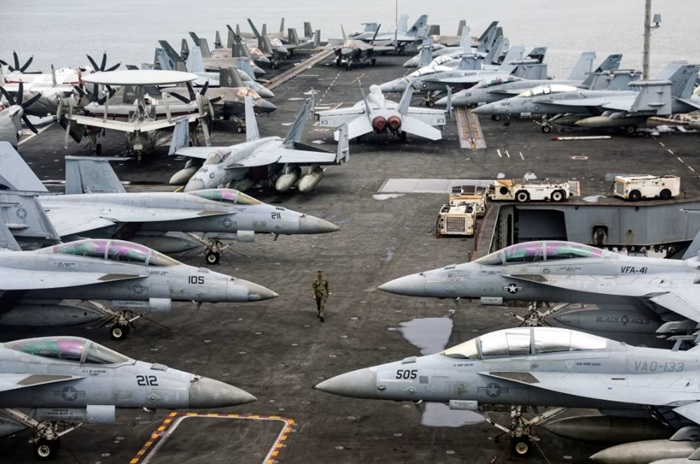
Combat power has also been reinforced. The US has deployed six F-35A stealth fighters alongside six EA-18G Growler electronic warfare aircraft, enhancing both strike and electronic attack capabilities. These assets join previously deployed F-15E Strike Eagles and A-10C Thunderbolt II attack aircraft already operating in the region.
U.S. Navy Strengthens Maritime Posture
At sea, the United States Navy has expanded its surface and subsurface presence across key maritime corridors.
Three Arleigh Burke–class guided-missile destroyers are operating with the USS Abraham Lincoln Carrier Strike Group in the Arabian Sea, providing air defense, missile interception, and strike support.
Additional Arleigh Burke–class destroyers have been positioned in the Gulf of Oman and the Persian Gulf to protect US military facilities and partner infrastructure in Qatar, United Arab Emirates, and Saudi Arabia.
Further north, two more US destroyers are operating in the Gulf of Aqaba and the Mediterranean Sea, where they are tasked with helping to defend Israel against potential missile and drone threats.
Adding a strategic dimension to the deployment, the nuclear-powered guided-missile submarine USS Georgia has been reported operating in the Mediterranean. The Ohio-class submarine is capable of carrying large numbers of cruise missiles and special operations forces, providing the US with a highly survivable strike option.
Deterrence Messaging and Regional Implications
US officials have not announced any imminent military action but emphasize that the buildup is defensive in nature and intended to deter Iran and its regional allies from targeting American forces or partners.
The scale and diversity of the deployments—spanning airlift, intelligence, electronic warfare, naval strike, and missile defense—underscore Washington’s intent to maintain escalation dominance while reassuring allies across the Middle East.
As tensions persist over Iran’s regional activities, maritime security, and ongoing conflicts involving US partners, the reinforced US posture signals readiness for rapid response while keeping diplomatic options on the table.