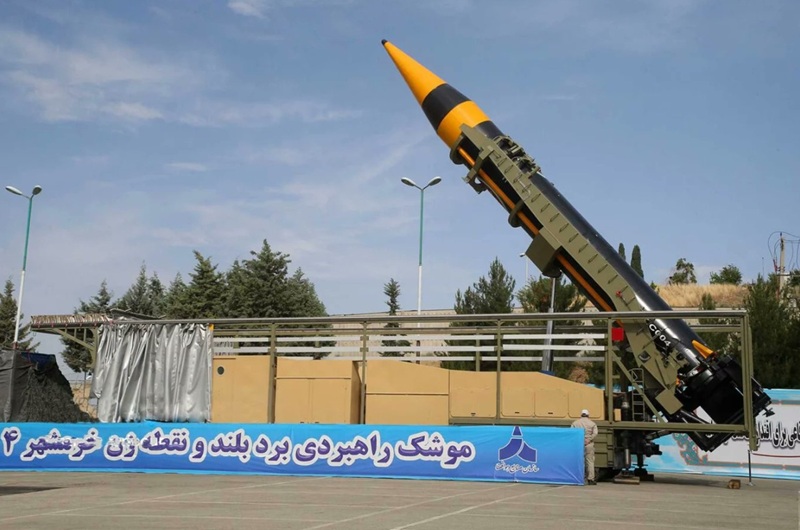
Iran has officially deployed the Khorramshahr-4 ballistic missile into active combat service, a move widely viewed as a deliberate escalation of strategic signalling amid heightened regional tensions. Iranian state media confirmed the deployment, framing it as both a military milestone and a geopolitical message to regional and extra-regional adversaries.
The announcement comes at a time of acute volatility in the Middle East, with missile capability increasingly central to deterrence, diplomacy, and crisis bargaining.
IRGC Messaging and Strategic Signalling
Senior Iranian military officials, including commanders of the Islamic Revolutionary Guard Corps Aerospace Force, stressed that the Khorramshahr-4 is a fully indigenous system developed despite years of sanctions.
Iranian military media explicitly linked the missile’s operational deployment to a doctrinal shift from defensive deterrence to a more offensive posture, signalling that ballistic missiles are no longer reserved solely for retaliation but are now positioned as tools of coercive diplomacy.
Timing Linked to Nuclear Diplomacy
The timing of the deployment is particularly significant. Reports indicate the missile became operational on February 4, 2026—just hours before anticipated U.S.–Iran nuclear talks in Oman. Analysts interpret this as an attempt by Tehran to harden its negotiating position by demonstrating irreversible military facts on the ground.
By showcasing an advanced, war-ready missile capability, Iran effectively converts military power into diplomatic leverage, narrowing the space for concessions under pressure.
Why the Khorramshahr-4 Changes the Threat Landscape
From a strategic perspective, the Khorramshahr-4 reflects Iran’s assessment that regional deterrence has shifted toward rapid-strike, high-payload ballistic systems designed to compress enemy decision-making timelines.
For Israel, U.S. forward-deployed forces in the Gulf, and allied command centres across the Middle East, the missile introduces a destabilising element: the ability to deliver extremely heavy warheads at hypersonic speeds within minutes, reducing early-warning margins and complicating missile defence planning.
Historical Roots of the Khorramshahr Missile Program
The Khorramshahr missile family is deeply rooted in Iran’s collective memory of the 1980–1988 Iran-Iraq War, when the city of Khorramshahr became a symbol of national endurance. That experience shaped Tehran’s long-term conviction that strategic survival depends on indigenous strike capabilities.
The first Khorramshahr variant was unveiled in 2017, reportedly drawing technical inspiration from North Korean designs before being extensively localised. Subsequent versions focused on improving survivability, payload capacity, and penetration against missile defences.
Technical Capabilities of the Khorramshahr-4
The Khorramshahr-4, also known domestically as the Kheibar missile, represents the most advanced iteration to date. Key reported characteristics include:
- Range: Approximately 2,000 kilometres
- Payload: Estimated 1,500–1,800 kg, the heaviest among Iran’s operational missiles
- Speed: Exo-atmospheric speeds reportedly reaching Mach 16, with terminal speeds around Mach 8
- Guidance: Manoeuvrable re-entry vehicle designed to evade interception
- Accuracy: Reported circular error probable of 10–30 metres
These attributes collectively position the missile as a precision strategic weapon rather than a purely symbolic deterrent.
Underground “Missile Cities” and Survivability
The integration of the Khorramshahr-4 into Iran’s underground “missile cities” significantly enhances survivability. Built deep within mountainous terrain, these facilities are designed to withstand precision strikes while enabling rapid, coordinated launches.
Dispersed basing and hardened infrastructure complicate adversary targeting efforts and increase the likelihood that Iran could sustain missile operations even after an initial attack.
Regional and Global Implications
The deployment compresses escalation timelines across the Middle East, increasing the risk of miscalculation during crises. For Gulf states and U.S. forces, it raises force-protection challenges, while for Israel it tests the limits of layered missile defence systems.
Beyond the region, the move resonates across Asia, where energy security and maritime trade—particularly through the Strait of Hormuz—remain vulnerable to missile-driven escalation and oil price volatility.
Missile Power as Diplomatic Leverage
International reactions underscore how missile capability has become inseparable from modern diplomacy. While Western officials warn of destabilisation and proliferation risks, Tehran appears intent on signalling that its missile programme is non-negotiable.
In this sense, the Khorramshahr-4 functions as both a weapon and a diplomatic instrument, shaping negotiations, alliances, and threat perceptions far beyond its physical range.
A New Geometry of Deterrence
Iran’s decision to operationalise the Khorramshahr-4 marks a decisive shift in its national security strategy. Ballistic missiles are no longer peripheral symbols of resistance but central instruments of power projection backed by credible combat readiness.
Whether this capability stabilises deterrence or accelerates escalation remains uncertain. What is clear, however, is that the deployment signals a new phase in Middle Eastern security dynamics—one defined by speed, payload dominance, and shrinking margins for error.