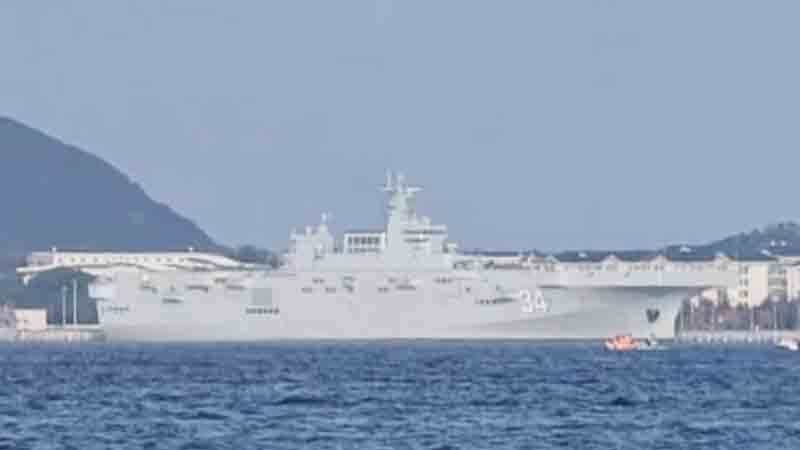
The People’s Liberation Army Navy has conducted a high-intensity, combat-oriented exercise involving its Type 075 amphibious assault ship Hainan in the South China Sea, underscoring Beijing’s accelerating shift from coastal defence toward expeditionary, multi-domain maritime warfare.
The drills, carried out under China’s Southern Theater Command, come amid heightened regional tensions and growing great-power rivalry across the Indo-Pacific.
Focus on Sea-Air Coordination and Missile Defence
Chinese military reporting described the exercise as “high-intensity and combat-oriented,” highlighting an emphasis on realistic warfighting scenarios rather than symbolic demonstrations.
Key elements included:
- Integrated sea-air coordination
- Air- and missile-defence drills under contested conditions
- Amphibious task force survivability in far-sea environments
These activities reflect the PLA Navy’s intent to prepare amphibious forces for operations under persistent aerial, missile, and electronic warfare threats.
From Modernisation Symbol to Frontline Asset
Commissioned in April 2021, Hainan has rapidly transitioned from a flagship of naval modernisation into a frontline operational platform. The ship is now routinely integrated into complex exercises combining aviation operations, surface manoeuvre, electronic warfare, and layered air defence.
Analysts increasingly assess the Type 075 not merely as a transport vessel, but as a command-and-control hub capable of orchestrating helicopter-borne assaults, anti-submarine screens, and defensive umbrellas within a single amphibious strike group.
Implications for Southeast Asia Claimant States
For Southeast Asian claimant states such as Philippines, Vietnam, and Malaysia, the presence of Hainan in realistic South China Sea drills signals a growing military asymmetry.
China’s ability to rapidly deploy marines, helicopters, and supporting fires is increasingly rehearsed, enhancing its capacity to impose faits accomplis in disputed maritime zones.
Type 075: A Leap in Chinese Amphibious Capability
The Type 075 Yushen-class represents a qualitative leap in China’s amphibious warfare architecture.
Key characteristics include:
- Displacement: ~40,000 tonnes (full load)
- Length: ~250 metres
- Aviation capacity: Up to 30 helicopters (Z-8, Z-9, Z-20 variants)
- Troop capacity: Up to 900 marines with vehicles and supplies
Constructed by China State Shipbuilding Corporation at Hudong-Zhonghua Shipyard, the class reflects the maturation of China’s military-industrial base under its military-civil fusion strategy.
Layered Defences and Command Integration
Hainan’s survivability is reinforced through layered defensive systems, including HHQ-10 short-range surface-to-air missiles and H/PJ-11 close-in weapon systems, supported by advanced radar and sensor suites.
Crucially, the ship’s command architecture enables real-time coordination between escorts, aviation assets, and potentially unmanned systems—central to China’s system-of-systems naval warfare doctrine.
Strategic Role of Hainan and Southern Theater Command
Named after China’s southernmost province, Hainan is homeported in Sanya and assigned to the Southern Theater Command, reflecting Beijing’s prioritisation of the South China Sea as its primary operational laboratory for expeditionary warfare.
Since entering service, the ship has participated in:
- Western Pacific far-sea deployments
- Taiwan-encirclement exercises in late 2025
- Large-scale replenishment-at-sea drills
These deployments signal that the Type 075 is central to China’s amphibious and counter-intervention planning.
High-Intensity 2026 Drills: What Was Tested
The February 2026 exercise reportedly tested:
- Helicopter-borne vertical envelopment missions
- Escort-provided layered air defence
- Simulated missile and aerial threat interception
- Electronic warfare and electromagnetic interference scenarios
Such training reflects Chinese assessments that future amphibious operations would face sustained resistance from advanced regional and extra-regional forces.
Regional and Indo-Pacific Strategic Implications
Beyond tactical training, the drills serve as strategic signalling. They reinforce China’s operational confidence in disputed waters while challenging external intervention by demonstrating readiness to counter advanced U.S.- and allied-style strike threats.
From a Taiwan contingency perspective, Type 075 platforms are increasingly viewed as critical enablers of large-scale landing operations, providing aviation lift, protection, and command integration.
A Shift Toward Amphibious-Centric Power Projection
The operational maturation of Hainan highlights a broader shift in Chinese naval strategy—one in which large-deck amphibious assault ships become central instruments of coercion, deterrence, and expeditionary power projection.
As amphibious task groups integrate with carriers, bombers, and shore-based missile forces, China is reshaping the Indo-Pacific maritime balance, compelling regional states and global powers to reassess crisis stability and naval posture.
Discover more from Defence Talks | Defense News Hub, Military Updates, Security Insights
Subscribe to get the latest posts sent to your email.