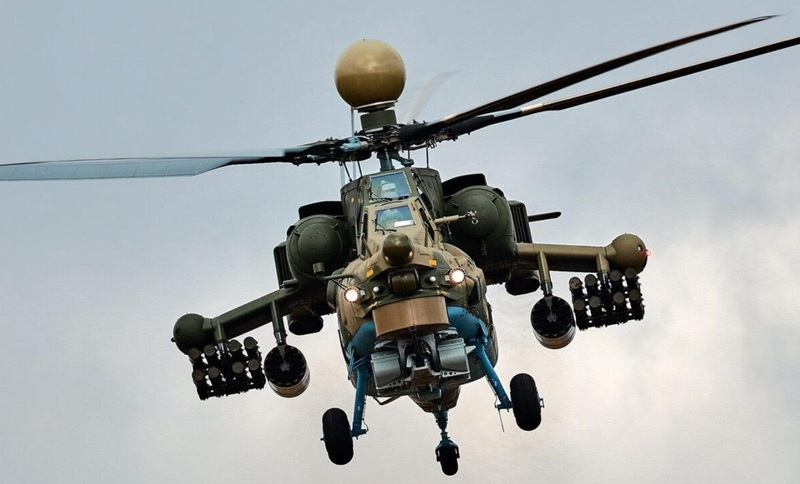
High-resolution imagery that surfaced in mid-February 2026 has conclusively confirmed that the Mil Mi-28NE Night Hunter has entered operational service with Iranian Army Aviation. Photographs captured during daylight functional check flights over western Tehran and inside the perimeter of Mehrabad Airport show freshly applied Iranian pixel camouflage, clear national insignia, and fully exposed sensor and defensive systems—leaving little doubt about the platform’s status or configuration.
Full-Standard Configuration Confirmed
The clarity of the imagery allows analysts, for the first time, to definitively identify the mast-mounted N025ME millimetre-wave radar above the main rotor hub, a ball-type electro-optical/infrared targeting turret beneath the nose, and multiple turrets of the L370V28 Vitebsk directional infrared countermeasures (DIRCM) suite. These features confirm that Iran has not received a downgraded export variant, but a 2018-standard Mi-28NE closely aligned with the domestic Mi-28NM baseline.
Closing a Long-Standing Capability Gap
The Mi-28NE’s arrival addresses a structural weakness that has shaped Iranian Army Aviation for decades. Sanctions constrained Tehran to incremental upgrades of legacy platforms, limiting night-fighting performance, sensor fusion, and survivability in infrared-threat environments. The Night Hunter introduces a modern, all-weather “hunter-killer” capability able to operate after dark and survive in MANPADS-saturated battlespaces.
Embedded in a Broader Russia–Iran Modernisation Drive
Iranian officials acknowledged the helicopter acquisition in late 2023 as part of a wider force-modernisation package that also includes Sukhoi Su-35 fighters and Yak-130 aircraft. From Tehran’s perspective, the deal reflects defensive modernisation under sanctions pressure; from Moscow’s standpoint, it demonstrates a deepening military-technical relationship framed as compliant with international norms.

Performance Optimised for Iranian Operating Conditions
Powered by twin VK-2500 engines, the Mi-28NE offers strong hot-and-high performance well suited to Iran’s arid climate and elevated terrain. Composite five-bladed rotors improve hover efficiency and responsiveness, while enhanced dust-filtration systems address long-standing engine and sensor degradation issues in sandy environments.
Sensors and Survivability at the Core
The helicopter’s defining feature—the mast-mounted N025ME radar—provides 360-degree situational awareness while allowing terrain-masked operations, exposing only the radar dome above cover. This is complemented by a modern EO/IR targeting turret and helmet-mounted cueing systems that shorten engagement timelines. The Vitebsk self-defence suite integrates radar and laser warning receivers, ultraviolet missile-approach sensors, and laser-based DIRCM, significantly improving survivability against infrared-guided threats.
Armament and Cost-Effectiveness
A chin-mounted 30 mm 2A42 cannon provides accurate suppressive fire, while stub wings support a wide range of munitions, including Ataka or Khrizantema-VM anti-tank guided missiles, rockets, limited air-to-air missiles, and conventional bombs. With an estimated unit cost of USD 18–20 million, the Mi-28NE represents a relatively economical yet transformative force multiplier within Iran’s constrained defence budget.
Regional and Strategic Implications
For Israel, the United States, and Gulf states, the appearance of modern Russian attack helicopters in Iranian service complicates assumptions about low-altitude air dominance, particularly in scenarios involving littoral operations or proxy conflicts. For Russia, the deployment offers revenue, leverage, and a live demonstration of export-grade hardware under combat-relevant conditions. For Iran, it signals a decisive shift from sanctions-era improvisation toward structured, networked modernisation.
A Quiet but Decisive Shift
With the Night Hunter now visibly airborne over Tehran, the images circulating globally represent more than confirmation of an arms transfer. They mark the operational debut of a modern, night-optimised attack helicopter under Iranian command—quietly but decisively recalibrating the rotary-wing balance across the Middle East.