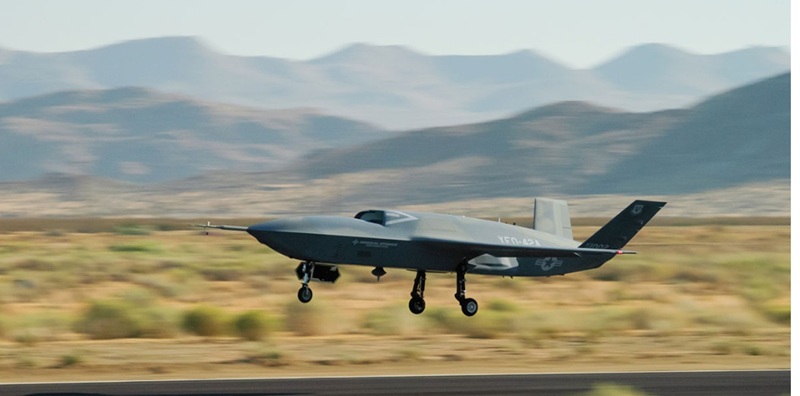
On February 12, 2026, General Atomics Aeronautical Systems (GA-ASI) announced that its YFQ-42A Collaborative Combat Aircraft (CCA) prototype completed a semi-autonomous flight lasting more than four hours, following the integration of autonomy software developed by Collins Aerospace.
According to the company, the sortie validated the aircraft’s compatibility with the United States Air Force Autonomy Government Reference Architecture (A-GRA), a framework intended to enable modular, third-party autonomy integration without modifying certified flight-critical systems. Commands issued from a ground control station were executed as planned, with the aircraft maintaining stable flight and completing assigned mission tasks under supervised autonomy.
From Platform-Centric to Software-Defined
The significance of the test lies less in the duration of the flight than in the architecture it validated. A-GRA is designed to separate safety-critical flight controls from higher-level mission autonomy, allowing autonomy software to be added, replaced, or upgraded without recertifying the entire aircraft. This approach aims to reduce long-term program risk and prevent dependence on a single autonomy provider.
By demonstrating that Collins Aerospace’s Sidekick software could operate within this framework, the U.S. Air Force is signaling a shift toward competitive and interchangeable autonomy, rather than tightly coupled, proprietary solutions. In effect, aircraft such as the YFQ-42A are being positioned as software-defined combat nodes, where mission capability evolves primarily through code rather than structural redesign.
Leveraging Existing Uncrewed Aviation Experience
Technically, the YFQ-42A builds on GA-ASI’s experience with jet-powered uncrewed aircraft, particularly the MQ-20 Avenger lineage and the broader Gambit family of designs. The platform is optimized for high subsonic flight, internal payload carriage, and digital flight controls developed from the outset to accommodate autonomy layers.
Previous demonstrations—including autonomous takeoff and landing—had already indicated a mature flight management system. The recent four-hour sortie extends that confidence to mission-level autonomy, showing that onboard systems can reliably exchange data with external autonomy software while maintaining predictable aircraft behavior.
Scaling Through Common Architectures
The test also reinforces GA-ASI’s broader manufacturing strategy, which emphasizes developing multiple mission variants from a common core airframe. This concept was previously demonstrated with the XQ-67A, and the YFQ-42A represents an air-to-air focused evolution of that approach.
If successful, this model could allow the U.S. Air Force to field families of Collaborative Combat Aircraft tailored to sensing, electronic warfare, decoy operations, or strike missions—without designing each platform from scratch. Open autonomy architectures are central to making such scalability economically and operationally viable.
Implications for Future Air Combat
Collaborative Combat Aircraft are expected to operate alongside crewed fighters such as the F-35 Lightning II and future Next Generation Air Dominance platforms, assuming roles that are either too risky or too resource-intensive for piloted aircraft alone. In contested environments where communications may be degraded, autonomy will be required to manage sensing, prioritization, and maneuvering with limited human input.
In this context, the February 2026 flight represents a step toward a force structure where software agility becomes as important as airframe performance. Hardware provides endurance and survivability; autonomy determines how effectively those attributes are translated into combat effect.
An Incremental Flight With Strategic Weight
While the sortie itself may appear incremental, it highlights a broader transition underway in U.S. airpower planning. The successful integration of third-party autonomy onto the YFQ-42A suggests that plug-and-play combat autonomy is moving from concept to practical application. The next test will be whether such architectures can perform reliably under contested electromagnetic conditions and complex tactical scenarios.
For now, the flight indicates that the U.S. Air Force’s vision of modular, rapidly adaptable uncrewed wingmen is no longer confined to design studies—it is beginning to take shape in the air.