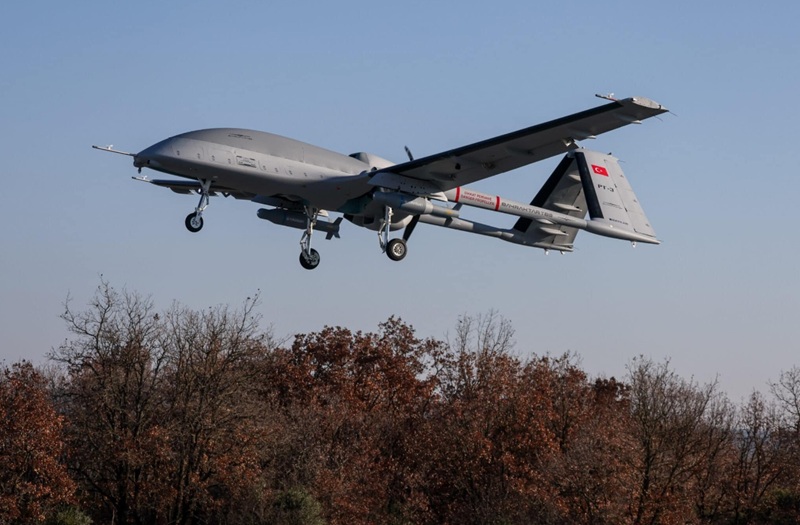
Turkish Bayraktar TB3 unmanned combat aerial vehicles (UCAVs) have demonstrated notable cold-weather and maritime operating capability during Steadfast Dart 2026, successfully flying missions over the Baltic Sea in conditions that grounded other aircraft participating in the exercise.
According to information released around the drills, the TB3 operated from the Turkish Navy’s amphibious assault ship TCG ANADOLU, conducting autonomous takeoffs and landings in temperatures around –5°C, amid heavy snowfall and strong winds. These conditions reportedly prevented several manned and unmanned aircraft from flying, leaving the TB3 as the only platform able to sustain operations during the worst weather phases.
For those wondering how the TB3 managed to land autonomously on the TCG Anadolu’s icy runway in sub-zero temperatures and strong winds in NATO exercise, here is the virtual corridor landing support system developed by Turkish engineers pic.twitter.com/H64tPw34et
— TR_tech (@T_Nblty) February 18, 2026
A test of expeditionary drone operations
Steadfast Dart 2026 is designed to stress NATO forces under high-intensity and degraded conditions, including severe weather, contested logistics, and joint maritime–land operations. Within that context, the TB3’s performance offered a practical demonstration of how ship-based unmanned systems can extend situational awareness and strike options when traditional aviation assets are constrained.
Operating from a short-deck naval platform in winter maritime conditions places high demands on flight control software, sensors, datalinks, and airframe resilience—areas where the TB3 appears to have met operational thresholds during the exercise.
Why the TB3 stands out
Developed by Baykar, the TB3 is a navalized evolution of the widely used Bayraktar TB2. It features folding wings for shipboard storage, reinforced landing gear, and design adaptations intended for short takeoff and recovery from vessels such as TCG ANADOLU without catapults or arrestor wires.
Its ability to conduct fully autonomous launch and recovery in adverse weather highlights the maturation of Turkey’s unmanned aviation ecosystem, particularly in maritime and expeditionary roles that NATO members are increasingly prioritizing.
Implications for NATO operations
The Baltic Sea scenario is especially relevant for NATO, where weather, limited basing options, and dense air-defense environments complicate manned aviation operations. A ship-based UCAV that can continue flying when conditions ground crewed aircraft provides commanders with persistent intelligence, surveillance, and reconnaissance (ISR), and potentially precision-strike capability, without exposing pilots or relying on shore-based runways.
The TB3’s performance also underscores the growing role of unmanned systems as force multipliers rather than niche enablers—able to sustain tempo when weather, risk, or logistics restrict conventional platforms.
A broader signal
Beyond the technical achievement, the TB3’s winter operations during Steadfast Dart 2026 carry strategic signaling value. They highlight Turkey’s expanding contribution to NATO’s emerging concepts around distributed maritime operations, drone-centric ISR, and resilience in degraded environments.
As NATO adapts to scenarios involving harsh climates and contested access, the exercise suggests that navalized UCAVs like the TB3 could become integral to alliance operations—particularly in regions such as the Baltic, Black Sea, and High North.