Recent media reporting suggests the UK Government has raised objections to U.S. strike aircraft launching from RAF Fairford or from Diego Garcia Airbase for potential operations involving Iran. While such concerns could complicate planning, defense analysts assess the issue as largely logistical rather than strategic.
From an operational standpoint, forward basing in the UK or the Indian Ocean would significantly reduce flight distances for U.S. bombers compared with sorties launched directly from the continental United States. Shorter routes mean fewer aerial refueling events, reduced strain on crews and airframes, and faster turnarounds. By contrast, strikes flown from CONUS require extensive tanker support and meticulous coordination across multiple air corridors.

Tanker Activity Tells Its Own Story
Open-source tracking and regional reporting pointing to 50-plus aerial refueling tankers positioned along potential transatlantic and Mediterranean routes suggest that U.S. planners are prepared to execute long-range missions from home bases if access to forward locations remains constrained. Such preparations are resource-intensive and typically indicate readiness rather than routine training.
In quiet-credibility terms, this posture signals optionality: Washington retains the ability to proceed regardless of basing politics, albeit at higher logistical cost.
Decision Authority and the Question of Timing
The question of “when” remains inherently limited to a narrow circle—principally the White House and a small group within the Pentagon. Historically, the final decision on timing reflects not only military readiness but diplomatic calculations, intelligence confidence, and escalation management.
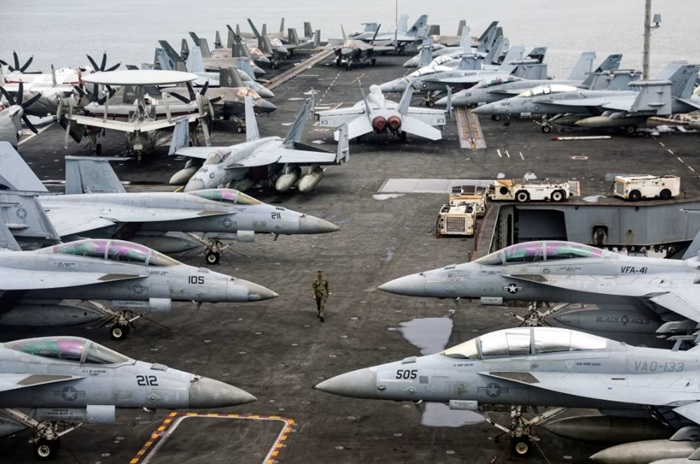
What can be assessed externally is preparedness. With a U.S. carrier strike group centered on the USS Gerald R. Ford now operating in the Mediterranean Sea and sailing east, the overall force posture suggests the next one to two weeks represent a plausible window—should political authorization be granted.

Readiness Without Announcement
Taken together, tanker deployments, bomber routing options, and naval positioning point to a familiar U.S. approach: build unmistakable readiness while preserving ambiguity. Whether operations proceed from forward bases or directly from U.S. soil, the infrastructure appears largely in place.
As with past crises, the decisive signal is unlikely to come from public statements, but from a convergence of quiet movements—many of which now appear to be underway.