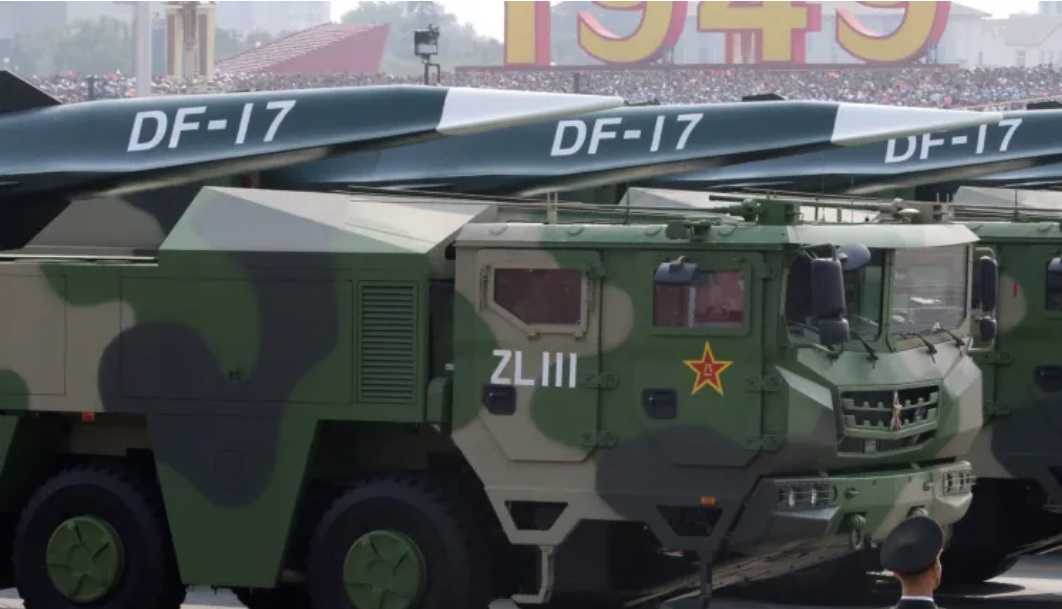
Chinese state media has released footage showing a new variant of the DF-17 medium-range hypersonic ballistic missile, offering the first public look at an updated hypersonic glide vehicle integrated with the system.
Defense analysts say the glide vehicle appears different from the version displayed during Chinese military parades in 2019 and 2025, suggesting that China has developed additional variants of the weapon as part of an ongoing modernization effort.
The development highlights the rapid progress China has made in hypersonic weapons technology, an area that has become central to global military competition.
A New Hypersonic Glide Vehicle Design
Analysis of the newly released footage indicates that the DF-17 may now be equipped with a different hypersonic glide vehicle configuration than earlier versions.
Some analysts believe the new design could represent a lower-cost variant, which would allow the missile system to be produced and deployed in greater numbers.
Since the DF-17 was first unveiled in 2019, multiple versions of the missile have reportedly entered service with incremental improvements in performance and mission capability.
The “Aircraft Carrier Killer” Variant
In 2022, Chinese state media reported that another upgraded version of the DF-17 had entered operational service.
That variant was described as an “aircraft carrier killer,” suggesting that it may include sensors or targeting systems capable of striking moving naval targets at sea.
Such capabilities would significantly enhance China’s ability to threaten U.S. aircraft carrier strike groups operating in the Western Pacific.
Range and Strike Capabilities
The DF-17 is estimated to have a range of approximately 900 kilometers, placing major regional military bases within its strike envelope.
Some reported variants are also capable of carrying specialized warheads, including penetrative bunker-buster payloads designed to destroy hardened underground facilities.
Hypersonic glide vehicles offer unique operational advantages because they can:
- Travel at extremely high speeds
- Maneuver during flight
- Change direction in both pitch and yaw
- Approach targets along unpredictable trajectories
These characteristics make them significantly more difficult to intercept than traditional ballistic missiles.
Potential Targets in the Indo-Pacific
Analysts say the DF-17 could be particularly relevant in potential conflicts involving Taiwan and U.S. regional allies.
The missile’s range allows it to target key military facilities such as:
- U.S. bases in Japan and South Korea
- Taiwanese military infrastructure
- Naval forces operating in the Taiwan Strait
Hypersonic maneuverability may also allow the weapon to penetrate dense air-defense networks deployed in these areas.
Launch System Improvements
In January 2021, images revealed that the DF-17 had adopted a modified launch vehicle design featuring an integrated protective cover that encloses the missile.
This configuration may serve multiple purposes, including:
- Concealing the missile from visual identification
- Protecting the weapon during transport
- Allowing operation in extreme climates such as deserts or sub-zero environments
Such modifications indicate continued refinement of the system as it moves into wider deployment.
China’s Growing Hypersonic Advantage
China has invested heavily in hypersonic weapons research and development, and many analysts believe it now holds a leading position in certain aspects of this technology.
In November 2021, U.S. Joint Chiefs Vice Chairman General John Hyten warned about a Chinese hypersonic test involving a long-range missile that reportedly circled the globe before deploying a glide vehicle capable of striking a target in China.
Hyten said the test demonstrated a system that could potentially strike targets anywhere in the world, raising significant concerns among U.S. defense planners.
Implications for Future Warfare
Hypersonic weapons are increasingly seen as a key element of modern military strategy.
A Pentagon briefing leaked in December 2025 reportedly highlighted how China’s expanding missile arsenal could threaten even the most advanced U.S. Navy carrier groups in a potential conflict.
If deployed in large numbers, hypersonic missiles such as the DF-17 could significantly complicate naval operations and missile defense planning.
The Expanding Hypersonic Arms Race
The appearance of a new DF-17 variant underscores the growing importance of hypersonic weapons in global military competition.
As China continues to expand its missile capabilities, other major powers—including the United States and Russia—are also accelerating development of their own hypersonic systems.
This technological race is expected to play a major role in shaping the future balance of power in the Indo-Pacific and beyond.