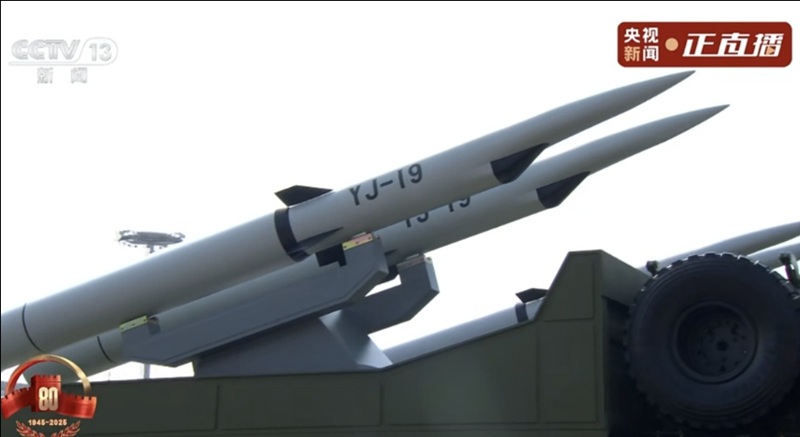
The People’s Liberation Army Navy (PLAN) has reportedly integrated the YJ-19 hypersonic anti-ship cruise missile onto its Type 039B (Yuan-class) diesel-electric submarines, signaling a notable shift in China’s approach to non-nuclear undersea strike capabilities. If confirmed in routine fleet deployment, the move would represent the first known instance of hypersonic weapons being fielded on conventionally powered submarines.
🇨🇳China confirms the YJ-19 Hypersonic Anti Ship missile is deployed on the non-nuclear Type 039B Submarines
This means our 20+ 039B/C SSK subs are now equipped with MACH 5 “Carrier Killers” just tailored for🇺🇸US carriers
Remember, 2 can sink the🇮🇳
Vikrant, 4 can sink the🇺🇸Ford pic.twitter.com/ypXue7ahmy— PLA Military Updates (@PLA_MilitaryUpd) February 16, 2026
A Quiet but Significant Capability Step
Chinese state-linked reporting and naval commentary indicate that the YJ-19 has been accepted for service aboard the Type 039B Yuan-class submarines equipped with air-independent propulsion (AIP). While Beijing has not released technical details or imagery confirming live firings from submerged platforms, the reported acceptance suggests the missile has passed integration and handling evaluations rather than remaining a purely experimental concept.
The development is notable less for its publicity than for what it implies about China’s confidence in marrying advanced propulsion, guidance, and thermal management technologies with the constraints of conventional submarine operations.
Tube-Launched Hypersonics and Fleet Scalability
A key aspect of the YJ-19 is its reported compatibility with standard 533-millimeter (21-inch) torpedo tubes. This design choice would allow the missile to be deployed without major hull modifications, enabling retrofitting across existing submarine classes. Beyond the Type 039B, this potentially includes later Type 039C variants and, over time, other conventional platforms in the PLAN inventory.
Such an approach favors scalability and rapid force-wide adoption, turning hypersonic strike from a niche capability into a more routine element of undersea warfare—at least in regional contexts where diesel-electric submarines operate close to contested waters.
From Supersonic to Hypersonic Underwater Strike
The YJ-19 is assessed to be an air-breathing, scramjet-powered missile capable of sustained speeds above Mach 5, positioning it as a successor to the supersonic YJ-18 family. While exact range and flight profiles remain undisclosed, the transition from supersonic to hypersonic anti-ship weapons significantly compresses defender reaction times and complicates interception, particularly when combined with the stealth and ambiguity of submarine launch platforms.
For surface forces, the challenge lies not only in intercepting a hypersonic missile, but in detecting, tracking, and localizing the launch platform in time to respond.
Strategic Implications at Sea
If operationally deployed as described, the YJ-19 would alter the risk calculus for carrier strike groups and high-value naval assets operating within reach of Chinese coastal and near-sea waters. Conventional submarines, already difficult to detect, would gain a weapon capable of threatening large surface combatants at extreme speed without resorting to nuclear propulsion or strategic-level systems.
This reinforces China’s broader emphasis on anti-access and area-denial strategies, where layered missile capabilities—launched from land, surface ships, aircraft, and now potentially conventional submarines—work together to constrain an adversary’s freedom of maneuver.
Regional and Export Considerations
The development also carries implications beyond the PLAN. The Type 039B design forms the basis of the Hangor-class submarines being constructed for the Pakistan Navy, with deliveries expected to begin in the mid-2020s. While there is no official confirmation that export variants would receive hypersonic weapons, regional observers note that advanced Chinese missile technologies have historically filtered to close partners over time.
Even the possibility of such integration adds a new dimension to undersea deterrence dynamics in the Indian Ocean region, particularly given Pakistan’s focus on sea-denial rather than power projection.
Part of a Broader Hypersonic Portfolio
The reported YJ-19 integration fits within a wider Chinese effort to field hypersonic systems across multiple domains. Alongside ship-launched weapons such as the YJ-21 and other emerging missile families, the undersea dimension points to a deliberate attempt to normalize hypersonic strike as a standard naval capability rather than an exceptional one.
Incremental Change, Strategic Weight
As with many Chinese military developments, the lack of detailed disclosure makes definitive assessment difficult. However, even incremental integration of hypersonic missiles onto conventional submarines carries disproportionate strategic weight. It suggests a future maritime environment where speed, surprise, and multi-axis launch options increasingly favor the offense.
For regional navies and extra-regional forces alike, the reported YJ-19 deployment is less about a single missile and more about the steady erosion of traditional assumptions surrounding undersea warfare and missile defense at sea.