China’s decision to establish a large-scale military drone manufacturing facility in Bangladesh marks a significant turning point in South Asia’s defence-industrial and geopolitical landscape. Valued at Tk608 crore (approximately US$55.3 million), the project embeds Beijing deeper into the Bay of Bengal security architecture, while simultaneously raising strategic concerns in India and beyond .
Approved by Bangladesh’s finance ministry, the government-to-government agreement places the Bangladesh Air Force (BAF) as the implementing authority. The project includes technology transfer from China Electronics Technology Group Corporation (CETC) International, a major Chinese state-owned defence conglomerate with global expertise in radar systems, electronic warfare, and unmanned aerial vehicles (UAVs) .
What the Drone Factory Will Produce
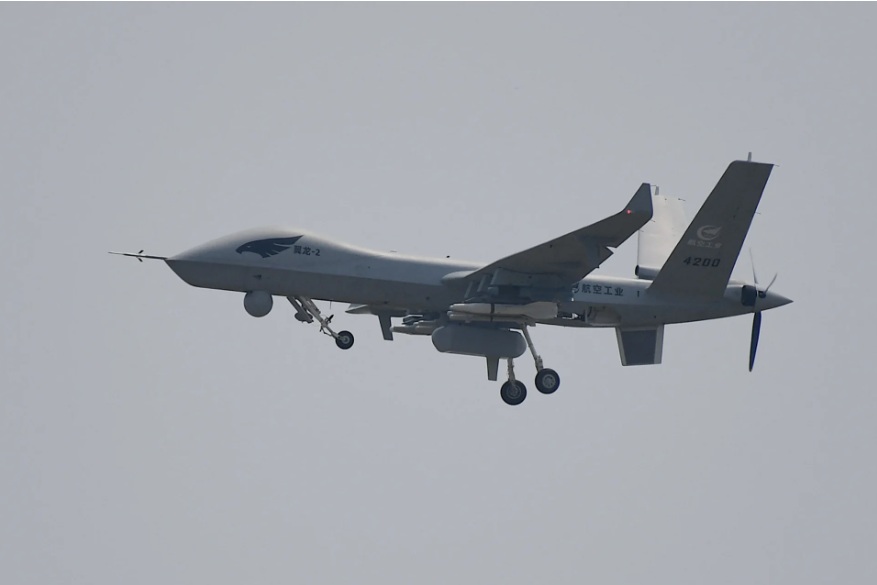
Although official documents do not specify exact platforms, industry assessments indicate the factory will prioritize production of the Wing Loong II, a medium-altitude long-endurance (MALE) armed drone often compared to the U.S. MQ-9 Reaper.
The Wing Loong II offers:
- Up to 32 hours endurance
- 480 kg payload capacity
- Precision strike capability using guided munitions
- Advanced ISR (intelligence, surveillance, reconnaissance) sensors suitable for maritime and border operations .
This capability represents a qualitative leap for the Bangladesh Air Force, enabling persistent maritime surveillance over the Bay of Bengal and enhancing deterrence against grey-zone threats such as illegal fishing, piracy, and covert incursions.
Why the Project Matters Strategically
For China, transferring UAV manufacturing technology—rather than merely exporting finished platforms—anchors long-term defence-industrial dependence and projects influence into a strategically contested maritime region. The move complements China’s broader Belt and Road Initiative (BRI) footprint in Bangladesh, where ports and transport corridors already offer potential dual-use value .
For Bangladesh, the factory aligns with its Forces Goal 2030 modernisation plan, which prioritises:
- Indigenous sustainment
- Reduced lifecycle costs
- Operational autonomy
- Integration of airpower into a network-centric battlespace
Domestic production will reduce foreign exchange outflows and allow incremental upgrades tailored to Bangladesh’s operational needs rather than supplier-driven configurations .
India’s Strategic Unease
The project has triggered immediate concern in New Delhi, where policymakers increasingly view Chinese defence cooperation with Bangladesh as part of a broader strategic encirclement of India’s eastern flank. Bangladesh’s proximity to India’s sensitive northeastern corridor amplifies these anxieties.
Indian analysts worry that armed MALE UAVs operating from Bangladeshi territory could enhance surveillance reach and electronic intelligence collection near Indian military installations. These concerns are intensified by CETC’s strengths in sensor fusion, secure datalinks, and electronic warfare, which could make Bangladeshi UAV operations resilient in contested electromagnetic environments .
At the same time, Bangladeshi officials have adopted a cautious public tone. Finance Adviser Salehuddin Ahmed has refrained from detailed comment, signalling Dhaka’s effort to manage regional sensitivities without abandoning its strategic objectives .
A Credibility Gap in Regional Defence Diplomacy
Academic Md Obaidullah of Daffodil International University notes that India’s resistance to Chinese arms sales has not been matched by credible alternatives. Stalled initiatives—such as a US$500 million defence line of credit pledged in 2019—have weakened India’s standing as a defence partner, pushing Dhaka closer to Beijing by default .
This dynamic was evident when Bangladesh selected Chinese-origin JF-17 fighters over India’s Tejas, citing delays and uncompetitive terms rather than ideological alignment.
Beyond Bangladesh: Regional Implications
China already accounts for roughly 11 percent of global Chinese arms exports to Bangladesh (2019–2023). By embedding production capacity locally, Beijing elevates the relationship from transactional arms sales to structural defence-industrial integration, significantly raising the cost for Dhaka should it seek to pivot away in the future .
The factory also opens the possibility of Bangladesh evolving into a regional UAV assembly or export hub, leveraging its strategic geography and competitive labour costs to serve South and Southeast Asian markets.
What Comes Next
Expected to become operational by late 2026, the drone factory’s symbolic weight may rival its physical output. It signals Bangladesh’s assertion of defence sovereignty amid intensifying great-power competition in the Indo-Pacific.
Whether this initiative stabilises the region or accelerates a UAV-centric arms competition will depend less on the drones themselves and more on how India, China, and regional stakeholders choose to respond.