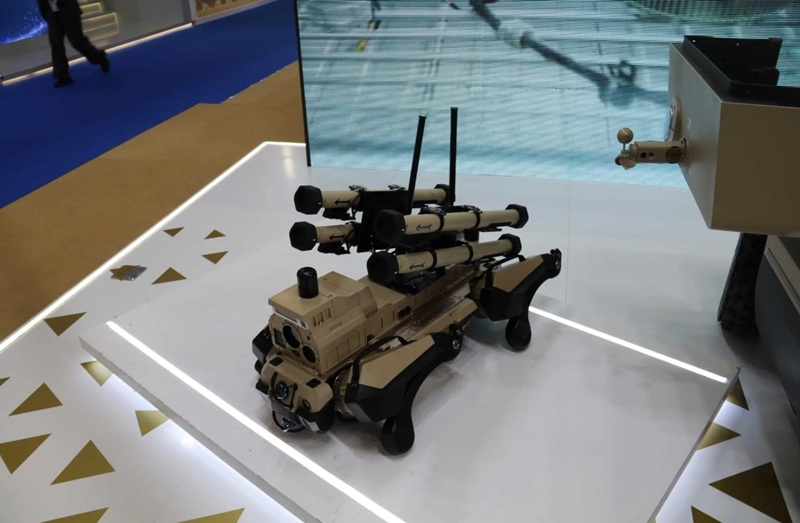
At the World Defense Show 2026 in Saudi Arabia, a major Chinese state-linked defense manufacturer publicly unveiled a new missile-armed quadruped robotic combat system, marking a significant escalation in the militarization of unmanned ground vehicles (UGVs).
The platform, equipped with four compact anti-tank guided missile (ATGM) launchers, reflects Beijing’s accelerating push into autonomous and semi-autonomous battlefield systems and highlights growing global competition in armed robotics.
Heavier Firepower, Expanded Combat Role
Displayed for the first time in this anti-armor configuration, the robotic dog features four missile tubes mounted in twin-pack launchers along its dorsal frame. Company representatives described the system as a remote-operated mobile fire-support asset, designed for deployment in high-risk urban and complex terrain environments.
According to a closed technical briefing attended by Army Recognition, the platform is modular and adaptable, retaining the low-profile silhouette and agile articulation seen in earlier Chinese quadruped prototypes. However, the addition of missiles dramatically expands its battlefield relevance beyond reconnaissance or light weapons support.
Missile Capability and Engagement Envelope
Industry sources at the exhibition indicated that the launchers are compatible with lightweight, short-range ATGMs, likely derived from existing Chinese man-portable missile families. Depending on configuration, the system is believed to support:
- Fire-and-forget guidance
- Semi-automatic command-to-line-of-sight (SACLOS) guidance
- Estimated effective range of 2–4 kilometers
If confirmed, this would allow the robotic platform to engage main battle tanks, armored fighting vehicles, fortified positions, and potentially low-flying helicopters under certain conditions.
Sensors, Autonomy, and Human Control
The quadruped is fitted with a front-mounted electro-optical targeting suite, combining day and thermal imaging with a laser rangefinder. A stabilized sensor head enables target tracking while stationary or moving at reduced speed.
Chinese engineers emphasized that the system supports autonomous navigation, including waypoint movement and obstacle avoidance, while maintaining human-in-the-loop control for weapons release—a key distinction amid international debates on lethal autonomous weapons.
PLA Modernization and Urban Warfare Focus
The emergence of missile-armed robotic ground systems aligns with broader modernization trends within the People’s Liberation Army, which has invested heavily in unmanned platforms across air, sea, and land domains.
For infantry units, such systems offer new tactical options in urban warfare, where narrow streets and dense infrastructure limit the effectiveness of traditional armored vehicles. Compared to manned anti-tank teams, robotic missile carriers significantly reduce personnel exposure to enemy fire.
Survivability and Engineering Challenges
Observers noted that integrating missile launch systems onto a quadruped platform presents substantial engineering challenges, particularly in recoil management and stability. The showcased model appears to address this through reinforced structural framing and a low center of gravity.
During simulated firing demonstrations, analysts reported minimal destabilization, suggesting that balance and recoil absorption were key design priorities.
Strategic and Export Implications
Defense analysts at the show suggested that missile-armed robotic dogs could be deployed in forward ambush roles, choke-point defense, or even in swarm configurations, complicating defensive planning for mechanized forces.
From a market perspective, the unveiling underscores China’s ambition to lead in armed ground robotics exports. Several Middle Eastern and Asian delegations examined the system closely, with industry insiders indicating that unarmed or lightly armed variants may be marketed for border security and counter-terrorism missions, subject to export controls.
A Glimpse of Future Ground Combat
The debut at World Defense Show 2026 reinforces the view that robotic ground combat systems are transitioning from experimental platforms to operational assets. As militaries worldwide pursue autonomy, dispersion, and precision strike capabilities, China’s missile-equipped robotic dog offers a stark illustration of how rapidly the character of ground warfare is evolving.