The public unveiling of China’s upgraded J-20A and twin-seat J-20S stealth fighters on the 15th anniversary of the J-20’s maiden flight marks more than a routine modernization milestone. It reflects a deliberate recalibration of China’s fifth-generation airpower doctrine, combining technological refinement with strategic signalling aimed at reshaping air dominance narratives in the Indo-Pacific.
Chinese official media confirmed that the aircraft made their first public appearance during China’s V-Day military parade on September 3, 2025. The formation—one J-20S, two J-20As, and two baseline J-20s flying in an arrow-shaped echelon—was itself a message, underscoring the emphasis of the People’s Liberation Army Air Force on integrated stealth mass rather than individual platform performance.
From Deterrence Symbol to Doctrine-Driving Platform
China Central Television described the J-20A as an upgraded variant designed to serve as a spearhead for future air combat operations. This framing implicitly confirms that the J-20 family has transitioned from an early deterrence asset into a mature, doctrine-shaping combat system.
The “A” designation signals that the aircraft is no longer experimental. Instead, it represents a platform entering a sustained modernization cycle aligned with evolving operational concepts, including long-range interception, persistent presence, and networked warfare.
Aerodynamic Refinement and Supercruise Priorities
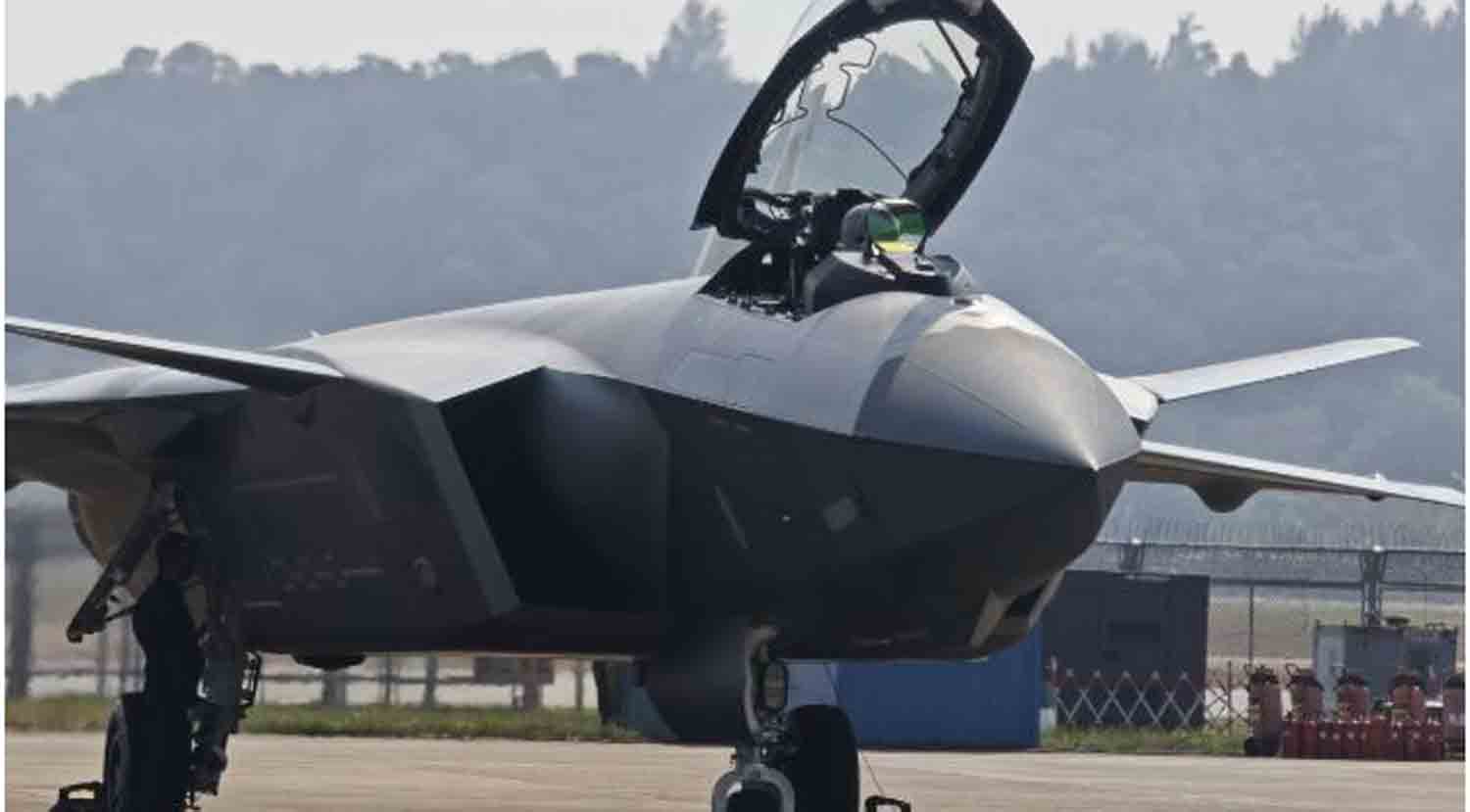
Military analyst Zhang Xuefeng emphasized that the J-20A’s visible airframe changes are functional rather than cosmetic. A raised section at the junction between the canopy and fuselage smooths airflow, reducing drag and minimizing separation during high-speed flight.
According to Zhang, this refinement directly supports sustained supersonic cruise, placing the J-20A firmly within the global fifth-generation trend where endurance at speed matters more than short-range maneuverability. The smoother canopy-fuselage blending also reflects a shift away from pilot-centric visibility toward aerodynamic efficiency and systems integration.
Internal Growth, Range, and Strategic Flexibility
Beyond aerodynamics, the raised rear canopy section introduces valuable internal volume. Zhang noted that this space can accommodate new equipment, additional fuel, or future systems, directly linking airframe geometry to combat radius and endurance.
In the vast Indo-Pacific battlespace—defined by long distances and contested access—such internal growth capacity translates into strategic flexibility rather than marginal performance gains. It also enables the integration of advanced electronic warfare modules, improved cooling architectures, and power-hungry sensors without compromising low observability.
Sensor-Centric Cockpit and Doctrinal Shift
Military commentator Fu Qianshao highlighted that the J-20A’s evolution extends well beyond its exterior. He argued that the aircraft must have received comprehensive internal upgrades, including avionics and sensors, to justify its new designation.
Fu pointed out that reduced reliance on traditional pilot line-of-sight visibility indicates a deeper doctrinal shift. In modern air combat, fused sensor data, distributed networks, and beyond-visual-range engagements have eclipsed the naked eye as the primary source of situational awareness.
This allows cockpit geometry to be optimized for stealth, structural efficiency, and systems integration rather than human visual constraints, reinforcing the aircraft’s role as a sensor-driven combat node.
Propulsion, Weight Growth, and Sustained Performance
Structural and systems upgrades inevitably introduce additional weight, raising questions about propulsion performance. Fu acknowledged this trade-off but suggested that the J-20A could be equipped with more powerful engines to offset mass growth.
Enhanced propulsion would not only preserve supercruise capability but potentially extend it—improving acceleration, missile kinematics, and survivability in high-threat environments. Increased onboard power generation would also support advanced sensors, electronic warfare systems, and future high-energy applications.
This balance between mass, power, and endurance suggests an effort to avoid the performance stagnation that has historically constrained some stealth platforms.
J-20S: Command, Control, and Manned–Unmanned Teaming
The introduction of the twin-seat J-20S represents a significant expansion of the J-20 family. China becomes the first country to field a fifth-generation stealth fighter explicitly optimized for tactical command, control, and manned–unmanned teaming roles.
State media described the J-20S as possessing strong medium- and long-range air superiority capabilities, precision strike potential, advanced electronic warfare functions, and enhanced situational awareness. Zhang characterized the aircraft as capable of forward tactical command, likening it to a “playmaker” that orchestrates engagements rather than merely executing them.
This positions the J-20S as a key node in a broader kill-web architecture, integrating manned fighters, unmanned systems, and off-board sensors across domains.
Conclusion: A Long-Term Air Superiority System
Taken together, the debut of the J-20A and J-20S confirms that China is no longer treating the J-20 as a transitional or symbolic capability. Instead, it is being refined into a long-term air superiority system optimized for endurance, information dominance, and high-intensity operations in a sensor-saturated battlespace.
The emphasis on aerodynamic efficiency, internal growth, propulsion upgrades, and command-centric roles reflects a clear intent: to shape engagement conditions before kinetic contact occurs and to contest air dominance on China’s terms across the Western Pacific.