


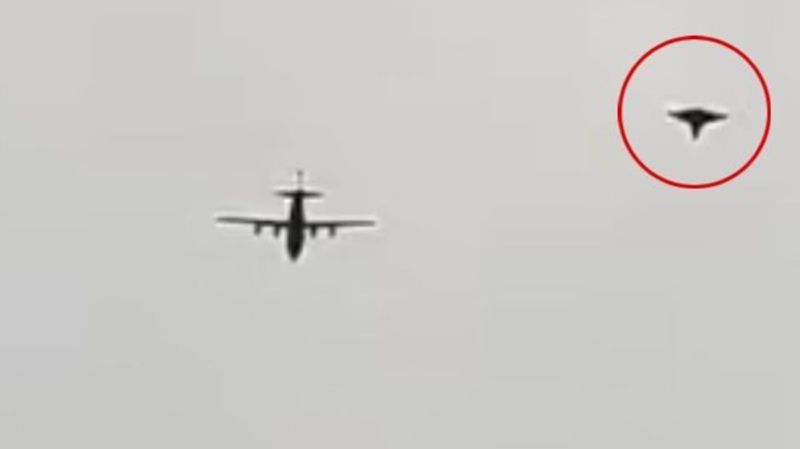
For the first time, video footage has emerged showing what appears to be China’s next-generation stealth unmanned combat aerial vehicle (UCAV)—informally known as the Collaborative Combat Aircraft (CCA)—flying in formation with a PLA Air Force Y-8 or Y-9 transport aircraft.
Shared on the Chinese platform Weibo and amplified by OSINT analyst @RupprechtDeino, the footage offers the clearest evidence yet that China has entered an active flight-testing phase for its loyal-wingman-style drone program, potentially accelerating its path toward operational deployment.
The CCA represents a pivotal step in China’s bid to integrate unmanned platforms into future combat formations. With the PLA Air Force (PLAAF) pursuing increasingly sophisticated concepts such as autonomous teaming, distributed lethality, and network-centric operations, the CCA appears poised to become a central component of next-generation airpower.
A Stealthy Flying-Wing UCAV Built for High-Risk Missions
Believed to be developed by AVIC’s Hongdu Aviation Industry Group, the drone features a sleek flying-wing design, optimized for a low radar cross-section and minimal infrared signature. The footage shows no visible external sensors—further strengthening assessments that the aircraft is purpose-built for stealth.
Analysts suggest the CCA is designed to serve multiple high-stakes missions:
- Loyal Wingman role: flying alongside manned fighters for data-sharing and tactical support
- Deep-strike operations: penetrating hostile air defenses
- SEAD/DEAD missions: targeting radar and missile sites
- Electronic warfare and decoy operations: disrupting or confusing enemy networks
- Target designation for long-range missiles
Its integration into “intelligent swarm” doctrine suggests the PLAAF aims to field UCAV formations capable of autonomous decision-making, coordinated strikes, and battlefield adaptation.
The UCAV’s pairing with a Y-8/Y-9 in the leaked video hints that the transport aircraft may have served as a mission control hub, testing real-time data exchange and coordinated maneuvers between manned and unmanned assets.
A Rare Glimpse Into a Secretive Program
The video, posted by Weibo user @lyman2003, reveals the CCA cruising in close formation with the PLA’s tactical transport aircraft—an unprecedented public sighting.
The presence of the Y-8/Y-9 suggests:
- Testing of command-and-control links
- Evaluation of multi-platform coordination
- Airborne networking trials mirroring Western ABMS/FCAS concepts
China often uses controlled “leaks” to signal confidence in new capabilities, and analysts believe this footage may have been intentionally permitted to demonstrate progress without formal announcement.
How China’s CCA Compares to Global UCAV Programs
The emergence of the CCA invites comparisons with similar projects:
- USAF: Kratos XQ-58A Valkyrie — low-cost attritable UCAV
- Australia: Boeing MQ-28 Ghost Bat — loyal wingman system
- Russia: S-70 Okhotnik-B — heavy stealth UCAV linked to Su-57
Key differences stand out:
- China appears to be developing the CCA at a notably faster pace than U.S. or Australian equivalents
- Its decentralized industrial model enables rapid prototyping and parallel production
- However, China’s program remains far less transparent, with unclear information about AI autonomy, payloads, range, or mission reliability
While speed boosts China’s lead in fielding operational UCAVs, the opacity of the program makes it difficult to assess real-world performance or shortcomings.
What We Know So Far: Production, Prototypes, and Program Status
Evidence of the CCA has surfaced gradually:
- 2022: First prototype spotted via satellite imagery
- 2023: A second prototype appears, indicating rapid iteration
- 2025: First public flight footage released, suggesting transition to early tactical testing
The program is likely linked to the secretive “J-XY” initiative, potentially part of China’s broader sixth-generation fighter ecosystem.
Manufacturers suspected:
- Hongdu Aviation Industry Group — expertise in drones
- Chengdu Aerospace Corporation — master of Chinese stealth designs
Both remain unconfirmed, consistent with China’s tight control over sensitive defence projects.
Strategic Implications: A Future Battlefield Shaped by UCAV Swarms
If the CCA becomes operational, the PLAAF could deploy 2–4 UCAV formations guided by a J-20 stealth fighter or ground-based command centers, enabling:
- Deep-penetration strikes
- Saturation attacks against air defenses
- Coordinated electronic warfare
- High-speed autonomous SEAD operations
Such systems would be especially impactful in contested theaters such as the Taiwan Strait or the South China Sea, where rapid dominance and distributed strike capability are essential.
The CCA’s integration into a “system of systems” approach—linking aircraft, drones, satellites, and ground stations—could give China a decisive edge in early-phase air superiority campaigns.
The Road Ahead: Potential Game-Changer or Unproven Prototype?
China’s unveiling strategy—quiet development followed by controlled exposure—suggests high confidence in the CCA’s trajectory. With its vast industrial base, China may outpace Western programs simply by producing UCAVs in large numbers, even if individual platforms lack perfect performance.
Yet major questions remain:
- How autonomous is the CCA?
- Can it reliably operate in contested electromagnetic environments?
- What are its endurance and payload limits?
- Will Beijing risk deploying it before rigorous testing is complete?
The next breakthrough will likely come from additional leaked footage or satellite imagery hinting at new prototypes, serial production, or operational trials.
For now, the CCA stands as one of the most significant unmanned aircraft developments of the decade—poised either to reshape air warfare or raise the stakes in the unfolding great-power drone race.


