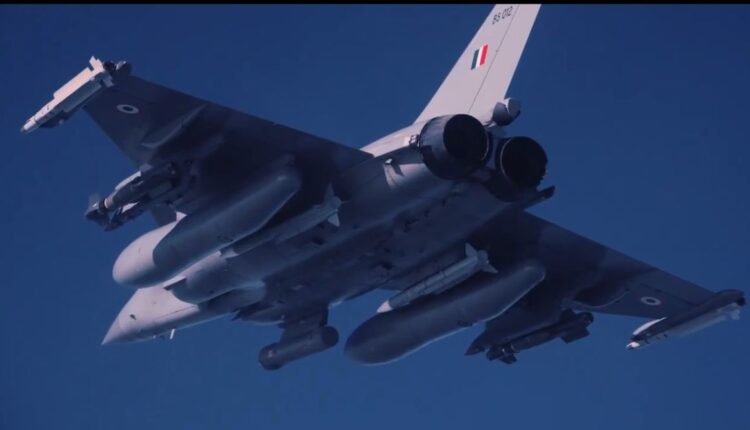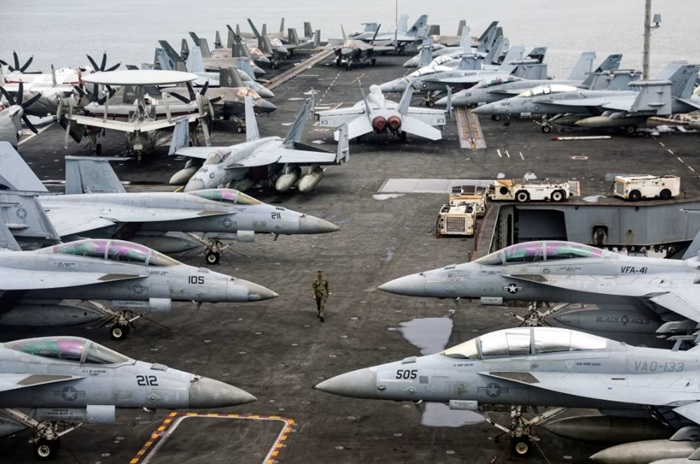
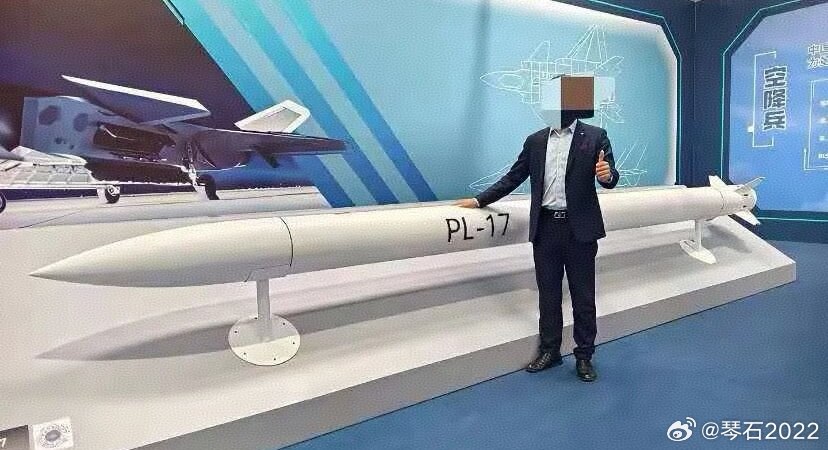
The emergence of the first high-resolution image of China’s PL-17 ultra-long-range beyond-visual-range (BVR) air-to-air missile marks a major inflection point in modern air combat, confirming that Beijing has moved from conceptual development to the operational deployment of a weapon designed to dismantle adversary airpower at unprecedented distances .
Defence analysts describe the PL-17 as a purpose-built counter-intervention weapon, aimed not at traditional fighter-to-fighter combat but at high-value airborne enablers such as aerial refuelling tankers, airborne early warning and control (AEW&C) aircraft, and strategic bombers—assets that underpin Western and allied expeditionary air operations.
First close-up image of China’s long-range PL-17 air-to-air missile (or its mock-up).
The PL-17 has been in service with the PLA Air Force since at least 2023, but until now it had only been seen in distant images carried under fighter aircraft.
Some estimates put its range at… pic.twitter.com/yODv1OuEMg
— Clash Report (@clashreport) January 27, 2026
Beyond Evolution: A Missile Built for Systemic Disruption
Unlike earlier Chinese BVR missiles, the PL-17 is not an incremental upgrade of the PL-15. Open-source intelligence analysis indicates it is engineered to achieve engagement ranges exceeding 400 kilometres, fundamentally altering airpower calculations by threatening targets once considered safely beyond the reach of fighter-launched weapons .
This capability directly targets the kill chains and sustainment architectures that enable long-range air campaigns, particularly across contested regions such as the Taiwan Strait and the South China Sea, where US and allied airpower relies heavily on airborne command and refuelling assets .
Integration with China’s Fifth-Generation Fighters
The PL-17 aligns closely with China’s fifth-generation airpower ambitions. Integration pathways with the Chengdu J-20 “Mighty Dragon” and the emerging Shenyang J-35 reflect a doctrinal shift toward networked, long-range air denial rather than close-range attritional combat .
While the missile’s large size—approximately six metres in length—limits internal carriage on the J-20, Chinese operational concepts appear to accept this trade-off during the opening stages of a conflict, prioritising the neutralisation of high-value airborne assets over maximum stealth .
In this role, the J-20 functions less as a traditional interceptor and more as a forward sensor and command node, detecting and cueing distant targets while the PL-17 delivers kinetic effects against critical enablers sustaining enemy air operations .
A Networked Kill-Chain Weapon
The true disruptive power of the PL-17 lies in its integration within China’s networked kill-chain architecture. Rather than relying solely on the launching aircraft’s radar, the missile is assessed to receive mid-course targeting updates from a constellation of off-board sensors, including airborne early warning platforms, long-range ground-based radars, and space-based surveillance systems .
This network-centric approach enables engagements far beyond the sensor horizon of any single fighter and complicates defensive countermeasures, as adversaries must confront not just the missile itself but the broader sensor ecosystem supporting it .
Implications for the Indo-Pacific
The operational deployment of the PL-17 erodes the long-standing assumption that high-value airborne assets can operate with relative sanctuary well behind the front lines. In a Taiwan Strait scenario, the credible threat to aerial refuelling tankers alone could severely constrain the effective range and persistence of fighter patrols, regardless of aircraft performance .
For regional actors such as Japan and Australia, the missile introduces new vulnerabilities for airborne command and surveillance platforms, forcing costly investments in redundancy, dispersal, or reduced operational tempo .
The implications extend to South Asia, where potential diffusion of ultra-long-range air-to-air missile technology could fundamentally reshape regional airpower balances by placing surveillance and refuelling assets at risk from distances beyond existing defensive capabilities .
Strategic Signalling and Deterrence
The timing of the image’s public appearance suggests growing confidence within China’s defence-industrial establishment that the PL-17 has reached sufficient maturity for strategic signalling. Earlier sightings of the missile on the J-16 platform support assessments that it is already embedded within operational units .
Beyond its physical lethality, the PL-17 functions as a psychological and doctrinal weapon, shaping adversary planning, influencing basing decisions, and complicating alliance coordination long before any conflict begins .
A Structural Shift in Air Warfare
Taken together, the PL-17 represents not merely a new missile but a structural transformation in air warfare, where victory is increasingly determined by the ability to deny the adversary the systems required to fight at all.
By pairing fifth-generation survivability with extreme-range lethality and networked targeting, China is seeking to compress the battlespace, increase operational risk for intervention forces, and impose prohibitive costs on sustained air presence near contested zones .
The first clear image of the PL-17 should therefore be understood not as the unveiling of a single weapon, but as visual confirmation of a broader doctrinal shift that will shape airpower competition across the Indo-Pacific for decades to come .