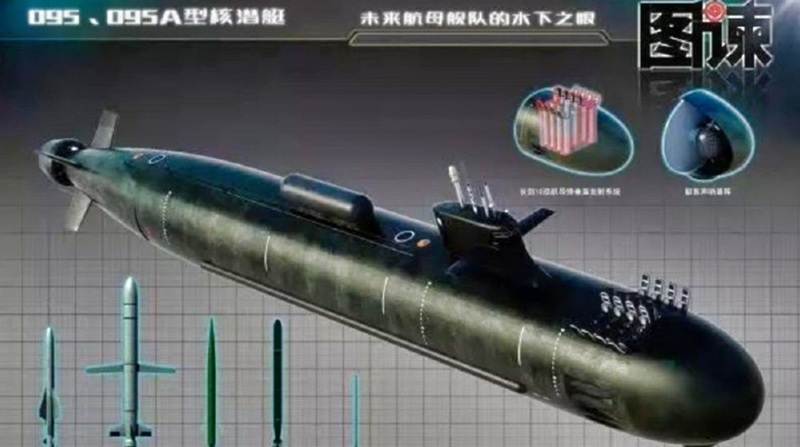
China has launched what analysts assess to be the first Type 095 (09V) nuclear-powered attack submarine at Bohai Shipbuilding Heavy Industry in Huludao, marking a significant inflection point in the evolution of the People’s Liberation Army Navy undersea force. Satellite imagery from early February 2026 confirms that the platform is not a further refinement of the Shang-class lineage but a clean-sheet, third-generation SSN designed for sustained blue-water operations .
Initial assessments misidentified the hull as another Type 093B. Higher-resolution optical and radar imagery, however, revealed distinct proportions, hull geometry, and beam expansion consistent with a new class. These features collectively indicate a platform engineered to prioritise acoustic discretion, endurance, and vertical strike capacity.

From Incremental Improvement to Generational Shift
With an estimated submerged displacement between 9,000 and 10,700 tonnes, the Type 095 enters the heavyweight SSN category. This places it in the same general class as the most capable Western and Russian attack submarines, underscoring China’s transition from incremental upgrades toward a qualitatively superior undersea combatant.
Analysts note that the Type 095 represents a generational architecture, not an evolutionary step. The hull form, internal volume, and aft geometry point toward a design optimised for noise reduction, survivability, and multi-mission flexibility—attributes that historically defined the gap between Chinese submarines and their Western counterparts.
Propulsion, Acoustics, and Survivability
One of the most consequential indicators is the apparent integration of a pump-jet propulsor, inferred from the absence of a visible skewback propeller and the shape of the stern section. Pump-jet propulsion significantly reduces cavitation and broadband noise, particularly at patrol speeds, aligning the Type 095 with contemporary best practices in acoustic suppression.
Open-source technical assessments suggest the use of advanced machinery isolation systems, including free-floating raft concepts referenced in Chinese technical literature since the late 2010s. Combined with a wider pressure hull and expanded internal isolation, these measures are designed to minimise structure-borne vibration and reduce detectability across a wide frequency spectrum .
Sensors and Strike Capacity
Imagery indicates an open compartment aft of the sail configured for a vertical launch system (VLS) array. While the layout resembles that of the Type 093B, analysts assess that the Type 095 may support a larger number of cells, reinforcing its role as a strike-capable platform rather than a purely traditional hunter-killer submarine.
Open-source estimates suggest VLS capacity ranging from 12 to potentially more than 20 cells, enabling carriage of land-attack and anti-ship cruise missiles. The submarine is expected to retain six 533-mm torpedo tubes for heavyweight torpedoes and anti-submarine weapons, preserving core SSN functions while adding layered strike options .
The most strategically significant prospect is the future integration of hypersonic anti-ship missiles, which would transform the Type 095 into a platform capable of holding high-value surface units at risk over extended ranges, dramatically compressing adversary decision and response timelines.
Industrial Momentum Behind the Platform
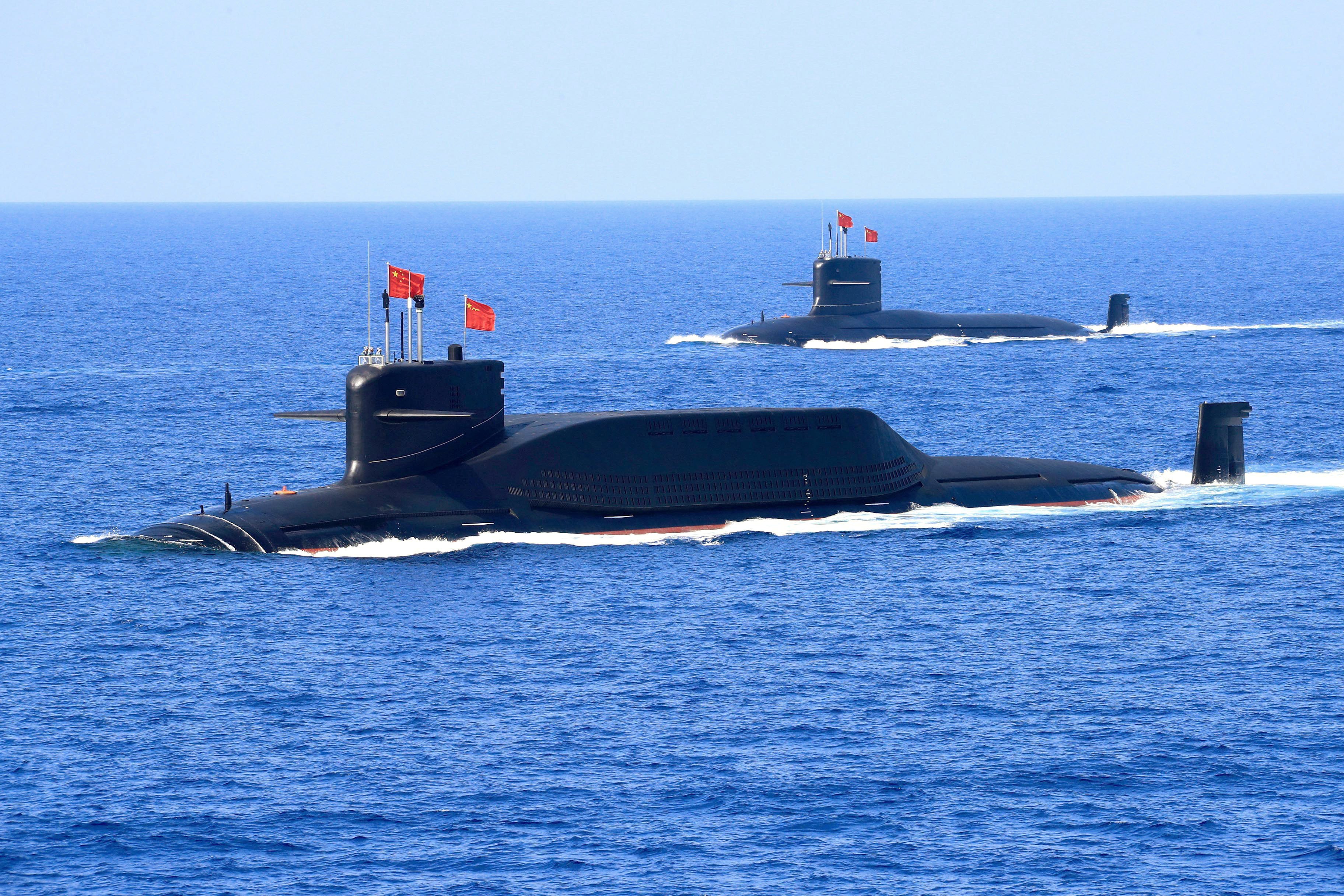
The Type 095’s emergence must be understood in the context of China’s submarine industrial base. Bohai Shipbuilding Heavy Industry has delivered seven to eight Type 093B submarines since 2022, a production tempo unmatched globally. Expanded infrastructure—including multiple covered construction halls and dedicated launch facilities—suggests an ecosystem calibrated for serial nuclear submarine production .
This industrial momentum contrasts with constraints facing Western shipyards, where workforce limitations and cost growth have slowed SSN output. The visibility of the Type 095 launch, identified rapidly through commercial satellite imagery, also reflects Beijing’s confidence in the maturity of the design.
Strategic Implications in the Indo-Pacific
The arrival of the Type 095 adds a new variable to undersea deterrence dynamics across the Indo-Pacific. As competition intensifies around Taiwan, the South China Sea, and critical sea lanes, a quieter, longer-ranged, and more heavily armed Chinese SSN complicates anti-submarine warfare planning for regional and extra-regional navies.
China now operates approximately 32 nuclear-powered submarines, excluding future ballistic-missile boats. The Type 095 signals a narrowing of the qualitative gap that once favoured Western fleets and reinforces Beijing’s intent to contest undersea dominance beyond its near seas .
Conclusion
The launch of the Type 095 is not simply the addition of another hull to China’s fleet. It represents the culmination of a decade-long effort to align doctrine, industrial capacity, and technology around undersea warfare as a central pillar of maritime power.
If serial production proceeds as expected, the Type 095 is likely to become the backbone of China’s attack submarine force through the 2030s, reshaping operational assumptions across the Indo-Pacific. In an environment where silence confers advantage, the strategic resonance of this platform will extend far beyond its physical presence beneath the waves .