
The public exposure of a U.S. Terminal High Altitude Area Defense (THAAD) battery deployed in Jordan by Chinese commercial satellite imagery illustrates how space-based surveillance is reshaping operational security in modern conflict environments.
High-resolution imagery released by the Chinese satellite firm MizarVision, dated 21 January and circulated publicly on 9 February 2026, showed the full configuration of a THAAD battery at Muwaffaq Salti Air Base in eastern Jordan. The imagery clearly identified launcher positions, radar placement, and supporting command elements, indicating an operationally active deployment.
Context of the Deployment
The THAAD deployment occurred amid elevated tensions between the United States and Iran, as Washington moved to strengthen regional missile defence coverage in response to Iran’s expanding ballistic and hypersonic missile capabilities. U.S. officials have described the deployment as a defensive measure aimed at protecting forward-deployed forces and regional partners from potential missile threats.
Jordan’s geographic position places it within effective intercept geometry against missile trajectories originating from Iran while limiting exposure to maritime attack vectors prevalent in the Gulf. Muwaffaq Salti Air Base already hosts a range of U.S. combat and support aircraft, reinforcing its role as a key regional hub for both defensive and power-projection missions.
What the Imagery Shows
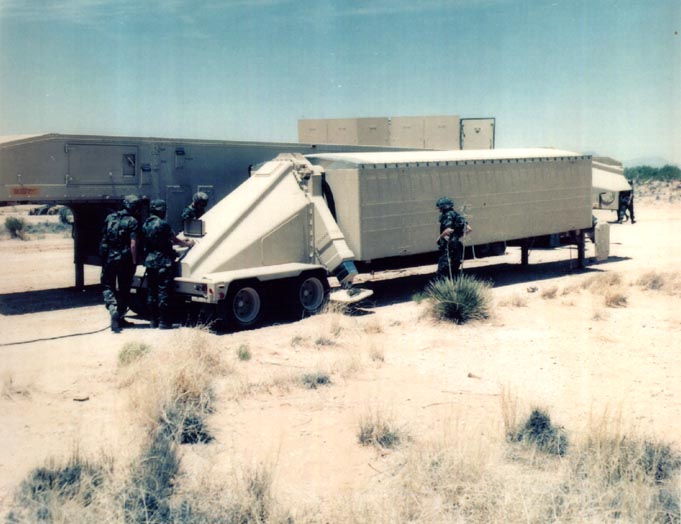
According to the released imagery, the Jordan deployment includes a complete THAAD battery architecture: multiple mobile launchers loaded with interceptors, the AN/TPY-2 X-band radar, and associated command and control infrastructure. The clarity of the satellite data leaves little ambiguity regarding the system’s presence and readiness status.
THAAD is designed to intercept short-, medium-, and intermediate-range ballistic missiles during their terminal phase at altitudes reaching approximately 150 kilometres. Unlike traditional air-defence systems, it uses kinetic “hit-to-kill” interceptors rather than explosive warheads, relying on precision and speed to neutralise incoming threats.
Implications of Commercial Satellite Exposure
The disclosure underscores a broader shift in military affairs: capabilities once visible only to state intelligence agencies are now increasingly accessible through commercial satellite constellations. China operates one of the world’s largest fleets of Earth-observation satellites, including optical and synthetic-aperture radar systems capable of persistent, all-weather monitoring.
For the United States, the episode highlights the challenge of protecting high-value defensive assets in an environment where concealment is increasingly difficult. Missile defence systems such as THAAD rely not only on interceptor performance, but also on mobility, electronic countermeasures, and operational discretion to reduce vulnerability.
From a strategic perspective, openly available imagery can inform regional threat assessments, even if translating such information into actionable targeting remains complex and resource-intensive.
Broader Strategic Significance
The Jordan THAAD exposure reflects the intersection of missile defence, regional deterrence, and space-enabled transparency. With only a limited number of THAAD batteries available globally, each deployment represents a significant strategic commitment and trade-off.
More broadly, the incident demonstrates how commercial space assets are narrowing the margin for secrecy in military planning. As satellite coverage expands and image resolution improves, defensive deployments themselves become visible elements of deterrence signalling, influencing escalation dynamics even in the absence of direct conflict.
In this sense, the exposure of THAAD in Jordan is less an isolated intelligence event than a marker of a changing battlespace—one in which space dominance and open-source visibility increasingly shape the effectiveness and survivability of terrestrial defence systems.