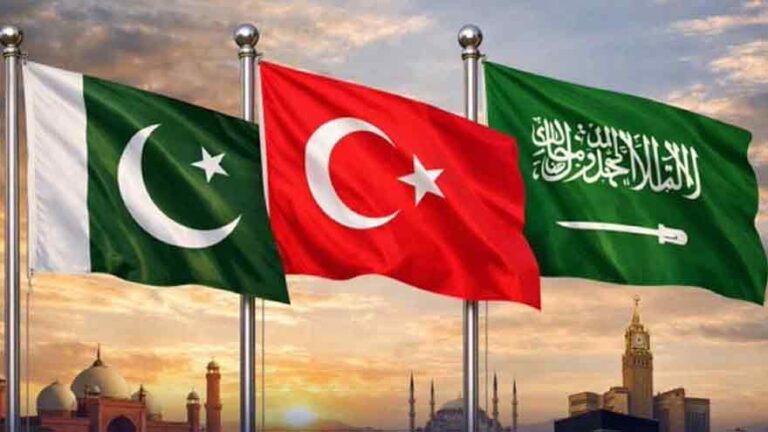
The possibility of a Pakistan–Saudi Arabia–Turkey military alliance has re-emerged as regional power dynamics evolve across South Asia and the Middle East. While no formal pact exists, growing defense cooperation and political coordination among the three countries have prompted debate over whether such an alignment could meaningfully alter regional deterrence—particularly between Pakistan and India.
Recent remarks by Türkiye’s foreign minister provide rare official insight into the status of discussions.
Reporter: Does Türkiye want to be part of a regional alliance like the one formed by Pakistan and Saudi Arabia?
Turkish Foreign Minister Hakan Fidan: As of now, there are ongoing talks, but we have not yet signed any agreement.
This statement reflects both interest and restraint, suggesting that while dialogue exists, a binding framework has yet to materialize.
Strategic Rationale Behind the Concept
The appeal of a trilateral alignment lies in complementary national strengths:
- Saudi Arabia offers financial capacity, energy influence, and diplomatic weight in the Islamic and Arab worlds.
- Pakistan contributes a large, experienced military, strong airpower, and a credible nuclear deterrent.
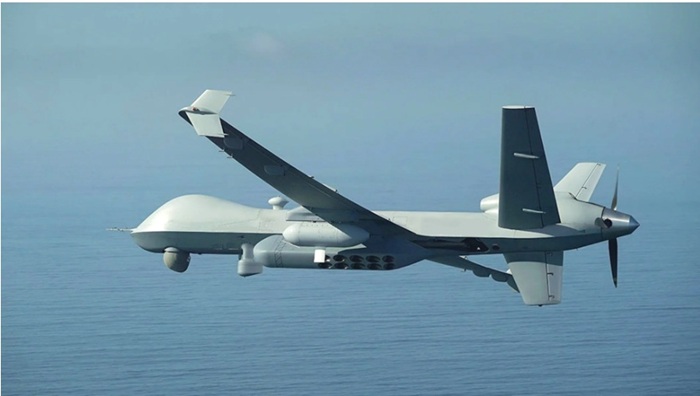
- Turkey brings advanced drone technology, a rapidly expanding defense-industrial base, and modern military R&D capabilities.
Supporters argue that institutionalizing cooperation among these three states could gradually evolve into a broader security framework, potentially attracting interest from countries such as Azerbaijan, Malaysia, Indonesia, Qatar, Jordan, and Morocco.
For Pakistan, deeper coordination with Ankara and Riyadh could strengthen deterrence by broadening strategic depth and diplomatic signaling, even without formal defense guarantees.
Pakistan’s Role: Conventional Strength and Strategic Deterrence
Pakistan would likely serve as the operational core of any alignment. Its air force remains among the most capable in the region, while its nuclear capability underpins long-term strategic stability in South Asia.
However, Pakistan’s deterrence posture is designed primarily for national defense, not alliance-based security commitments. Any perception of extending deterrence assurances to external partners would raise doctrinal, diplomatic, and legal questions at the international level.
Islamabad must also balance any new alignments with its longstanding strategic partnership with China, ensuring that emerging frameworks do not create conflicting obligations or perceptions.
Saudi Arabia: Influence Without Formal Alliance Obligations
Saudi Arabia is often viewed as the financial anchor of a potential alliance, yet Riyadh’s foreign policy has increasingly emphasized flexibility and diversification rather than rigid military blocs.
Key considerations shaping Saudi caution include:
- Continued security cooperation with the United States
- Expanding economic and investment ties with India
- A preference for regional stability and de-escalation
While Saudi–Pakistan military cooperation—particularly in training, advisory roles, and defense exchanges—has deep historical roots, Riyadh has consistently avoided treaty-based alliances that could draw it into external conflicts.
As a result, Saudi Arabia is more likely to support selective defense cooperation rather than a formal collective defense pact.
Turkey: Active Engagement, Measured Commitments
Among the three, Turkey appears the most openly engaged, as reflected in Foreign Minister Fidan’s confirmation of ongoing talks. Ankara has steadily expanded defense cooperation with Pakistan, particularly in naval platforms, aerospace projects, and unmanned systems.
Turkey’s defense exports and joint R&D initiatives align well with Pakistan’s modernization priorities, offering long-term strategic value beyond short-term military coordination.
Nevertheless, Turkey faces important constraints:
- NATO membership limits overt bloc formation
- Economic pressures require balanced diplomacy
- Managing relations with Europe, the Gulf, and the United States simultaneously
Fidan’s remarks underline that Turkey is exploring options without committing to formal alliance structures.
Prospects for Expansion: Cooperation Over Coalition
Speculation that additional Muslim-majority countries might join a future alliance remains largely aspirational. States such as Indonesia, Malaysia, Morocco, Jordan, and Qatar generally prefer:
- Strategic autonomy
- Non-aligned or multi-aligned foreign policies
- Issue-based cooperation over permanent military commitments
While expanded participation in joint exercises, defense procurement, or political coordination forums is plausible, a unified military bloc with collective defense obligations appears unlikely.
Implications for India: Strategic Complexity, Not Constraint
Even absent a formal alliance, closer coordination among Pakistan, Turkey, and Saudi Arabia could add diplomatic and strategic complexity to South Asia’s security environment.
However, claims that such an alignment would fundamentally prevent Indian military action are overstated. India retains:
- Strong strategic partnerships with the United States, France, Israel, and Russia
- Growing indigenous defense-industrial capacity
- Expanding political and economic ties with Gulf states, including Saudi Arabia
New Delhi would likely respond through counter-balancing diplomacy and deeper partnerships, rather than altering its core security doctrine.
Will It Become Reality?
A formal, treaty-based military alliance among Pakistan, Saudi Arabia, and Turkey is unlikely in the near future.
What is far more realistic—and already visible—is:
- Expanded defense cooperation
- Joint training and military exercises
- Defense-industrial collaboration
- Issue-specific political coordination
In effect, a strategic alignment without alliance formalities.
Conclusion
The idea of a Pakistan–Saudi Arabia–Turkey military alliance reflects genuine shifts in regional geopolitics, but practical constraints continue to limit its realization. As Türkiye’s foreign minister candidly acknowledged, discussions are underway—but agreements have not been signed.
Rather than the emergence of a rigid military bloc, the more plausible trajectory is incremental, pragmatic cooperation—subtle enough to avoid escalation, yet significant enough to influence regional deterrence over time.