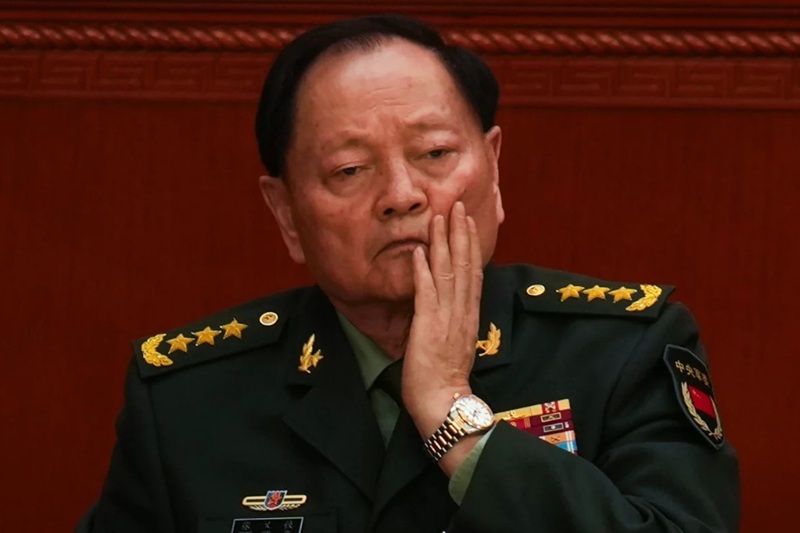
A recent report by The Wall Street Journal has ignited intense debate by claiming that Zhang Youxia, one of the most senior generals in the People’s Liberation Army (PLA), leaked core technical data related to China’s nuclear weapons program to the United States. The allegation, if true, would represent one of the most extraordinary intelligence penetrations in modern history.
However, a closer examination raises serious questions about the credibility and plausibility of the claim, as well as about how elite Chinese Communist Party (CPC) politics actually function.
The Practical Implausibility of a Nuclear Leak
The first and most fundamental problem with the allegation is how such a leak could realistically occur. China’s nuclear weapons data is not controlled by the PLA alone, but by tightly compartmentalized institutions such as the China National Nuclear Corporation. For a serving vice chairman of the Central Military Commission (CMC) to access, extract, and transmit “core technical data” would require an extensive conspiracy involving multiple agencies—without triggering internal security alarms.
Senior PLA leaders operate under constant surveillance. Their communications are monitored, their movements controlled, and unsupervised meetings are extremely rare. The idea that a battle-hardened general, whose career and identity are inseparable from the Chinese state, would secretly betray decades of loyalty without detection stretches credibility. If true, it would imply an intelligence triumph of historic proportions—but also an almost unbelievable failure of China’s internal security system.
Questionable Parallels With Past Rumors
Some commentators have attempted to bolster the story by pointing to reports from 2023 alleging that a Russian official told President Xi Jinping that former Chinese foreign minister Qin Gang had helped pass nuclear secrets to the West.
Those claims were widely viewed as dubious at the time. China’s Ministry of Foreign Affairs and the PLA operate in highly segregated bureaucratic silos, making access to nuclear secrets by a civilian diplomat extraordinarily unlikely. Moreover, if such a betrayal had been proven, it would almost certainly have resulted in criminal prosecution rather than a quiet political removal.
A More Plausible Explanation: Political Justification
One alternative explanation is that nuclear espionage accusations may have been raised internally as a justification, not as an established fact. In China’s political system, the removal of a figure as senior and historically important as Zhang Youxia requires an exceptionally serious rationale, even within closed party forums.
In such cases, internal briefings may include exaggerated or unverified claims intended to underscore the gravity of the decision. While still extreme, this explanation aligns more closely with known patterns of elite CPC governance than the notion of an undetected nuclear betrayal.
Corruption and Patronage: A Familiar Pattern
A far more plausible element of the Wall Street Journal report concerns allegations that Zhang Youxia accepted large bribes to facilitate the promotion of Li Shangfu to the CMC in 2022.
This scenario fits well within the long history of corruption cases that have plagued China’s military procurement system. Li Shangfu himself was later brought down in a sweeping anti-corruption campaign targeting defense acquisitions. In this interpretation, Zhang’s primary political offense would not be espionage, but enabling corruption, protecting subordinates, and failing to implement Xi Jinping’s anti-corruption directives.
Such behavior is especially serious under Xi, who has made military discipline and institutional loyalty central pillars of his rule.
Why Coup and Espionage Narratives Fall Apart
More sensational claims—such as coup plots or assassination conspiracies—collapse under minimal scrutiny. Stories suggesting that a coup was planned while Xi Jinping stayed at a Beijing hotel are contradicted by well-established security practices. Xi does not reside in commercial hotels in the capital, and claims to the contrary originate from dissident rumor networks rather than verifiable sources.
In elite CPC politics, unauthorized leaks are exceptionally rare. The risks are enormous, surveillance is pervasive, and consequences are severe. As a result, most “inside stories” circulating in financial or exile circles are best understood as speculation rather than evidence.
Reading the Tea Leaves: What Official Language Suggests
When hard facts are unavailable, the only reliable method is careful analysis of official language. In Zhang Youxia’s case, People’s Daily accused him of having “severely trampled on and undermined” (践踏破坏) the CMC Chairman Responsibility System.
This phrasing is notable. Similar language was used in past cases involving former CMC vice chairmen such as Guo Boxiong, who was accused of forming political cliques and undermining centralized command. However, the wording used for Zhang is even stronger, implying deliberate and contemptuous disregard rather than passive failure.
This suggests that Zhang’s alleged wrongdoing likely involved challenging or bypassing the chain of command, thereby undermining Xi Jinping’s authority—possibly by tolerating corruption despite explicit instructions to eradicate it.
What We Actually Know
Beyond official statements, certainty is elusive. China’s political system is deliberately opaque, and senior elites do not leak sensitive information to the media. The most honest conclusion is also the least satisfying: we do not know the full truth.
Any claim of detailed knowledge about Zhang Youxia’s alleged crimes should be treated with skepticism. In the realm of elite CPC politics, speculation is abundant, evidence is scarce, and restraint is often the most accurate analytical position.