France’s decision to name its next-generation nuclear aircraft carrier “France Libre” (Free France) reflects more than symbolism—it signals a strategic shift toward greater European defense independence.
Announced by President Emmanuel Macron, the vessel will replace France’s current flagship, the Charles de Gaulle, and is central to a €10.2 billion modernization program aimed at reinforcing both national and regional military capabilities.
Vive le France Libre ! pic.twitter.com/OydF3TtY2F
— Emmanuel Macron (@EmmanuelMacron) March 18, 2026
A Symbol Rooted in History
The name France Libre carries deep historical significance.
It references the Free France movement of World War II, symbolizing resistance, sovereignty, and national resilience. By choosing this name, Paris is linking its future military posture to a legacy of strategic independence.
A Cornerstone of Nuclear Deterrence
The new carrier will play a critical role in France’s nuclear deterrent.
France remains:
- The only nuclear power in the European Union
- One of the few countries globally operating aircraft carriers
- The only nation besides the United States with a nuclear-powered carrier
Nuclear propulsion provides key advantages:
- Extended deployment without refueling
- Greater operational endurance
- Enhanced strategic reach
Technical Overview of “France Libre”
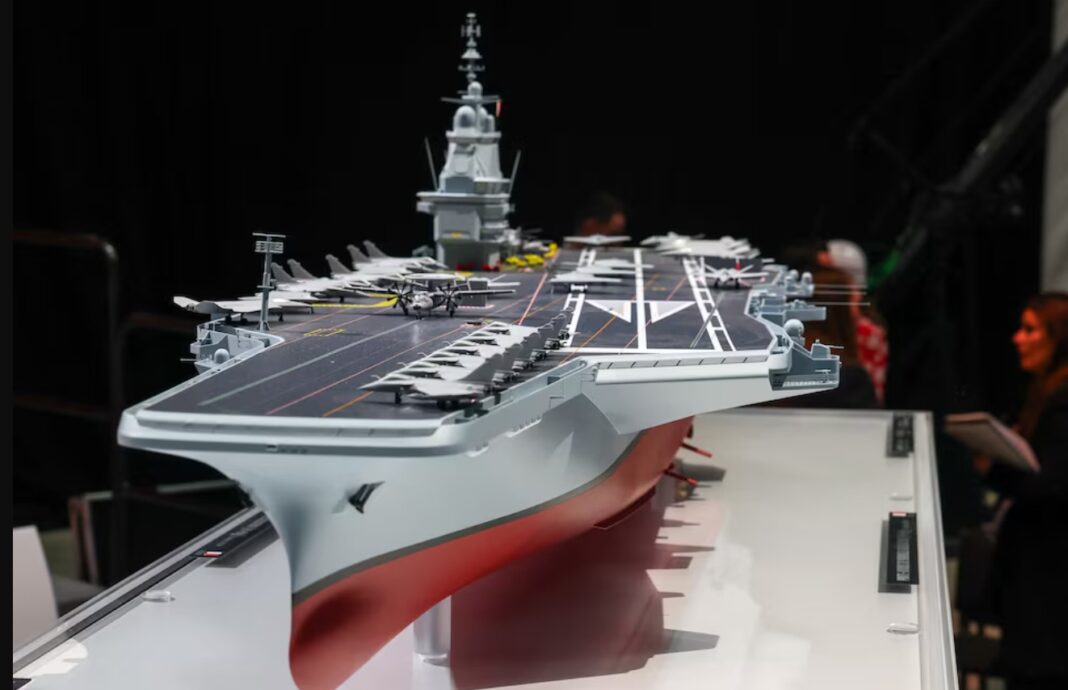
The future carrier is expected to be the largest warship ever built in Europe.
Key Features:
- Length: Approximately 310 meters
- Propulsion: Two nuclear reactors
- Air Wing:
- Fighter jets (next-generation aircraft expected)
- Advanced drones and unmanned systems
The integration of drone technology reflects the evolving nature of naval warfare, where manned and unmanned systems operate together.
Timeline and Transition
The program follows a long-term transition plan:
- Construction underway at Naval Group facilities
- Sea trials expected by 2036
- Full operational capability by 2038
- Replacement of Charles de Gaulle, which entered service in 2001
This ensures continuity in France’s carrier-based capabilities.
Europe’s Limited Carrier Capability
Despite the scale of the project, Europe’s overall carrier capacity remains limited compared to other major powers.
- United States: 11 aircraft carriers
- China: 3 carriers (and expanding)
- France: 1 nuclear carrier (future replacement planned)
This gap underscores the importance of the France Libre project for Europe’s strategic positioning.
Strategic Context: Pressure for Burden Sharing
The announcement comes amid increasing calls for NATO allies to take greater responsibility for their own defense.
Recent geopolitical developments have reinforced several trends:
- Reduced reliance on U.S. military guarantees
- Growing emphasis on European strategic autonomy
- Expansion of naval capabilities to secure global trade routes
France’s investment in a nuclear-powered carrier aligns with these broader shifts.
The Maritime Domain as a Future Battleground
French leadership has emphasized that oceans are becoming central to modern conflict.
Key trends include:
- Increased competition over maritime chokepoints
- Expansion of naval power projection
- Integration of advanced technologies, including drones
Aircraft carriers remain critical platforms in this environment, enabling:
- Air superiority at sea
- Rapid response to crises
- Long-range power projection
Strategic Implications
The France Libre program highlights several important dynamics:
1. European Defense Autonomy
France is positioning itself as a leader in independent European military capability.
2. Long-Term Power Projection
Nuclear-powered carriers enable sustained global presence without logistical constraints.
3. Technological Evolution
Integration of unmanned systems signals a shift toward hybrid naval warfare.
Conclusion
The announcement of the France Libre aircraft carrier represents more than a fleet upgrade—it is a strategic statement about Europe’s future role in global security.
As geopolitical tensions rise and alliances evolve, France’s investment in advanced naval power underscores a broader reality:
Control of the seas remains central to military influence, and Europe is preparing to play a more independent role in that domain.
France Libre vs Charles de Gaulle
| Feature | 🇫🇷 France Libre (PANG) | 🇫🇷 Charles de Gaulle |
|---|---|---|
| Status | Under development | Active (since 2001) |
| Length | ~310 meters | ~261 meters |
| Displacement | ~75,000 tons (est.) | ~42,000 tons |
| Propulsion | 2 nuclear reactors (next-gen) | 2 nuclear reactors |
| Air Wing | Next-gen fighters + drones | Rafale M, E-2C Hawkeye |
| Technology | AI systems, unmanned integration | Conventional carrier ops |
| Operational Date | ~2038 | 2001–2038 (planned retirement) |