


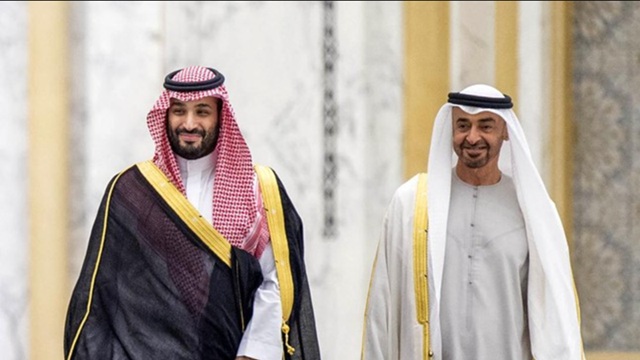
A Saudi airstrike on what Riyadh described as a UAE-linked weapons shipment in Yemen has marked the most serious rupture yet between Saudi Arabia and the United Arab Emirates, two states long regarded as the twin pillars of Gulf security.
The strike near the Yemeni port of Mukalla underscored how years of diverging strategic, economic and political interests have steadily eroded a partnership once defined by close coordination. From Yemen and Sudan to oil policy, Israel and regional commerce, Riyadh and Abu Dhabi have increasingly found themselves on opposite sides of key regional questions.
Below is a timeline tracing how the Saudi–UAE relationship evolved from strategic alignment to open confrontation.
2011: United Front During the Arab Spring
As uprisings swept the Arab world, Saudi Arabia and the UAE formed a common front against Islamist movements. The two deployed joint forces to Bahrain to help quell unrest and later coordinated support for Egypt’s 2013 military takeover that removed the Muslim Brotherhood-led government.
March 2015: Joint War in Yemen
Riyadh and Abu Dhabi launched a military intervention in Yemen to restore the internationally recognised government ousted by the Iran-aligned Houthi movement. UAE forces led ground operations, while Saudi Arabia dominated the air campaign, cementing the alliance’s military partnership.
June 2017: Qatar Blockade
The two Gulf powers jointly spearheaded a regional boycott of Qatar, accusing Doha of supporting terrorism—allegations Qatar denied. The move strengthened the personal alignment between Saudi Crown Prince Mohammed bin Salman and UAE President Mohammed bin Zayed.
2019: UAE Drawdown in Yemen
The UAE began scaling back its troops in Yemen, shifting toward a lower-profile strategy while maintaining influence through the Southern Transitional Council (STC). Saudi Arabia was left to carry the bulk of the war against the Houthis, marking the first major strategic divergence.
September 2020: Israel Normalisation
Abu Dhabi normalised ties with Israel under the US-brokered Abraham Accords. Saudi Arabia declined to follow, insisting that recognition must be preceded by Palestinian statehood—giving the UAE a unique diplomatic channel to Washington.
January–July 2021: Economic and Oil Rivalry
Saudi Arabia led the Al-Ula summit to end the Qatar dispute, with the UAE signing on reluctantly. Soon after, Riyadh moved to challenge Dubai’s commercial dominance by requiring foreign firms to relocate regional headquarters to the kingdom or risk losing government contracts.
Economic rivalry intensified when Saudi Arabia withdrew tariff concessions for goods from free zones, undercutting the UAE’s trade model. At the same time, a rare public rift erupted at OPEC, as the UAE blocked a Saudi-backed deal and demanded a higher oil production baseline.
April 2023: Sudan War Split
As conflict erupted in Sudan, Saudi Arabia hosted ceasefire talks backing the Sudanese army. UN experts later accused the UAE of arming the rival Rapid Support Forces—claims Abu Dhabi denied—highlighting another proxy arena where the two diverged.
December 8, 2025: Hadramout Red Line
Tensions surged in Yemen when UAE-backed STC forces seized oilfields in Hadramout, crossing what Saudi officials privately described as a strategic red line near the kingdom’s border.
December 30, 2025: Saudi Strike in Mukalla
Saudi jets struck a vessel in the port of Mukalla, which the Saudi-led coalition said was unloading heavy weapons destined for separatist forces. The incident marked the first direct military action targeting what Riyadh framed as Emirati-linked interests in Yemen—pushing the rivalry into open confrontation.
What It Means
Analysts say the Mukalla strike reflects a broader shift from partnership to competition between Saudi Arabia and the UAE. While both states remain aligned on some regional goals, their endgames in Yemen, economic ambitions, and approaches to global diplomacy increasingly diverge.
With Yemen already fragmented and the Red Sea emerging as a strategic flashpoint, the Saudi–UAE rift risks adding a new layer of instability to an already volatile region.
Discover more from Defence Talks | Defense News Hub, Military Updates, Security Insights
Subscribe to get the latest posts sent to your email.


