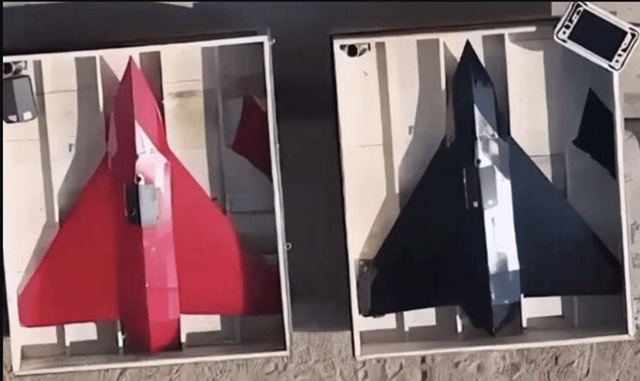
Iran’s public unveiling of the Hadid-110—a high-speed, jet-powered stealth combat drone—marks a major turning point in Tehran’s evolving drone warfare strategy. The platform represents a deliberate shift away from mass-produced, slow loitering munitions toward faster, stealth-enhanced strike systems designed to challenge modern air-defense networks across the Middle East.
Revealed during the Sahand 2025 military exercises, the Hadid-110 was introduced by the Islamic Revolutionary Guard Corps (IRGC) as Iran’s fastest stealth-configured UAV to date, reportedly capable of exceeding 500 km/h and operating inside contested airspace where legacy drones have become vulnerable.
Its debut comes as unmanned warfare has moved from a supporting role to a central tool of deterrence, retaliation, and power projection across the region—from the Persian Gulf to the Levant.
While Iranian state media has framed the Hadid-110 as a transformational leap in asymmetric warfare, the absence of independent performance verification has led global defense analysts to react with a mix of interest and caution.
Yet even without external confirmation, the drone’s introduction signals Iran’s commitment to pairing speed, low observability, and precision strike capability to compensate for adversaries’ technological superiority.
A Geopolitical Debut on a Multinational Stage
Iran showcased the Hadid-110 during Sahand 2025 drills in East Azerbaijan Province, held with the participation of Russia, China, India, Pakistan, and Central Asian SCO members, alongside observers including Saudi Arabia and Oman.
By introducing the drone in a multinational setting, Iran ensured the platform functioned both as a technical demonstration and a geopolitical message aimed at allies, competitors, and potential arms clients.
Tehran emphasized that the Hadid-110 is intended for deterrence and defensive precision strikes, highlighting its suitability for hitting radar systems, command centers, and critical infrastructure — core components of Iran’s long-standing anti-access/area-denial (A2/AD) doctrine.
Technical Profile: Speed, Stealth, and a Compressed Strike Window
The Hadid-110 features a jet engine engineered to sustain speeds of 500–517 km/h—far outpacing Iran’s propeller-driven Shahed-136 drones, which cruise around 185 km/h.
This speed dramatically reduces the time available for air-defense systems to detect, track, and intercept incoming threats, placing greater pressure on command-and-control networks.
Key Technical Characteristics
- Speed: 500+ km/h (claimed)
- Range: ~350 km
- Endurance: 1 hour
- Warhead: ~30 kg
- Ceiling: 9.1 km
- Radar Cross-Section: 0.01–0.02 m² (claimed)
Its delta-wing design supports both aerodynamic efficiency and reduced radar visibility. Though not comparable to advanced manned stealth aircraft, even partial stealth could challenge legacy regional radar systems.
With modest endurance and a tactical-range strike envelope, the Hadid-110 functions as a high-speed precision attack drone, intended to penetrate defenses, strike high-value targets, and expend itself in a single mission.
In capability terms, it sits somewhere between Russia’s Lancet and Israel’s Harop, but prioritizes speed over loiter time.
A Drone Born From Decades of Technological Reinvention
The Hadid-110 represents the newest phase of Iran’s drone evolution, which began under wartime scarcity during the Iran-Iraq War and accelerated through:
- Reverse-engineering efforts
- Battlefield experimentation
- Technological lessons from captured foreign systems, most notably the U.S. RQ-170 Sentinel (2011)
The IRGC Aerospace Force has since driven drone innovation across stealth design, rapid prototyping, and battlefield integration.
First displayed publicly in February 2025, the Hadid-110—also referred to as Dalahu—was positioned as both a technological milestone and an emblem of national resilience under sanctions.
Crucially, the drone’s development reflects Iran’s experience in recent conflicts, including the widely reported 12-day confrontation with Israel, where slower drones struggled against modern interceptors. This reinforced Tehran’s belief that future drone survivability will depend on speed and reduced detectability—not sheer numbers.
Launch Flexibility: Designed for a Dispersed, Survivable Strike Force
One of the Hadid-110’s most strategically important features is its non-runway launch capability.
The drone can be fired from rail systems or with solid-fuel boosters, enabling launches from:
- Mobile truck-based platforms
- Concealed ground locations
- Potentially even maritime vessels
Footage from Sahand 2025 showed the UAV being catapulted into flight before transitioning to jet propulsion, demonstrating a launch system optimized for dispersed operations and survivability under attack.
Regional Impact: A New Challenge for Middle Eastern Air Defenses
The introduction of a high-speed, semi-stealth attack drone forces regional adversaries—especially Gulf states and Israel—to reassess air-defense priorities.
Implications include:
- Shorter detection and interception windows for Patriot and other regional air-defense systems
- Increased interceptor expenditure and sensor fatigue
- Potential need for upgraded radars, faster interceptors, and improved AI-driven tracking solutions
Analysts note that Iran’s UAV portfolio, ranging from slow kamikaze drones to high-speed stealth types, now presents a multi-layered threat spectrum requiring costly countermeasures.
Globally, the Hadid-110 may also attract interest from countries like Russia and China, where demand for affordable precision-strike UAVs continues to rise.
However, Iran’s reliance on domestically produced parts under sanctions raises questions about manufacturing scale and long-term sustainment.
Skepticism and the Need for Verification
Despite Iran’s ambitious performance claims, defense analysts stress that independent verification remains absent.
Past Iranian platforms have often shown lower performance than advertised once observed in real conditions.
Still, even discounted claims show the Hadid-110 represents a coherent response to evolving air-defense environments, emphasizing:
- Speed
- Survivability
- Precision
- Compressed engagement timelines
Iran positions the drone as a dedicated asset for penetrating layered defenses and striking high-value targets, reflecting a doctrinal shift from mass swarm tactics to more sophisticated unmanned strike capabilities.
Strategic Takeaway
More than a new drone, the Hadid-110 is a strategic signal: Iran intends to remain a disruptive, adaptive player in the regional and global unmanned warfare landscape.
It reinforces a future battlespace in which speed, stealth, and autonomy increasingly dominate—challenging traditional airpower assumptions and reshaping defensive planning across the Middle East.