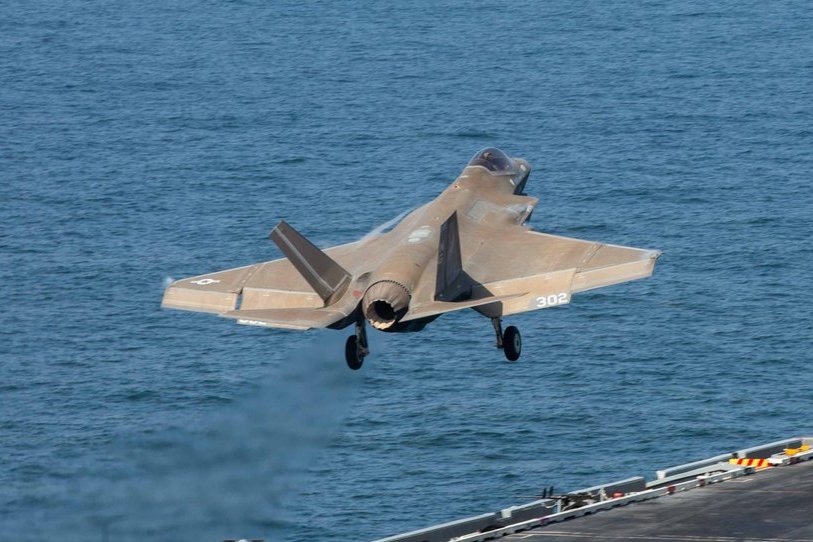
The possibility of India acquiring the Lockheed Martin F-35 Lightning II has once again entered the geopolitical spotlight, but the latest signals from Lockheed Martin suggest that no active engagement currently exists with New Delhi.
The aerospace giant has indicated that any discussion involving the F-35 must proceed strictly through government-to-government channels under the U.S. Foreign Military Sales (FMS) framework, effectively confirming that there are no ongoing corporate-level briefings, technical presentations, or negotiations with India at this stage.
That position underscores a broader reality: while the F-35 remains strategically attractive, major political, technological, and sovereignty-related barriers continue to keep it out of India’s near-term procurement plans.
No Active F-35 Talks With India
Lockheed Martin’s carefully worded response has not closed the door on a future sale, but it does make clear that no direct company-level dialogue currently exists.
Any potential acquisition would first require India to submit a formal Letter of Request to the U.S. government.
Only after review by the Pentagon, State Department, and Congress could the process move forward.
Until then, the F-35 remains more a diplomatic talking point than an active program.
This comes despite earlier remarks from Donald Trump about potentially “paving the way” for future F-35 sales to India.
So far, no concrete follow-up appears to have emerged.
India’s Strategic Autonomy Remains the Main Obstacle
The biggest barrier is not capability.
It is sovereignty.
India’s defense policy increasingly prioritizes Aatmanirbhar Bharat, the country’s self-reliance doctrine aimed at reducing long-term dependence on foreign military platforms.
For New Delhi, the F-35 raises immediate concerns because it comes with tight U.S. control over:
- mission software
- stealth maintenance systems
- logistics networks
- upgrade pathways
- diagnostics and support infrastructure
The aircraft’s ODIN and ALIS digital support ecosystems are particularly sensitive because they create ongoing software dependence on Washington.
For India, which has historically sought operational independence, that level of foreign control remains politically difficult.
Why Source Code and Mission Data Matter
Indian planners have repeatedly emphasized that access to mission software and electronic warfare libraries is now nearly as important as aircraft performance itself.
The F-35’s mission data files determine how the aircraft:
- identifies radar signatures
- prioritizes threats
- integrates intelligence
- configures combat response
Even some close U.S. allies receive only limited access.
Full source-code sovereignty remains highly restricted.
That directly conflicts with India’s long-term defense-industrial ambitions.
AMCA Still Remains India’s Priority
Rather than importing a fifth-generation fighter under restrictive terms, India continues to focus on its indigenous Advanced Medium Combat Aircraft (AMCA).
The AMCA is not merely an aircraft program.
It is central to India’s broader effort to build domestic capability across:
- engines
- sensors
- weapons
- mission software
- aerospace manufacturing
Alongside this, India is also expanding its Dassault Rafale fleet, upgrading Sukhoi Su-30MKI aircraft, and accelerating HAL Tejas Mk-1A deliveries.
This layered strategy gives New Delhi flexibility while preserving industrial control.
Cost Is Another Major Factor
The financial burden is also significant.
The F-35’s estimated operating cost remains around $36,000 per flight hour, making it one of the most expensive combat aircraft to sustain.
Over decades, even a modest fleet could generate lifecycle costs exceeding $30 billion.
That would compete directly with India’s domestic fighter, missile, and naval modernization programs.
For Indian planners, this makes the aircraft difficult to justify against long-term self-reliance goals.
Indo-Pacific Tensions Keep the Question Alive
Despite the obstacles, the F-35 question will likely remain alive because of worsening Indo-Pacific security pressures.
China’s expanding airpower and Pakistan’s fighter modernization continue to shape India’s force-planning decisions.
If regional military pressure intensifies significantly, Washington may again explore ways to support India.
However, that support may be more likely to come through engines, sensors, weapons integration, and collaborative development rather than a direct F-35 sale.
For now, the gap between America’s most tightly controlled fighter and India’s pursuit of strategic autonomy remains unresolved.