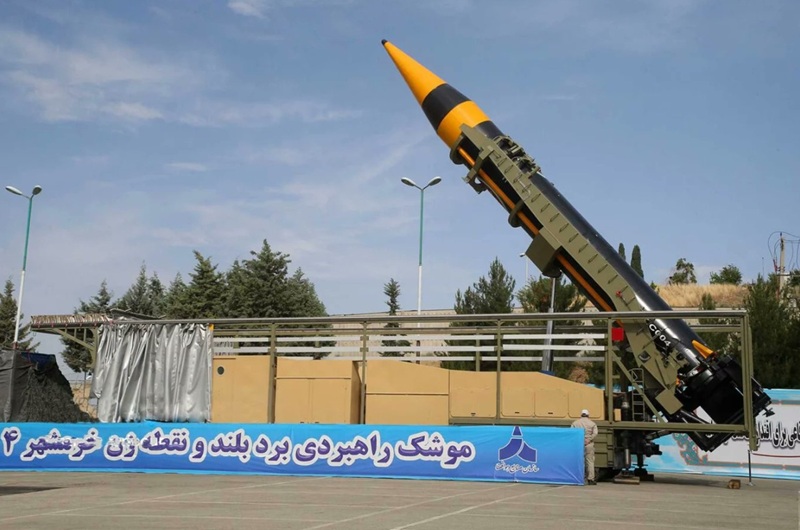
A reported ballistic missile launch from Iran toward the eastern Mediterranean region has sparked intense debate among security analysts about whether the incident could trigger NATO’s Article 5 collective defense clause.
Article 5 of the NATO treaty states that an attack against one member state is considered an attack against all members, making it one of the most significant provisions in the alliance’s security framework.
The missile incident has now raised a critical question: Did the event meet the threshold for invoking NATO’s collective defense mechanism?
Sequence of Events
According to reports from multiple sources, a ballistic missile launched from Iranian territory followed a long trajectory across the Middle East.
The missile reportedly:
-
Launched from Iran
-
Passed over Iraq
-
Continued across Syria
-
Entered the eastern Mediterranean region
-
Was intercepted by NATO air defenses before reaching Turkish airspace
Officials from Turkey, NATO, and international media outlets acknowledged that a missile was intercepted during the event.
Iran’s Denial
Shortly after the reports emerged, Iranian armed forces issued a statement denying that any missile had been fired toward Turkey.
NEW: Iranian military general staff denies any missile launches towards Turkey.
“Iran respects the sovereignty of the neighboring and friendly country, Turkey”
— IRNA pic.twitter.com/RyTF0IBTn4
— Ragıp Soylu (@ragipsoylu) March 5, 2026
Iran’s denial created an unusual situation in which two conflicting narratives quickly emerged:
-
NATO and Turkish sources confirming an intercepted missile.
-
Iranian officials denying responsibility for any launch directed at Turkey.
This contradiction has complicated efforts to determine whether the incident qualifies as a direct attack on a NATO member state.
Possible Target: British Base in Cyprus
Some Turkish officials suggested that the missile may not have been aimed at Turkey at all.
Instead, they indicated the missile’s intended target might have been a British Royal Air Force base in Cyprus.
If true, this would mean:
-
The missile’s path over the region near Turkey was incidental
-
Turkey itself may not have been the intended target
Such a scenario could significantly affect how NATO legally interprets the incident.
What NATO’s Article 5 Means
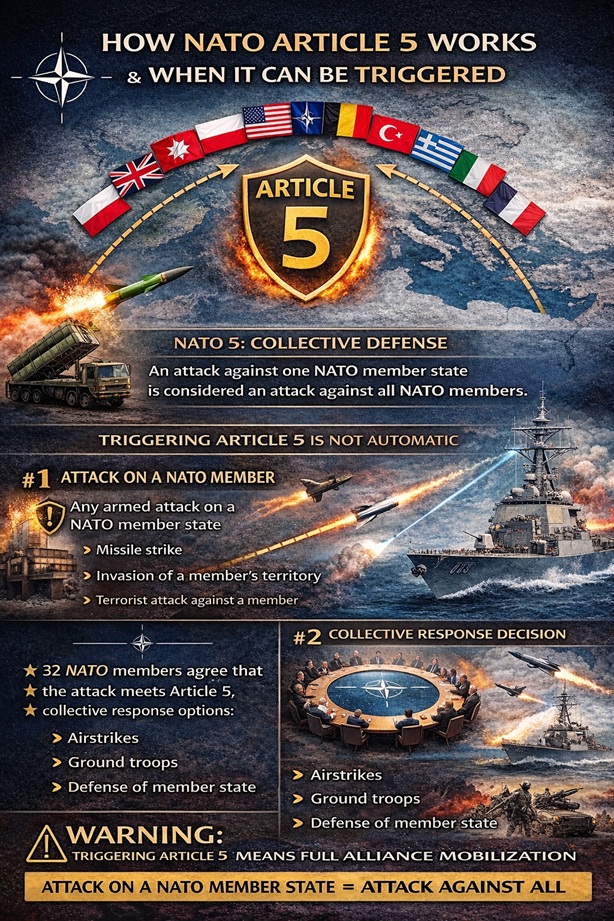
Article 5 is the core of NATO’s collective defense system.
The clause states that an armed attack against one member state is considered an attack against the entire alliance.
However, invoking Article 5 is not automatic.
It requires political consensus among NATO’s 32 member states.
Even when an incident meets the legal threshold, alliance members must still agree that collective defense should be activated.
Why the Incident Is So Sensitive
The reported missile trajectory raises complex legal and strategic questions.
A ballistic missile launched by a state actor that:
-
crosses multiple countries
-
approaches NATO territory
-
requires NATO air defense interception
could potentially be interpreted as an armed attack under the treaty framework.
However, NATO governments often consider intent, targeting, and context before determining whether Article 5 applies.
U.S. Response Remains Cautious
When asked directly about whether the incident triggered Article 5, U.S. officials avoided confirming that the clause had been activated.
This cautious response suggests that alliance leaders may be seeking to avoid rapid escalation while investigating the circumstances surrounding the missile launch.
Because the United States plays a central role in NATO’s military posture, its interpretation of events carries significant influence over how the alliance responds.
Iran’s Denial and Strategic Messaging
Iran’s denial of responsibility may serve a strategic purpose.
By rejecting claims that the missile was aimed at Turkey, Tehran may be offering NATO a diplomatic path to avoid a formal Article 5 decision.
If the missile is interpreted as:
-
a navigational error
-
a misidentified launch
-
or an unintended trajectory
then the alliance may avoid treating the event as a direct attack.
This would allow NATO governments to prevent a broader confrontation.
A Critical Test for NATO
The incident highlights the delicate balance between legal obligations and geopolitical realities.
Article 5 has only been invoked once in NATO history—after the September 11, 2001 attacks on the United States.
A state-launched ballistic missile crossing near NATO territory could represent one of the most serious tests of the clause since the alliance was founded in 1949.
The Bigger Strategic Question
Ultimately, the debate surrounding the missile incident goes beyond technical details about its trajectory.
The central issue is whether NATO member states are prepared to treat incidents arising from the wider regional conflict as direct threats to the alliance itself.
For now, the situation remains unresolved.
But the way NATO interprets this event could shape how the alliance responds to future crises involving missile warfare, air defense, and regional escalation.