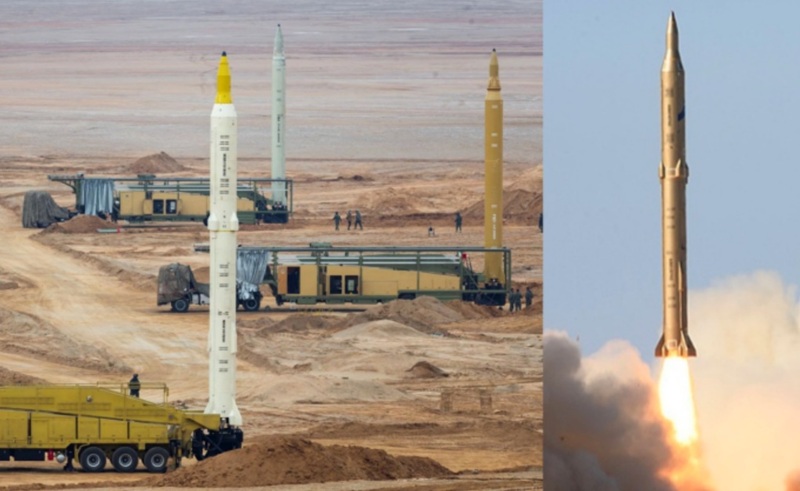
Iran’s deployment of the Sejjil medium-range ballistic missile (MRBM) during recent military operations has drawn renewed attention to one of the most advanced systems in its arsenal.
Nicknamed the “dancing missile” due to its unpredictable flight behavior, the Sejjil is designed to penetrate modern multi-layered air defense networks, posing a significant challenge to systems used by the United States and Israel.
What Is the Sejjil Missile?

The Sejjil is a two-stage, solid-fuel medium-range ballistic missile developed by Iran.
It was reportedly used during the 54th wave of “Operation True Promise 4,” targeting positions associated with U.S. and Israeli forces.
Key Specifications
- Range: Approximately 2,000 km
- Warhead: 500–1,000 kg
- Launch Platform: Road-mobile transporter systems
This range allows Iran to strike targets across the Middle East, including anywhere in Israel, without leaving its own territory.
Why It’s Called the “Dancing Missile”
The Sejjil’s nickname comes from its maneuvering and unpredictable trajectory, particularly during the terminal phase of flight.
This behavior complicates interception by missile defense systems, which rely on predicting a target’s path.
By altering its flight profile, the missile can reduce the effectiveness of interceptors designed to engage more predictable ballistic trajectories.
The Key Advantage: Solid-Fuel Technology
One of the most important features of the Sejjil is its solid-fuel propulsion system.
Unlike older liquid-fuel missiles, solid-fuel systems offer several advantages:
- Rapid launch capability (no fueling delay)
- Reduced vulnerability to pre-emptive strikes
- Higher survivability for launch units
- Greater operational flexibility
This allows the missile to be launched within seconds, making it much harder for surveillance systems to detect and neutralize before firing.
Evolution of the Sejjil Missile Family
Sejjil-1 (2008)
- First generation of Iran’s solid-fuel MRBM program
- Marked a major technological milestone
Sejjil-2
- Improved guidance systems (GPS + inertial navigation)
- Estimated accuracy within 50 meters
- Higher re-entry speed, increasing interception difficulty
- Widely believed to be the main operational variant
Sejjil-3 (Under Development)
- Reported three-stage design
- Potential range up to 4,000 km
- Could extend Iran’s strike reach beyond the Middle East
Designed for Saturation Attacks
The Sejjil missile family is optimized for high-volume, rapid-launch operations.
By combining:
- Solid-fuel propulsion
- Mobile launch platforms
- Fast launch cycles
Iran can potentially fire multiple missiles in quick succession, overwhelming air defense systems through saturation tactics.
Implications for Missile Defense

Systems such as Israel’s multi-layered air defense network—including long-range interceptors and short-range systems—are designed to counter a variety of threats.
However, missiles like Sejjil introduce new challenges:
- Reduced reaction time due to rapid launch
- Difficulty tracking maneuvering targets
- Increased pressure from multiple simultaneous launches
This makes interception more complex, especially in large-scale attack scenarios.
Strategic Significance
The deployment of the Sejjil highlights a broader trend in modern missile warfare:
- Shift toward solid-fuel, mobile systems
- Emphasis on speed and survivability
- Use of saturation tactics to defeat advanced defenses
For regional security dynamics, this means that missile defense systems must continuously adapt to increasingly sophisticated threats.
Conclusion
Iran’s Sejjil missile represents a significant step forward in its ballistic missile capabilities.
While not invulnerable, its combination of mobility, rapid launch capability, and maneuvering trajectory makes it a formidable system in modern warfare.
As missile technology evolves, the balance between offensive strike systems and defensive interceptors will remain a central factor shaping conflicts in the Middle East and beyond.
Sejjil Missile vs Israeli Air Defense Systems
Core Comparison
| Feature | Sejjil MRBM (Iran) | Israeli Air Defense Systems |
|---|---|---|
| Type | Medium-Range Ballistic Missile | Multi-layered missile defense |
| Role | Offensive strike weapon | Defensive interception systems |
| Range | ~2,000 km | Layered (short to long range) |
| Launch | Road-mobile, rapid launch | Fixed + mobile launch batteries |
| Fuel | Solid fuel (instant launch) | Interceptor missiles |
Flight vs Interception
Sejjil Missile Path
- Boost phase (rapid launch)
- Mid-course ballistic trajectory
- Terminal phase with maneuvering (“dancing”)
Israeli Defense Layers
1️⃣ Arrow-3 (Outer Layer)
- Intercepts missiles in space (exo-atmospheric)
- Targets long-range ballistic threats
2️⃣ David’s Sling (Middle Layer)
- Engages medium-range threats
- Designed for maneuvering missiles
3️⃣ Iron Dome (Inner Layer)
- Handles short-range rockets and drones
- Last line of defense
Key Performance Factors
| Factor | Sejjil Advantage | Defense Advantage |
|---|---|---|
| Speed | High re-entry speed (Mach 3–5+) | Advanced radar tracking |
| Launch Time | Seconds (solid fuel) | Constant readiness |
| Mobility | Highly mobile launchers | Networked defense grid |
| Accuracy | ~50m (Sejjil-2) | Precision interceptors |
| Saturation | Multiple launches overwhelm defenses | Layered interception |