Satellite imagery suggests that Iran has carried out a coordinated series of strikes against U.S. military facilities across the Middle East, damaging key communications infrastructure used by American forces in the region.
Since Saturday, at least 11 U.S. military facilities have reportedly been struck or affected by Iranian attacks, according to satellite analysis. The strikes appear to have focused primarily on satellite communication systems, radomes, and supporting infrastructure, which are critical for maintaining real-time command and control across U.S. forces operating in the Gulf.
The attacks mark a significant escalation in the ongoing confrontation between Iran and the United States, as they target systems that enable long-distance military communication and operational coordination.
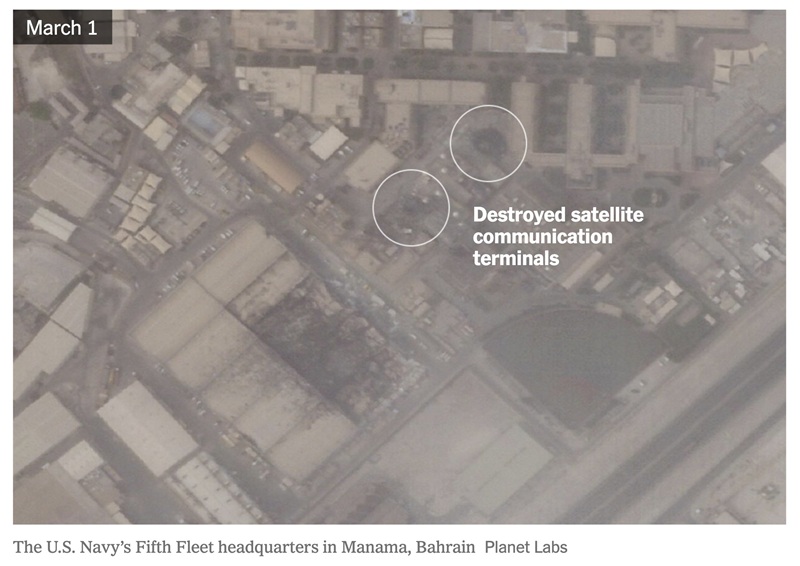
Satellite imagery shows two AN/GSC-52B SATCOM terminals at the US Navy’s 5th Fleet HQ in Bahrain were destroyed. These play a key role in facilitating high-capacity and near real-time communication for the U.S. military. pic.twitter.com/O5fYxWKvEb
— Devon Lum (@devonjlum) March 4, 2026
Damage at U.S. 5th Fleet Headquarters in Bahrain
Satellite imagery indicates that two AN/GSC-52B satellite communications (SATCOM) terminals at the U.S. Navy’s Fifth Fleet headquarters in Bahrain were destroyed.
These terminals are part of the U.S. military’s global communications architecture, enabling high-capacity and near real-time data transmission between deployed forces and command centers. Their destruction could temporarily disrupt secure communications in the region.
The Fifth Fleet plays a central role in maintaining U.S. naval operations in the Persian Gulf, Arabian Sea, and surrounding waters.
Strike on Al Udeid Air Base in Qatar
A tent structure surrounded by satellite dishes at Al Udeid Air Base in Qatar was also destroyed, according to satellite imagery.
Several of the nearby dishes appear to have been damaged as well.
Al Udeid serves as the regional headquarters of U.S. Central Command (CENTCOM) and hosts thousands of American personnel. The base was previously targeted by Iranian strikes last year, highlighting its importance as a command hub for U.S. military operations in the Middle East.
Communications Infrastructure Hit in Kuwait
Iranian strikes also appear to have targeted U.S. installations in Kuwait.
At Camp Arifjan, at least three radomes—protective structures that shield sensitive communication equipment—were either damaged or destroyed. Radomes typically house antennas used for long-distance military communications.
Meanwhile, Ali Al Salem Air Base sustained damage to at least eight buildings or structures located near satellite communications infrastructure, suggesting the attacks may have been aimed at disrupting command-and-control systems.
Prince Sultan Air Base in Saudi Arabia Targeted
Iran’s Islamic Revolutionary Guard Corps (IRGC) announced on Saturday that it had targeted Prince Sultan Air Base in Saudi Arabia.
Satellite images taken by Tuesday show that a fenced building located near a radome at the base had been largely destroyed. The base is an important site for U.S. air operations and regional defense coordination.
Possible Damage Near AN/TPY-2 Radar in the UAE
Satellite imagery also indicates potential damage at a military installation near Al Ruwais in the United Arab Emirates.
An AN/TPY-2 radar system, part of the missile defense architecture used to track ballistic missiles, has been stationed next to a building at the site since last year. Imagery from Sunday shows that the adjacent building was damaged, although it remains unclear whether the radar itself was affected.
Repeated Strikes on Al Dhafra Air Base
Another compound was damaged at Al Dhafra Air Base in the UAE, a major hub for U.S. air operations.
Satellite dishes had been visible at the location as recently as mid-June last year. While it is unclear whether the equipment was still present during the attack, Iran reportedly struck the same area again on Monday.
Strategic Focus on Communications Systems
The pattern of the strikes suggests a deliberate focus on communications infrastructure rather than large troop concentrations or aircraft.
Military analysts note that satellite communications terminals, radomes, and command facilities are essential for coordinating operations across the vast distances of the Middle East. Disrupting them could temporarily complicate command and control for U.S. forces.
The attacks underscore the increasing role of precision targeting and satellite intelligence in modern warfare, as both sides attempt to degrade each other’s operational networks without triggering full-scale regional conflict.