Iran’s claim that it has recovered a critical component from one of America’s most advanced aircraft self-protection systems has transformed the wreckage of a failed rescue mission near Isfahan into what could become a major strategic intelligence crisis.
According to Iranian media, the recovered scorched spherical device may be the Guardian Laser Transmitter Assembly from the AN/AAQ-24(V) Large Aircraft Infrared Countermeasures (LAIRCM) suite, a highly classified system built by Northrop Grumman.
If confirmed, the incident could expose sensitive U.S. countermeasure technology to Iran, Russia, and China, potentially reshaping the balance between missile technology and aircraft survivability systems.

What Happened Near Isfahan?
The reported recovery follows a failed U.S. special operations extraction mission in southern Isfahan province.
Iranian officials claim that during the operation:
- at least two U.S. C-130 variants were destroyed
- two Black Hawk helicopters were also lost
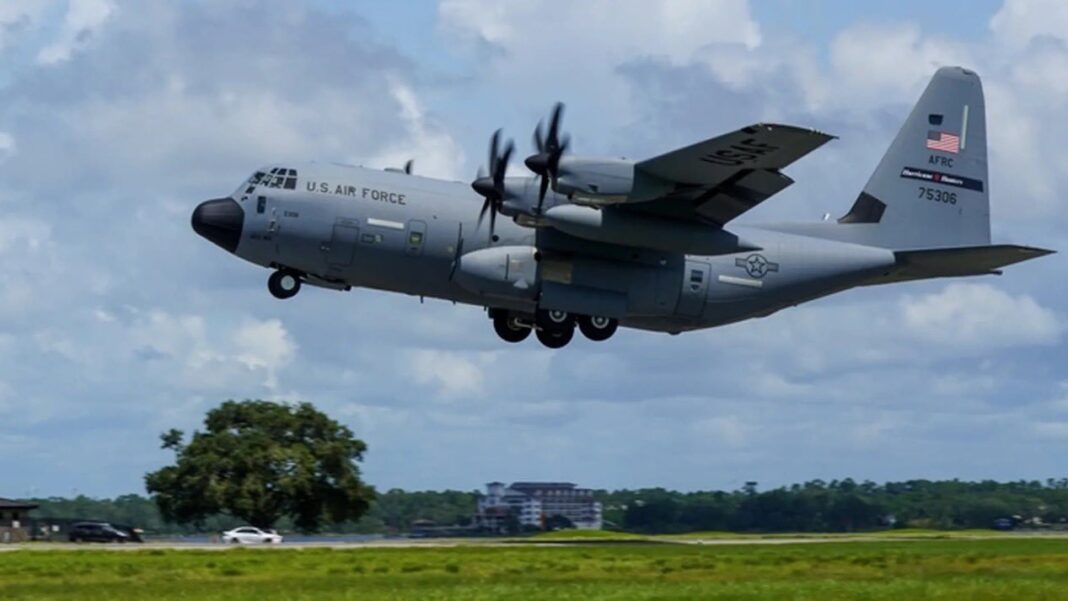
- aircraft may have included MC-130J Commando II or HC-130J Combat King II
Washington has acknowledged that American aircraft were destroyed on the ground after becoming stranded due to mechanical problems.
However, U.S. officials insist the destruction was intentional to deny sensitive equipment from falling into hostile hands.
Despite this, even partially burned hardware could still provide valuable intelligence.
Why the LAIRCM System Matters
The AN/AAQ-24(V) LAIRCM system is one of the most advanced Western aircraft survivability technologies.
It is specifically designed to protect large aircraft against:
- heat-seeking missiles
- MANPADS such as FIM-92 Stinger
- 9K38 Igla variants
- modern imaging infrared seekers
Unlike conventional flare dispensers, LAIRCM uses a directional infrared countermeasure laser.
Once missile warning sensors detect an incoming threat, the external turret slews toward the missile and fires a precisely coded multi-band infrared laser waveform designed to blind or confuse the seeker.
Because the Guardian turret contains optics, laser source, stabilization hardware, and targeting logic, it is considered the most intelligence-sensitive part of the system.
Potential Intelligence Windfall for Russia and China
If Iran has genuinely recovered even a partially intact Guardian Laser Transmitter Assembly, it could become an intelligence prize of exceptional value.
Even damaged hardware may reveal:
- laser wavelengths
- optical coatings
- cooling systems
- tracking logic
- modulation waveforms
- seeker disruption methods
This information could allow rival engineers to design missile seekers specifically intended to resist or exploit Western infrared countermeasures.
For Russia and China, access to such technology could accelerate development of next-generation infrared-guided missiles.

Strategic Impact on US Aircraft Survivability
The implications go far beyond a single wrecked aircraft.
LAIRCM protects multiple U.S. platforms, including:
- Boeing C-17 Globemaster III
- Boeing KC-46 Pegasus
- Lockheed Martin C-130J Super Hercules variants
- special operations aircraft
These aircraft cannot rely on speed or maneuverability like fighter jets.
Their survivability in contested airspace depends heavily on systems like LAIRCM.
If adversaries learn how the system disrupts missile seekers, the U.S. may need to:
- modify software
- introduce new laser waveforms
- replace external turrets
- upgrade large fleet segments
According to your draft’s estimate, an urgent fleet-wide modification program could exceed $2 billion.
Intelligence Battlefield Beyond the Crash Site
Even if the recovered object is later proven not to be genuine, the Isfahan incident already highlights a major reality of modern warfare:
wreckage itself has become an intelligence battlefield.
Destroyed aircraft, abandoned electronics, and battlefield fragments can yield critical insights long after combat operations end.
This makes technology denial and destruction protocols as strategically important as the mission itself.