



Israel has carried out one of the most significant strikes of the ongoing war with Iran, targeting what Israeli officials describe as a major underground wartime command bunker beneath Tehran.
According to Israeli Defense Forces (IDF) briefings, 50 Israeli fighter jets dropped approximately 100 bombs on the underground complex during the thirteenth wave of Operation Roaring Lion.
The facility was located beneath a leadership compound in central Tehran and was believed to serve as a key command center for Iran’s wartime leadership structure.
Israeli officials say the strike was launched after intelligence indicated that at least one very senior Iranian regime official was inside the bunker at the time of the attack.
Target: Iran’s Underground Wartime Command Center

Israeli military officials say the bunker was an extensive underground complex stretching beneath several streets in Tehran.
According to the IDF, the facility included:
- underground meeting halls and command rooms
- living quarters for senior officials
- multiple concealed entrances and exits at street level
- reinforced construction designed to survive conventional airstrikes
The IDF said the bunker “stretched across long streets beneath the civilian population and had multiple entrances,” and was considered by Iranian authorities to be “impenetrable.”
After the death of Iran’s Supreme Leader Ali Khamenei on February 28, Israeli intelligence believes senior officials from the surviving command structure moved operations into this underground facility.
Israeli intelligence reportedly tracked those movements, identifying the bunker as a high-value strategic target.
Operation Roaring Lion vs Operation Epic Fury
The strike forms part of Operation Roaring Lion, Israel’s codename for its role in the joint U.S.–Israeli military campaign against Iran.
The broader conflict currently involves two coordinated but distinct military operations.
Operation Roaring Lion (Israel)
- Air superiority operations
- Leadership targeting missions
- Strikes on IRGC and Basij infrastructure
- Degradation of radar and missile defense systems
Operation Epic Fury (United States)
- Strikes on nuclear infrastructure
- Attacks on naval assets
- Destruction of deep underground hardened facilities
- Use of the GBU-57 Massive Ordnance Penetrator, delivered by B-2 Spirit stealth bombers
While the operations are strategically coordinated, each follows different targeting priorities and military doctrine.
Why 100 Bombs Were Used on a Single Target
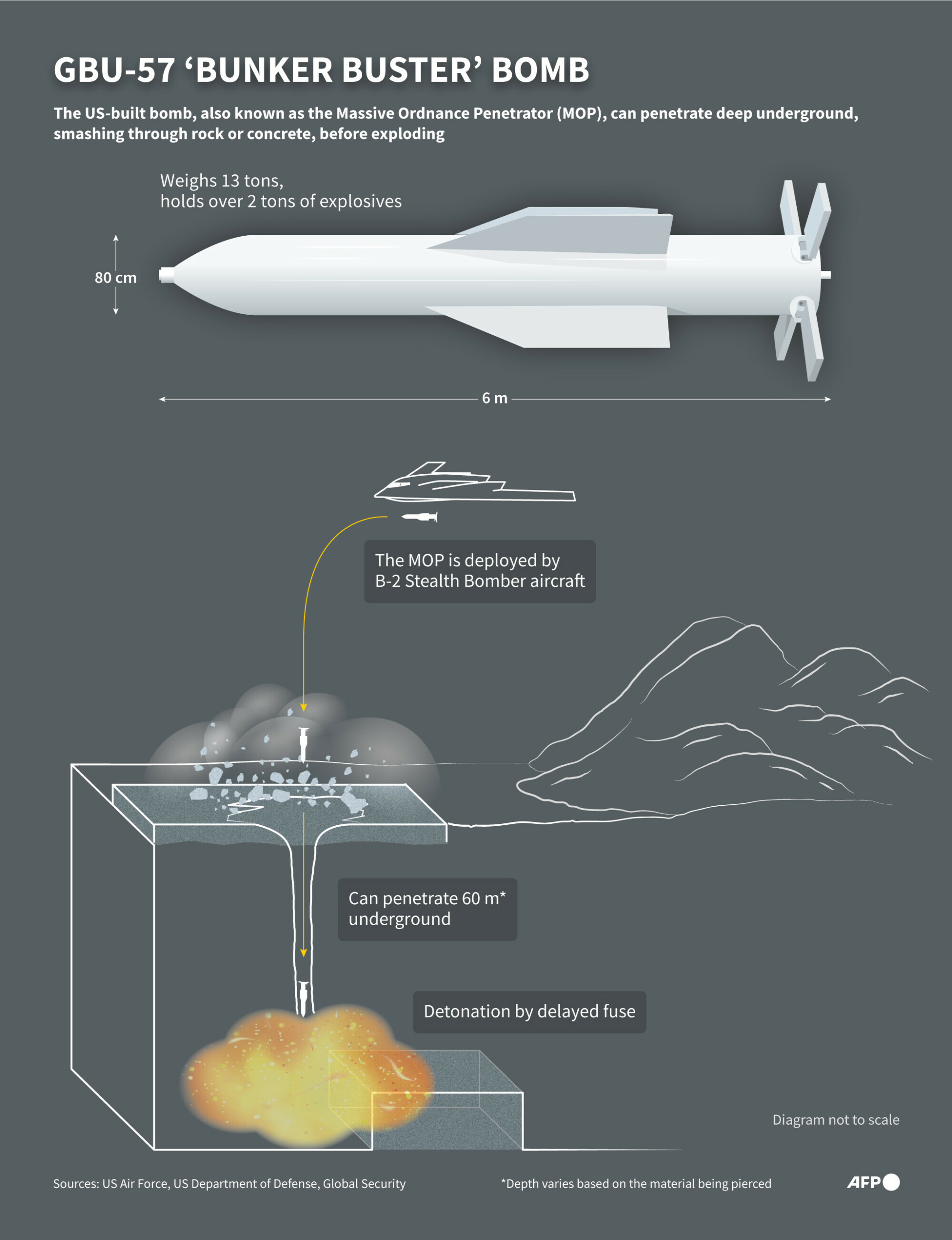
The use of 100 bombs on a single underground target reflects the technical challenges involved in destroying hardened subterranean command facilities.
Deep military bunkers are built to survive conventional bombing campaigns.
Military engineers explain that destroying such structures often requires layered penetration strikes, where multiple weapons hit the same coordinates repeatedly.
The process typically works as follows:
- The first bomb penetrates the surface layer and creates a cavity.
- Follow-up bombs strike the same location to deepen the penetration.
- Successive impacts weaken the structural layers of the bunker.
- Eventually the underground structure collapses.
A single penetrating munition might damage a bunker, but repeated strikes can collapse the entire facility.
Israeli analysts say the large number of bombs suggests the objective was complete structural collapse rather than temporary disruption.
Intelligence Trigger Behind the Strike
Israeli officials say the operation was launched after new intelligence indicated that at least one very senior Iranian regime official was present inside the bunker.
This intelligence reportedly triggered the decision to conduct the large-scale strike immediately.
However, the full casualty assessment remains unclear.
The IDF confirmed:
- the existence of the underground bunker
- the scale of the strike
- the number of aircraft and bombs used
But Israeli officials have not yet confirmed whether senior Iranian leadership figures were killed.
Iranian state media acknowledged intense airstrikes in central Tehran but has not confirmed the bunker’s destruction or the presence of senior officials inside it.
A Direct Challenge to Iran’s Underground Defense Strategy
Iran has spent decades building a vast network of deep underground military facilities designed to protect command structures from Israeli or American airstrikes.
These include:
- hardened command bunkers
- underground missile bases
- dispersed leadership nodes
- concealed tunnel networks
The strategy aims to ensure that Iran’s leadership and military command systems can continue functioning even during sustained air campaigns.
By locating and striking a multi-block underground command center in the capital, Israel has demonstrated its ability to penetrate that defensive architecture.
Strategic Impact of the Strike
The Tehran bunker attack represents one of the most ambitious leadership-targeting operations of the war so far.
Even without confirmed casualties, the operation sends a powerful strategic signal.
Israel has demonstrated that it can:
- locate deeply buried command infrastructure
- conduct large coordinated air operations over Tehran
- target facilities designed to survive decades of military planning
Whether the Iranian leadership inside the bunker survived remains uncertain.
But the strike itself highlights a key reality of the conflict: even heavily fortified underground command facilities are no longer guaranteed protection against modern airpower and intelligence-driven targeting.
This article has been updated with additional information following new Israeli intelligence disclosures. The update includes details indicating that the strike was conducted after intelligence suggested that at least one very senior Iranian regime official was inside the underground bunker at the time of the attack, as well as further description of the bunker’s size, structure, and multiple access points beneath civilian areas in central Tehran.


