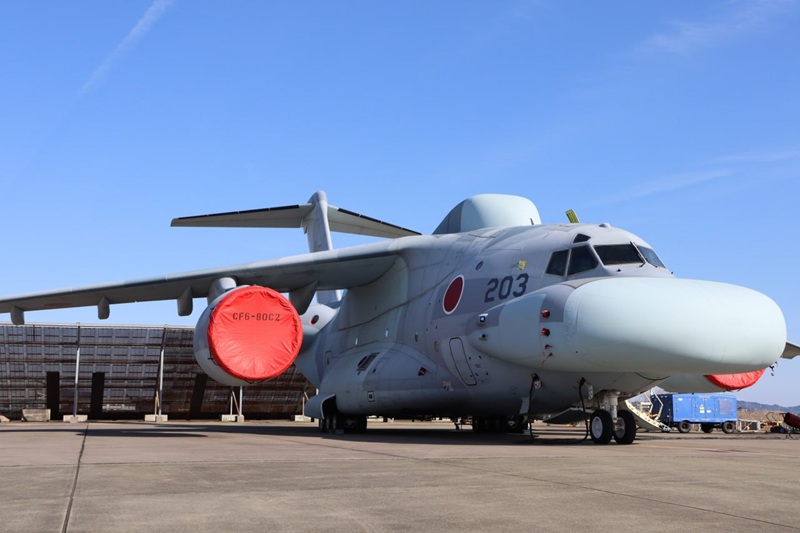
Japan has publicly revealed its EC-2 Stand-Off Jammer (SOJ) electronic warfare aircraft, marking a major step in the country’s effort to enhance its ability to operate in contested electromagnetic environments across the Indo-Pacific.
The aircraft, developed for the Japan Air Self-Defense Force (JASDF), represents a significant evolution in Japan’s electronic attack capability. Rather than serving as a limited support platform, the EC-2 is designed to conduct long-range electronic warfare missions that can disrupt enemy radar systems, communications networks, and missile guidance channels.
🇯🇵 BREAKING: The Japan Air Self-Defense Force has unveiled its new Kawasaki EC-2 SOJ electronic warfare aircraft, designed to jam enemy radars and communications. pic.twitter.com/PgaFB3r0iF
— Defence Index (@Defence_Index) March 13, 2026
A New Era of Stand-Off Electronic Warfare
The EC-2 introduces a stand-off jamming concept, allowing the aircraft to interfere with enemy sensors and communication networks from outside the engagement range of hostile air-defense systems.
This capability is increasingly important as modern air-defense networks rely on interconnected radar systems, missile batteries, and data-link communications. By degrading these networks electronically, friendly aircraft can operate more safely in contested airspace.
Unlike earlier electronic warfare platforms that required closer proximity to threats, the EC-2 can remain at safer distances while still disrupting adversary systems.
Built on the Kawasaki C-2 Transport Aircraft
The EC-2 is based on Japan’s Kawasaki C-2 strategic transport aircraft, but the platform has undergone extensive structural and electronic modifications.
Visual analysis of official imagery reveals a dramatically altered airframe featuring:
- A large bulbous nose radome for electronic surveillance equipment
- Multiple fuselage protrusions housing antenna arrays and receivers
- High-power jamming transmitters designed to operate across several frequency bands
These features indicate the presence of a sophisticated electronic warfare suite capable of both signal detection and active electronic attack.
Designed for High-Power Electronic Attack
Electronic warfare missions require large amounts of electrical power and internal space for mission equipment, cooling systems, and signal processors.
The C-2 transport platform provides these advantages through:
- Large internal volume for electronic systems
- Long-range flight capability
- High electrical generation capacity
These characteristics make it well suited for sustained high-power jamming operations during long-duration missions.
Supporting Modern Air Operations
The EC-2 is intended to support a wide range of air operations by degrading an adversary’s ability to detect and track aircraft.
Key mission roles include:
- Jamming enemy radar networks
- Disrupting tactical communications and data links
- Interfering with surface-to-air missile guidance systems
- Providing electronic protection for fighter and strike aircraft
By disrupting these systems, the aircraft can create an electronic shield that improves the survivability of friendly forces operating near contested airspace.
Development Timeline and Program Structure
The EC-2 program began around 2020–2021 under the designation “C-2 SOJ.”
Development has been divided into two major phases:
Phase One (2020–2026)
Focuses on establishing core stand-off jamming capabilities against radar systems and communication data links.
Phase Two (2023–2032)
Aims to improve reliability, expand capabilities, and achieve full operational capability.
This long development timeline reflects the complexity of integrating advanced electronic warfare systems into a large aircraft platform.
Replacing the Aging EC-1 Fleet
The EC-2 will replace Japan’s aging EC-1 electronic warfare aircraft, which entered service in the mid-1980s.
Japan plans to operate four EC-2 aircraft, significantly expanding its airborne electronic attack capacity compared to the single-aircraft capability of the EC-1 era.
Operating multiple platforms will allow Japan to maintain continuous electronic warfare coverage during extended operations.
Strategic Investment in Spectrum Dominance
The EC-2 program forms part of a broader Japanese investment in intelligence and electronic warfare systems valued at approximately ¥508.6 billion (around $3.8 billion).
Development of the EC-2 aircraft itself is estimated at roughly ¥41.4 billion ($310 million).
All aircraft will be operated by the Electronic Warfare Operations Group at Iruma Air Base, enabling specialized training and mission planning for electromagnetic spectrum operations.
Preparing for Future Conflicts
Japan’s decision to invest heavily in stand-off electronic attack capabilities reflects the growing importance of electromagnetic spectrum dominance in modern warfare.
Modern military systems rely heavily on radar sensors, communications networks, and digital data links. Disrupting these systems can weaken an opponent’s situational awareness and reduce the effectiveness of integrated air-defense networks.
By introducing the EC-2, Japan is positioning itself to operate effectively in high-tech conflict environments where control of the electromagnetic spectrum may determine the outcome of air operations.
The unveiling of the EC-2 therefore represents not just the introduction of a new aircraft, but a clear signal that electronic warfare is becoming a central pillar of Japan’s future air-power strategy.