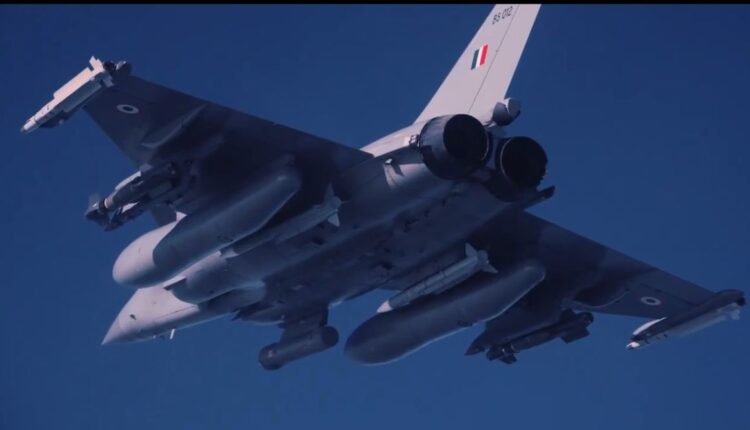
India’s public display of Indian Air Force Rafale fighters armed with MBDA Meteor beyond-visual-range (BVR) air-to-air missiles during the 77th Republic Day flypast has been widely portrayed as a decisive leap in Indian airpower. Yet beneath the spectacle, the event raises important questions about deterrence signalling, escalation risks, and whether visual confirmation truly equates to sustained operational dominance.
While veteran aircraft observers described the flypast as the first unambiguous public confirmation of Meteor missiles on Indian Rafales in Indian airspace, the strategic meaning of this reveal deserves closer scrutiny.
A Carefully Staged Message, Not a Combat Disclosure
The Rafales appeared in highly choreographed Sindoor and Vajraang formations over Kartavya Path, carrying under-wing Meteor missiles. This was not a spontaneous revelation but a deliberate, centrally controlled disclosure, later reinforced by an Indian Air Force video tied to “Operation Sindoor.”
The video juxtaposed Rafale-Meteor imagery with archival footage from the 2019 Balakot airstrikes, implicitly suggesting a seamless evolution from past combat to present capability. Critics argue this comparison risks over-simplification, conflating technological possession with proven combat effectiveness under contested conditions.
Notably absent were details on:
- Stockpile size
- Pilot training maturity
- Sustained wartime sortie rates
- Rules of engagement for BVR use
Without these, the reveal remains symbolic rather than operationally transparent.
Meteor’s Capabilities: Formidable, But Not Unique
There is little doubt that the MBDA Meteor is among the most advanced BVR missiles in service. Its ramjet propulsion, high terminal energy, and expanded no-escape zone represent a genuine technological edge over older solid-fuel designs.
However, framing Meteor as a decisive game-changer risks ignoring key realities:
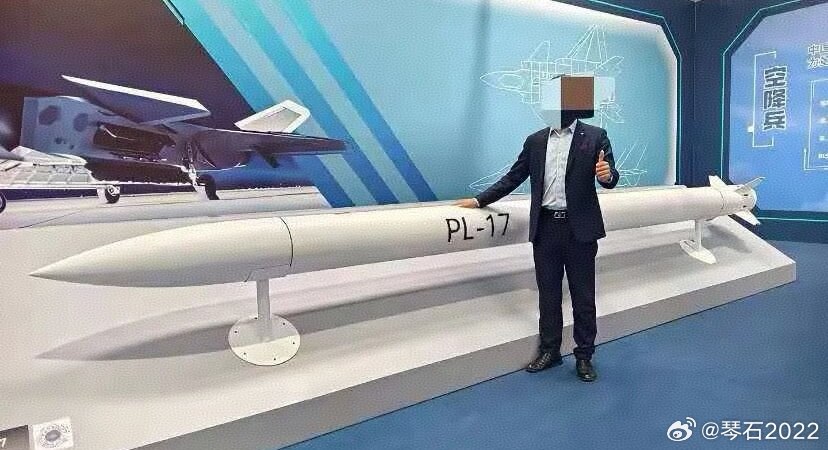
- China’s PL-15 is widely assessed to offer comparable range and kinematics
- Pakistan is actively upgrading sensors, electronic warfare, and countermeasures
- Modern air combat increasingly depends on networked kill chains, not single missiles
In such an environment, missile performance alone does not guarantee first-shot dominance.
The Deterrence Paradox
Indian commentators have framed the Meteor reveal as restoring a standoff advantage allegedly absent during the 2019 Balakot crisis, when Pakistan claimed a MiG-21 kill using AIM-120 missiles. But deterrence is not simply about technical parity or superiority — it is about perception management under crisis conditions.
Publicly displaying sensitive weapons can:
- Signal strength
- But also compress decision-making timelines
- Incentivise adversaries to accelerate counter-measures
- Reduce diplomatic off-ramps during escalation
A Pakistani strategist quoted after the flypast warned that visible capability shifts often invite responses rather than restraint, a concern echoed in broader deterrence literature.
Why the Silence Until Now?
For years, analysts questioned why Meteor missiles were absent from public Rafale imagery despite being part of India’s €7.87 billion acquisition package. The Indian Air Force neither confirmed nor denied operational status, allowing speculation to flourish.
The sudden decision to reverse that ambiguity suggests a shift in communication doctrine, prioritising narrative dominance over traditional secrecy. Critics argue this may reflect:
- Political messaging needs
- Procurement justification amid rising costs
- A desire to counter persistent online scepticism
rather than a fundamental change in battlefield readiness.
Escalation Risks in a Crowded Airspace
South Asia’s airspace is already among the world’s most compressed and escalation-prone. Introducing explicit BVR signalling — especially during ceremonial national events — risks turning airpower modernisation into performative deterrence.
In crisis scenarios involving drones, stand-off weapons, or mixed manned-unmanned formations, miscalculation becomes more likely when both sides assume first-shot advantage.
The Cost Question Remains Unanswered
Each Rafale’s lifecycle cost is estimated to exceed USD 200 million, and the Meteor missile itself is among the most expensive air-to-air weapons in service. As India debates acquiring 114 additional fighters, the Republic Day reveal strengthens negotiating optics — but also intensifies scrutiny.
Critics ask:
- Are such high-end systems scalable in prolonged conflict?
- Can inventory depth match platform sophistication?
- Does symbolic deterrence justify opportunity costs elsewhere in defence spending?
These questions remain unresolved.
Conclusion: Capability Confirmed, Certainty Not
The Republic Day 2026 flypast undeniably confirms that Meteor missiles are integrated on Indian Rafales. What it does not confirm is how decisive this capability would be in a real, contested, electronically degraded conflict against peer adversaries.
Rather than closing debate, the reveal opens a more complex discussion about:
- Deterrence versus escalation
- Secrecy versus signalling
- Technology versus doctrine
The Meteor on Rafale is real — but whether it fundamentally reshapes South Asia’s airpower balance remains an open question.