NATO has formally launched Arctic Sentry, a new operational framework aimed at consolidating allied military activities across the Arctic and High North under unified command. Announced on 11 February 2026, the operation reflects a significant adjustment in the alliance’s posture as climate change, great-power competition, and renewed military activity elevate the strategic importance of the region.
According to NATO, Arctic Sentry is designed to improve situational awareness, close security gaps, and enable faster collective responses to emerging risks linked primarily to Russian and, increasingly, Chinese activity in Arctic waters and airspace.
Unified Command and Operational Model
The operation will be led by Joint Force Command Norfolk, operating under the authority of the Supreme Allied Commander Europe. NATO officials describe the structure as an Arctic adaptation of earlier vigilance missions such as Baltic Sentry and Eastern Sentry, which focused on maritime surveillance and infrastructure protection.
By bringing national and allied Arctic activities into a single operational framework, NATO aims to reduce fragmentation and improve coordination across an area that spans vast distances, extreme weather conditions, and limited infrastructure.
Greenland and Alliance Dynamics
Arctic Sentry emerged after weeks of internal consultations following controversial remarks by Donald Trump regarding Greenland’s strategic value and security. The comments prompted concerns within the alliance about sovereignty and cohesion, particularly for Denmark, which retains responsibility for Greenland’s defence.
Subsequent discussions, including a January 2026 meeting between NATO Secretary General Mark Rutte and Trump in Davos, resulted in a consensus that Arctic security should be addressed collectively through NATO mechanisms rather than unilateral approaches. Denmark has since increased its military presence in Greenland and invited allied participation, framing the response as reinforcement rather than escalation.
Russian and Chinese Activity as a Strategic Driver
NATO leadership has repeatedly pointed to increased Russian military activity in the Arctic as a primary concern. Russia has reopened and expanded Cold War–era bases, strengthened its Northern Fleet, and invested heavily in Arctic-capable forces and icebreakers. British Defence Secretary John Healey described Russia as presenting the most serious Arctic security challenge since the Cold War.
While Chinese naval presence near Greenland remains limited, NATO officials argue that Beijing’s growing interest in polar shipping routes, infrastructure, and satellite coverage represents a longer-term strategic factor that cannot be ignored.
Multi-Domain Operations in a Harsh Environment
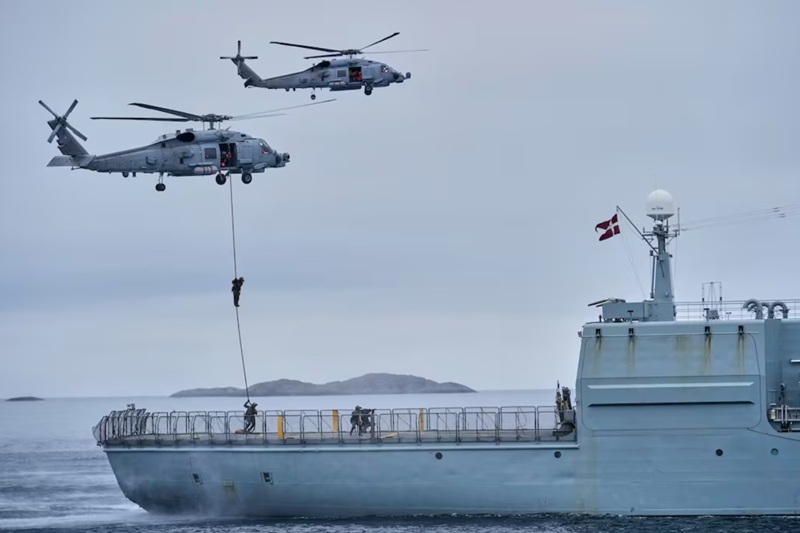
Arctic Sentry is structured as a multi-domain operation, integrating air, maritime, land, cyber, and space capabilities. It will coordinate existing exercises and deployments, including Denmark’s Arctic Endurance activities and contributions from the United Kingdom, Norway, Canada, and other allies.
The United Kingdom plans to double troop deployments to Norway over the next three years, while Royal Marine Commandos and allied forces will participate in major exercises such as Cold Response 2026. These activities are intended to test interoperability, logistics, and command-and-control in extreme conditions rather than signal imminent conflict.
Structural Challenges
Despite the expanded framework, NATO faces material constraints in the High North. The alliance collectively operates far fewer icebreakers than Russia, limiting persistent presence in ice-covered waters. Operational experience is also uneven, with only a subset of member states routinely training and operating in Arctic conditions.
These limitations suggest that Arctic Sentry is best understood as a coordination and deterrence mechanism, rather than a comprehensive solution to Arctic security challenges.
Strategic Significance
The launch of Arctic Sentry signals NATO’s recognition that the Arctic is no longer a peripheral theatre. Melting ice is opening new sea lanes and exposing undersea infrastructure—such as energy pipelines and communication cables—that underpin transatlantic security and global commerce.
By institutionalising Arctic operations within NATO’s command structure, the alliance is attempting to shift from reactive crisis management to sustained vigilance. Whether this approach will keep pace with environmental change, adversary investment, and internal political pressures remains an open question, but Arctic Sentry marks a clear step toward treating the High North as a core strategic domain.