The Pakistan Air Force has successfully concluded Exercise Golden Eagle within the Southern Air Command’s area of responsibility, focusing on validating combat readiness, operational agility, and integrated employment of its full-spectrum airpower in a complex operational environment.
Designed around a Two-Force construct, the exercise emphasised AI-enabled, net-centric operations, reflecting the evolving character of air warfare and the increasingly compressed decision cycles of modern conflict. The scenario-based framework allowed participating formations to operate under conditions shaped by contemporary regional security dynamics, including contested airspace, information dominance challenges, and rapid escalation timelines.
Integrated Multi-Domain Operations
A central feature of Exercise Golden Eagle was the employment of a robust Integrated Air Defence System (IADS), under which friendly forces conducted coordinated operations across air, cyber, space, and the electromagnetic spectrum. The exercise demonstrated the Pakistan Air Force’s ability to fuse kinetic and non-kinetic effects to shape the battlespace before and during active engagements.
The kinetic phase featured swing-role combat aircraft operating under a First-Shoot, First-Kill philosophy, equipped with long-range beyond-visual-range (BVR) air-to-air missiles, extended-range stand-off weapons, and precision-guided munitions. These strike and counter-air operations were supported by Airborne Early Warning & Control (AEW&C) platforms and Air-to-Air Refuellers, enabling sustained operations at range and reinforcing situational awareness across the battlespace.
Manned–Unmanned Teaming and Deep-Reach Effects
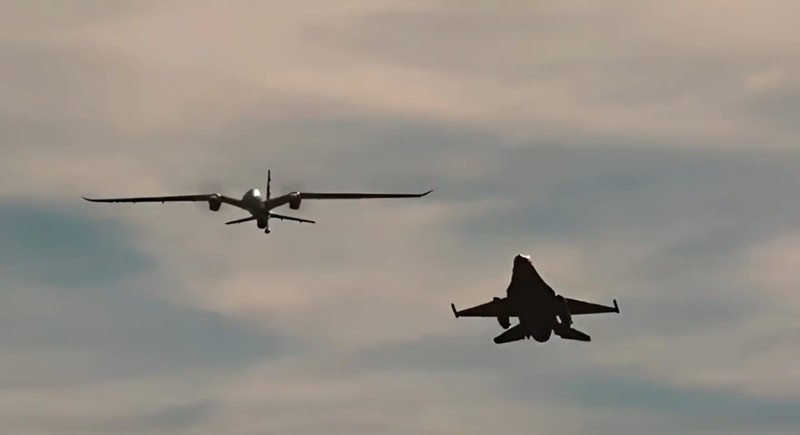
One of the defining aspects of the exercise was the extensive use of Manned–Unmanned Teaming (MUM-T). Deep-reach killer drones and loitering munitions were integrated into strike packages, operating in highly contested, congested, and degraded environments. This validated the PAF’s growing emphasis on combining manned platforms with unmanned systems to extend reach, reduce risk to aircrew, and maintain operational tempo in modern warfare conditions.
The use of indigenous niche, disruptive, and smart technologies during the exercise reflects a broader institutional focus on local innovation, adaptability, and resilience in the face of emerging threats, including electronic warfare, cyber interference, and space-enabled targeting.
Networked Command and Control
Exercise Golden Eagle was executed under unified command and control from the Next-Generation All-Domain Command & Control Centre at Air Headquarters in Islamabad. This architecture enabled real-time data fusion, rapid dissemination of targeting information, and coordinated decision-making across multiple domains, reinforcing the PAF’s transition toward fully networked operations.
Strategic Significance
The successful conduct of Exercise Golden Eagle underscores the Pakistan Air Force’s sustained focus on operational preparedness, jointness, and technological integration. By validating high-tempo operations under realistic and demanding conditions, the exercise reinforces the PAF’s ability to respond effectively across the spectrum of conflict while adapting to future challenges shaped by automation, information dominance, and multi-domain convergence.