
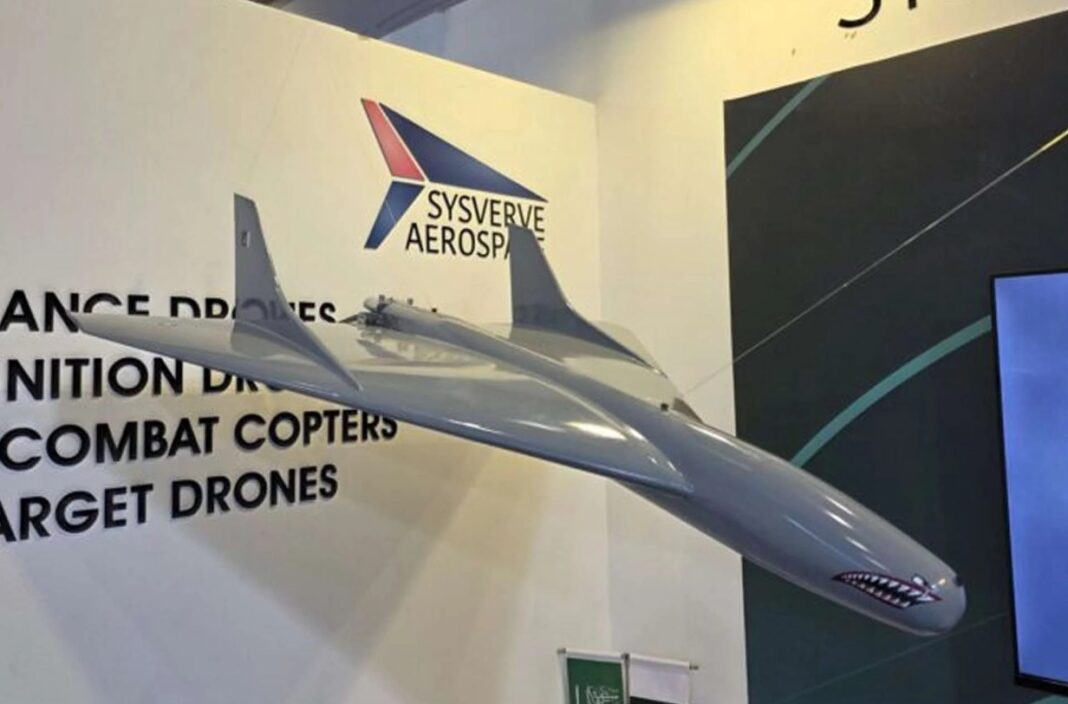
Pakistan has introduced the Mudamir-LR, a new long-range maritime strike drone designed to target naval assets and coastal infrastructure across the Arabian Sea, marking a significant step in Islamabad’s push toward low-cost, AI-guided autonomous weapons.
The system, developed by Sysverve Aerospace, is designed for sea-denial missions, giving the Pakistan Navy an affordable strike layer capable of operating in contested maritime environments where electronic warfare and GPS disruption are expected.
Its unveiling comes amid a rapidly intensifying drone competition in South Asia, as regional powers accelerate investment in loitering munitions, unmanned maritime strike systems, and AI-enabled navigation.
Built for Long-Range Naval Strike Operations
The Mudamir-LR is a one-way attack drone optimized for maritime strike roles.
According to available specifications, the platform features:
- delta-wing configuration
- blended fuselage
- rear pusher propeller
- vertical tail surfaces
- estimated length of 3.5 meters
- wingspan of approximately 2.5 meters
- operational range exceeding 600 kilometers
The most significant feature is its AI-based navigation system designed for GPS-denied and GNSS-jammed environments.
Global Navigation Satellite System
This capability is particularly important in maritime conflict zones, where signal jamming, spoofing, and degraded satellite reception are increasingly common.
Designed for Sea Denial in the Arabian Sea
The drone’s strategic purpose is clear: sea denial and saturation strike operations.
Rather than serving as a traditional anti-ship missile replacement, the Mudamir-LR appears designed as an attritable strike layer that can harass naval movements, attack patrol vessels, target radar nodes, and pressure logistics routes.
Weapons in this class are especially effective because they create an unfavorable cost-exchange ratio.
Defenders are often forced to expend expensive interceptors and significant radar resources against comparatively low-cost incoming drones.
Used in swarms or in combination with missiles and decoys, such systems can overwhelm shipboard air-defense timelines.
This makes the Mudamir-LR particularly relevant in the narrow and highly contested waters of the Arabian Sea.
Comparisons With Shahed and LUCAS Drones
The Mudamir-LR’s geometry has drawn immediate comparisons with the Shahed-136.
Like the Shahed family, it uses a delta-wing layout and rear pusher-prop configuration.
However, its mission profile appears more regionally focused.
While the Shahed-136 is associated with ranges of more than 2,000 kilometers, the Mudamir-LR appears optimized for shorter-range, maritime-focused missions within Pakistan’s coastal battlespace.
Analysts also compare it to the U.S. LUCAS FLM-136, which occupies a similar doctrinal space as a mass-producible expendable strike platform.
This reflects a wider global shift toward precision mass and low-cost autonomous warfare systems.
January Naval Testing Suggests Operational Integration
The drone’s significance extends beyond its unveiling.
Pakistan Navy exercises in January reportedly included loitering munition strikes against surface targets alongside air-defense drills involving the LY-80(N).
This suggests the Mudamir-LR is not merely a display item but part of an emerging operational concept integrating:
- naval ISR
- coastal sensors
- drone strike layers
- air defense validation
Such integration points toward a broader layered unmanned kill chain.
Strategic Message to Regional Rivals
The timing is strategically significant.
India has recently expanded its own unmanned systems roadmap, accelerating the regional drone competition.
For Pakistan, a low-cost indigenous strike drone offers a practical way to challenge a larger naval force without matching platform-for-platform.
This is especially important given wartime concerns over imported weapons flows and supply-chain disruptions.
Domestic production of attritable strike drones reduces that vulnerability and strengthens deterrence.
Why It Matters
If produced in meaningful numbers, the Mudamir-LR could become one of the most consequential additions to Pakistan’s maritime strike architecture.
Networked with platforms such as the Shahpar-III, it could support a distributed strike system from surveillance to terminal attack.
It may not fundamentally alter the naval balance in the Arabian Sea.
But it can make that balance significantly more dangerous, distributed, and expensive for any adversary to manage.