


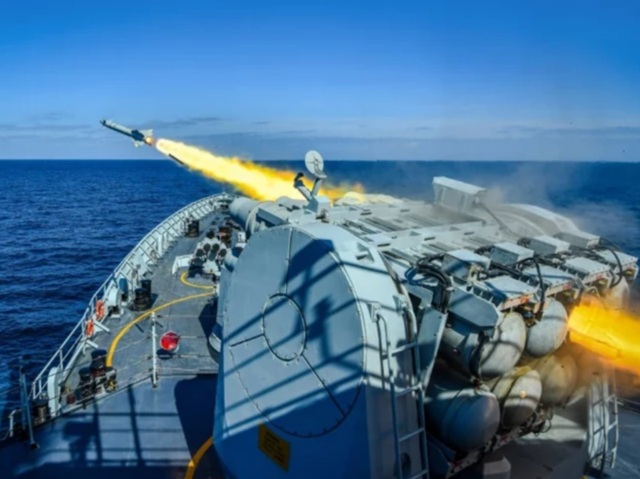
The Pakistan Navy on Monday reaffirmed its commitment to safeguarding the country’s maritime frontiers after successfully conducting a live firing test of a medium-range surface-to-air missile in the northern Arabian Sea, according to an official statement by the military’s media wing.
The test involved the FM-90(N) ER, a ship-borne air-defence missile system capable of intercepting fast, low-flying and highly manoeuvrable aerial threats. The firing comes at a time when Pakistan has increased its emphasis on maritime vigilance and integrated air-defense readiness, following months of heightened regional tensions.
Missile Test Demonstrates Combat Readiness After Pakistan–India Standoff
The latest drill follows a brief but high-intensity four-day confrontation between Pakistan and India, during which both sides exchanged missile and artillery fire and deployed drones, fighter jets and long-range precision systems.
Although the standoff did not escalate into a naval confrontation, the Pakistan Navy remained on heightened alert until a U.S.-mediated ceasefire was reached.
ISPR: Navy Ship Successfully Engaged Aerial Targets
In its statement, ISPR noted:
“Pakistan Navy successfully conducted a Live Weapon Firing (LWF) of the FM-90(N) ER Surface-to-Air Missile in the North Arabian Sea.”
The statement added that during the firepower demonstration, a Pakistan Navy warship “effectively engaged highly manoeuvrable aerial targets, reaffirming the Navy’s war-fighting capability and combat readiness.”
Commander Pakistan Fleet (COMPAK) personally observed the missile launch from a fleet unit at sea, underscoring the strategic significance of the drill.
ISPR further said the fleet commander praised the officers and sailors for their professionalism, precision and operational competence, reaffirming the Navy’s resolve to protect Pakistan’s maritime interests and sea lines of communication (SLOCs).
Why the FM-90(N) ER Test Matters
Defence officials note that the FM-90(N) ER system strengthens Pakistan Navy’s layered air defence by providing:
- Engagement capability against aircraft, drones and anti-ship missiles
- Faster reaction time in saturated threat environments
- Greater survivability for frontline naval assets
The test is also part of Pakistan’s broader effort to upgrade its naval firepower, including expansion of its frigate fleet, acquisition of new UAV systems, and development of long-range precision-strike options.
Pakistan’s Military Increasing Focus on Integrated Readiness
The Navy’s demonstration follows a series of recent readiness activities across Pakistan’s armed forces.
Just last week, Chief of Defence Staff Field Marshal Asim Munir visited forward garrisons in Gujranwala and Sialkot, where he reviewed a field training exercise involving tanks, drones and real-time surveillance systems.
Munir emphasized that modern warfare demands agility, battlefield awareness, data-driven decision cycles and rapid technological adaptation, urging formations to build interoperability across land, air and maritime domains.
Growing Importance of Maritime Security
With over 1,000 km of coastline, major ports such as Karachi and Gwadar, and critical sea lanes supporting Pakistan’s trade and energy imports, naval preparedness remains a strategic priority.
The Northern Arabian Sea has also seen increased military activity involving:
- U.S. and regional naval patrols
- Escalating India-Pakistan airpower competition
- Expansion of Chinese naval presence under CPEC cooperation
Against this backdrop, Pakistan Navy’s live missile firing is seen as a message of deterrence, preparedness and regional stability.


