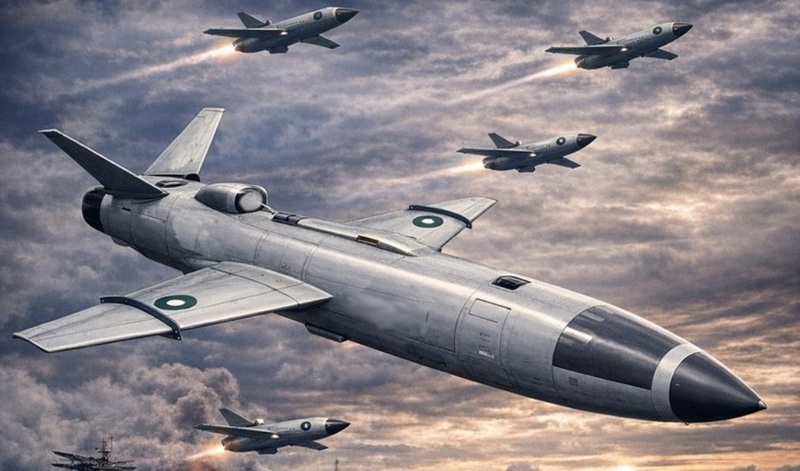
Pakistan has quietly advanced its indigenous unmanned aviation capabilities with the successful testing of a high-speed target drone developed by AvRID (Aviation Research, Innovation and Development). The test, revealed through brief but clear launch footage in mid-February 2026, highlights a growing emphasis on locally designed systems intended to support air-defence training, missile testing, and realistic threat simulation.
The footage shows a jet-powered drone launched via a large pneumatic rail system in a desert environment, underscoring Pakistan’s continued investment in self-reliant aerospace technologies rather than headline-grabbing combat platforms.
High speed drone designed by AvRID being tested. This is a different pneumatic launcher to the ones I’ve seen before… seems larger. pic.twitter.com/ZGTAas5DkH
— Amir Husain (@amirhusain_tx) February 14, 2026
A Quiet Test with Strategic Weight
The test became public through a social media post by Amir Husain, who noted that the pneumatic launcher appeared larger than previous variants. While limited in duration, the clip confirms iterative progress rather than experimentation, suggesting a programme that has moved well beyond proof-of-concept.
Unlike armed UAVs designed for combat roles, high-speed target drones are critical force enablers. They allow air-defence units, radar operators, and missile crews to train against fast, manoeuvring targets that replicate hostile aircraft or cruise-missile profiles—capabilities increasingly relevant in modern air warfare.
AvRID, NASTP and the Indigenous Push
AvRID operates under the umbrella of the Pakistan Aeronautical Complex and is now integrated into the National Aerospace Science & Technology Park (NASTP). This structure links government, industry, and academia, creating a pipeline for indigenous aerospace development that prioritises reduced foreign dependency.
The high-speed target drone fits squarely within this framework, complementing other initiatives such as advanced weapons testing ranges and manned-unmanned teaming concepts that are shaping Pakistan’s future air-combat doctrine.
Evolution of the High-Speed Target Drone Programme
Pakistan’s work on jet-powered target drones dates back several years, with early test launches publicly acknowledged around 2019. Since then, successive trials—reported in 2022, 2023, and late 2025—have demonstrated gradual improvements in launch infrastructure, reliability, and performance envelopes. The February 2026 test appears to build on these milestones, pointing to a mature and repeatable system rather than a one-off demonstration.
The visible scaling of the pneumatic launcher may indicate accommodation for heavier drones, higher launch energy, or extended operational profiles, all of which are relevant for modern air-defence training scenarios.
Inferred Capabilities and Role
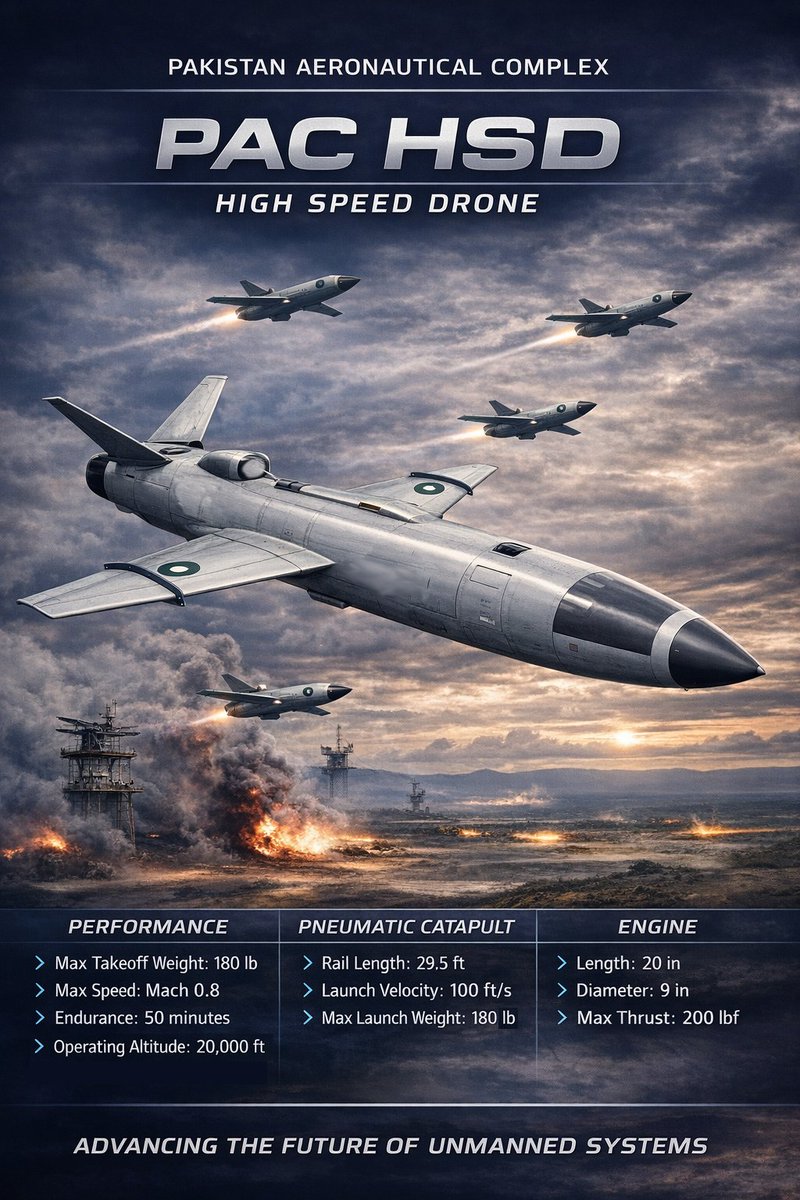
While official specifications remain undisclosed, the drone is assessed to be jet-powered and capable of sustained high-subsonic speeds. Its primary role is to serve as a realistic target for surface-to-air missile systems, radar calibration, and anti-aircraft gunnery. Such platforms are far more cost-effective than using manned aircraft for training, while offering repeatability and lower operational risk.
The system’s design also aligns with broader trends in unmanned operations, including autonomy and potential integration into more complex training scenarios involving multiple aerial targets.
Strategic and Industrial Implications
From a strategic perspective, the programme enhances Pakistan’s air-defence readiness by enabling frequent, realistic training against high-speed threats. Industrially, it reflects a shift from assembly and adaptation toward full-cycle indigenous design and testing—an important distinction for long-term sustainability.
Although unlikely to attract the attention reserved for combat drones or fighter aircraft, the high-speed target drone represents a foundational capability. It strengthens Pakistan’s defence ecosystem, supports domestic industry, and reinforces a quiet but consistent trajectory toward aerospace self-reliance.