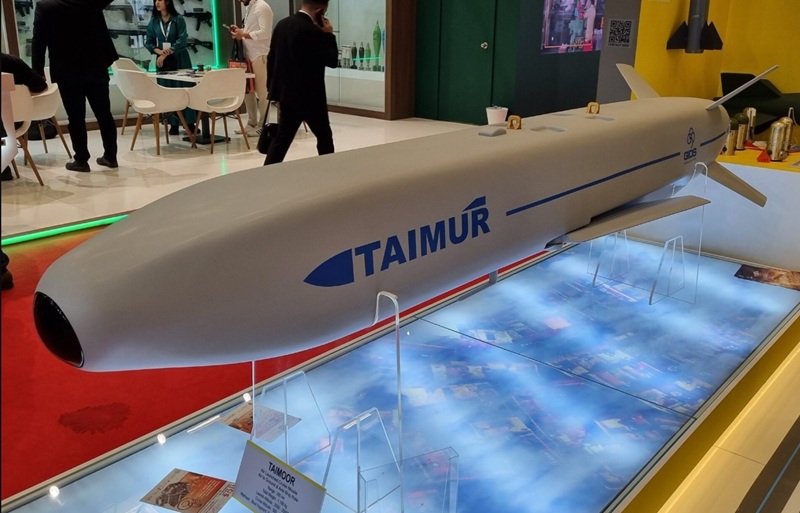
Pakistan is set to publicly unveil its newly tested Taimoor Air-Launched Cruise Missile (ALCM) at the World Defense Show (WDS) 2026 in Riyadh, marking a calibrated assertion of the country’s growing indigenous precision-strike capability and long-range conventional deterrence.
The unveiling follows the Pakistan Air Force’s successful test-firing of the missile on January 3, 2026, and reflects Islamabad’s intent to translate domestic defence innovation into credible operational capability within a rapidly evolving regional airpower environment.
Senior Leadership Signals Strategic Importance
President Asif Ali Zardari described the successful test as evidence of Pakistan’s advancing defence-industrial maturity, stating that it reflects “the growing technical innovation achieved by Pakistan’s defence sector.”
Similarly, Air Chief Marshal Zaheer Ahmed Baber Sidhu emphasised that the missile enhances the Pakistan Air Force’s operational flexibility and strengthens conventional deterrence, positioning the system as a key doctrinal enabler rather than a standalone weapon.
600-Kilometre Range Strengthens Conventional Deterrence
The Taimoor ALCM has a declared domestic strike range of 600 kilometres, while an MTCR-compliant export variant is capped at 280 kilometres. This configuration underscores Pakistan’s strategy of reinforcing long-range conventional strike options without crossing nuclear escalation thresholds in South Asia’s volatile security environment.
By focusing on standoff precision rather than sheer speed, Pakistan aims to impose operational costs on adversaries while maintaining escalation control.
Designed for Modern Air-Defence Environments
Developed by the Air Weapons Complex under the National Engineering and Scientific Commission ecosystem, the Taimoor missile is optimised for survivability against modern layered air-defence systems.
According to ISPR, the missile flies at very low altitudes, uses advanced navigation and guidance systems, and is capable of engaging both land and sea targets with high precision. Terrain-hugging flight profiles and reduced radar signatures are intended to compress enemy detection and interception timelines.
Successful Test from Mirage III Validates Readiness
The January 2026 flight test, conducted from a Dassault Mirage III, confirmed the missile’s full operational profile, including launch dynamics, propulsion reliability, and guidance stability across its strike envelope.
Testing from a legacy fighter platform highlights Pakistan’s weapons-centric modernisation philosophy, allowing new strike capabilities to be integrated rapidly without waiting for next-generation aircraft induction.
Technical Profile of the Taimoor ALCM
Key reported characteristics include:
- Range: 600 km (domestic), 280 km (export variant)
- Speed: Subsonic (approximately Mach 0.7–0.8)
- Weight: Under 1,200 kg
- Guidance: INS with satellite augmentation and terrain-contour matching
- Flight Profile: Ultra-low altitude, terrain-following
- Warhead: Conventional, including blast-fragmentation options
The design prioritises endurance, guidance resilience, and penetration rather than hypersonic dash speed.
World Defense Show 2026 and Export Strategy
Pakistan will display the Taimoor missile at World Defense Show 2026, hosted in Riyadh from February 4 to 8, a venue that has rapidly become a major marketplace for advanced aerospace and missile technologies.
The selection of Riyadh reflects a deliberate export-oriented strategy led by Global Industrial & Defence Solutions (GIDS), positioning the Taimoor as a cost-effective precision-strike alternative for Middle Eastern, African, and Global South air forces.
Appeal to Gulf and Emerging Markets
Compared to Western air-launched cruise missiles, which often cost over US$1.5–2 million per unit, the Taimoor’s competitive pricing and lack of political conditionalities enhance its export appeal.
Saudi Arabia’s Vision 2030 defence localisation framework may also open avenues for co-production, technology transfer, or joint integration discussions.
Impact on Regional Airpower Balance
Within South Asia, the Taimoor introduces a survivable conventional standoff option that complicates adversary air-defence planning while avoiding nuclear signalling. Its anti-ship capability also strengthens Pakistan’s maritime deterrence posture in the Arabian Sea.
By diversifying launch platforms and extending strike reach, the missile contributes to a layered deterrence architecture designed to create uncertainty rather than numerical parity.
A Strategic and Industrial Milestone
The Taimoor ALCM builds on Pakistan’s earlier cruise missile programmes, refining guidance resilience, survivability, and export compliance. Its debut at World Defense Show 2026 signals not just a new weapon, but Pakistan’s emergence as a mature precision-strike developer in the global defence market.