The ongoing Iran conflict has reinforced a key lesson in modern warfare: the most dangerous threats are often the least visible.
As naval battles increasingly shift toward stealth, autonomy, and unmanned systems, Pakistan is accelerating its investment in underwater and surface drones to protect its ports, shipping lanes, and maritime infrastructure.
This growing focus reflects a broader transformation in naval strategy, where unmanned platforms are becoming critical force multipliers.
Focus on Unmanned Maritime Systems
Pakistan’s naval modernization effort includes a mix of:
- Unmanned Surface Vessels (USVs)
- Autonomous Underwater Vehicles (AUVs)
- Aerial drones integrated into maritime operations
These systems are designed to operate across multiple domains, providing surveillance, strike capability, and defensive coverage.
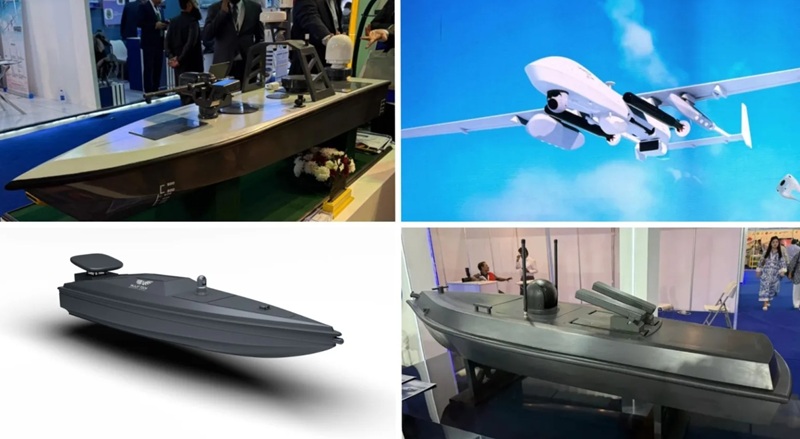
Muhassir USV: Semi-Submersible Recon and Strike Platform
One of the key developments is the Muhassir, a locally developed unmanned surface vessel.
Key features:
- Length: approximately 10 meters
- Weight: 7.3 tons
- Speed: up to 40 knots
- Range: over 400 nautical miles
The platform is designed primarily for reconnaissance but can also be armed with:
- A 12.7mm machine gun
- Explosive payloads for strike missions
Its semi-submersible design enhances survivability by reducing its radar and visual signature.
Corsair USV: Kamikaze Drone for Naval Warfare
Pakistan is also exploring more aggressive unmanned systems through private-sector collaboration.
The Corsair USV is a smaller, fast attack drone designed for offensive operations.
Key features:
- Length: approximately 4 meters
- Speed: up to 30 knots
- Range: around 100 nautical miles
- Payload: up to 50 kg
This system is intended for suicide missions targeting:
- Warships
- Port infrastructure
- High-value maritime assets
Israr AUV: Underwater Surveillance and Mapping
Beneath the surface, Pakistan is developing the Israr Autonomous Underwater Vehicle (AUV).
Key capabilities:
- Length: approximately 3 meters
- Dive depth: up to 300 meters
- Endurance: around 4 hours
The Israr is designed for:
- Intelligence, Surveillance, and Reconnaissance (ISR)
- Seabed mapping
- Port security monitoring
Such systems are particularly valuable in detecting underwater threats such as mines or hostile submarines.
Force Multipliers: Expanding Naval Drone Ecosystem
Pakistan’s drone strategy is not limited to maritime platforms alone. It is supported by additional systems that enhance overall capability.
Mudmair Loitering Munition
- Acts as a precision strike drone
- Successfully tested in January 2026 against surface targets
- Provides long-range strike capability
Shahpar III (MALE UAV – Naval Variant)
- Equipped for maritime patrol and anti-submarine warfare
- Can carry:
- Lightweight torpedoes
- Sonobuoys
- Radar systems
This integration of aerial and maritime drones creates a multi-layered unmanned warfare network.
Strategic Implications
Pakistan’s investment in unmanned naval systems reflects several strategic priorities:
- Protecting critical ports and shipping routes
- Countering asymmetric maritime threats
- Enhancing surveillance across coastal and offshore zones
- Reducing reliance on large, vulnerable naval platforms
As demonstrated in recent conflicts, low-cost unmanned systems can pose serious challenges to traditional naval forces.
The Future of Naval Warfare
The expansion of Pakistan’s underwater drone program highlights a broader shift in global military trends.
Modern naval warfare is increasingly defined by:
- Stealth over visibility
- Autonomy over manpower
- Distributed systems over centralized fleets
In this evolving environment, underwater drones and unmanned vessels are likely to play a decisive role in shaping future maritime security.
Pakistan Naval Drone Comparison
| Feature | Muhassir (USV) | Corsair (USV) | Israr (AUV) |
|---|---|---|---|
| Type | Unmanned Surface Vessel (Semi-submersible) | Unmanned Surface Vessel (Kamikaze) | Autonomous Underwater Vehicle |
| Role | Reconnaissance + Strike | Offensive attack (suicide drone) | Surveillance & underwater monitoring |
| Length | ~10 meters | ~4 meters | ~3 meters |
| Weight | ~7.3 tons | Not specified (lightweight) | Not specified |
| Speed | Up to 40 knots | Up to 30 knots | Slow underwater movement |
| Range | 400+ nautical miles | ~100 nautical miles | Limited (endurance-based) |
| Endurance | Long-range missions | Short attack missions | ~4 hours underwater |
| Dive Capability | Semi-submersible | Surface only | Up to 300 meters depth |
| Payload | 12.7mm gun / explosives | ~50 kg explosive payload | Sensors (ISR equipment) |
| Primary Targets | Ships, surveillance zones | Warships, ports | Seabed, ports, underwater threats |
| Key Strength | Stealth + long range | Low-cost high-impact attack | Stealth underwater surveillance |
Key Differences (Simple Breakdown)
Muhassir
- Multi-role drone (surveillance + attack)
- Long range and higher survivability
- Semi-submersible design for stealth
Corsair
- Designed purely for kamikaze attacks
- Cheap, fast, and expendable
- Effective against ships and port infrastructure
Israr
- Fully underwater drone
- Focus on ISR, seabed mapping, and port security
- Difficult to detect due to underwater operation
Strategic Insight
Together, these systems create a layered unmanned naval capability:
- Muhassir → Long-range patrol & strike layer
- Corsair → Close-range attack layer
- Israr → Underwater surveillance layer
This combination allows Pakistan to operate across:
Surface + Subsurface + Coastal Zones