The U.S. Department of Defense is set to formalize the adoption of Palantir’s Maven artificial intelligence platform as an official program of record, marking a major step toward integrating AI-driven decision-making across the U.S. military.
In a March 9 letter to senior Pentagon leadership, Deputy Secretary of Defense Steve Feinberg confirmed that the Maven Smart System will become a permanent part of U.S. military infrastructure, ensuring long-term funding and widespread deployment.
The move is expected to take effect by the end of the current fiscal year in September.
What is Palantir Maven AI?
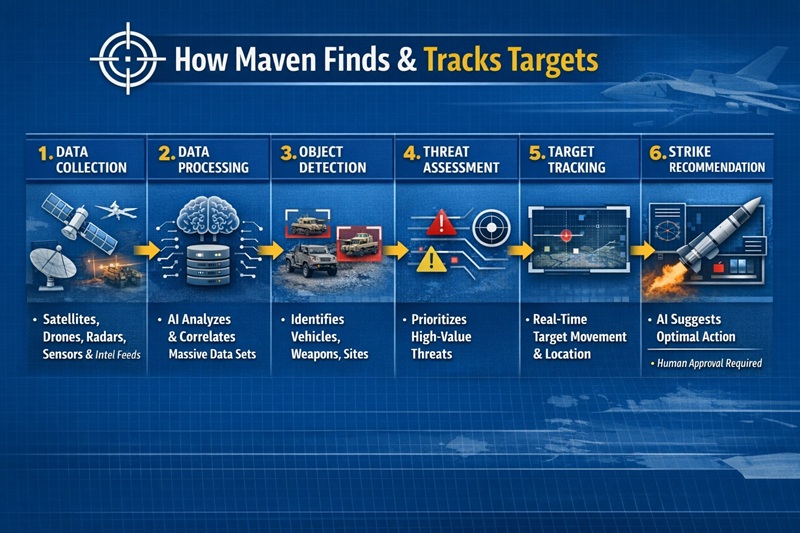
Maven is a powerful command-and-control AI platform designed to analyze vast amounts of battlefield data and identify potential targets in real time.
It integrates inputs from:
- Satellites
- Drones
- Radar systems
- Sensors
- Intelligence reports
Using artificial intelligence, Maven can rapidly detect threats such as:
- Enemy vehicles
- Weapons stockpiles
- Strategic infrastructure
This capability significantly reduces the time required for battlefield analysis—from hours to minutes.
From Experimental Tool to Core Warfighting System
Originally developed under the Pentagon’s Project Maven in 2017, the platform began as a tool for labeling drone imagery.
Since then, it has evolved into what is now considered the primary AI operating system for U.S. military targeting operations.
According to officials, Maven has already supported thousands of strike operations, demonstrating its operational value in modern warfare.
What “Program of Record” Means
Designating Maven as a program of record has major implications:
- Guarantees long-term funding
- Standardizes deployment across all military branches
- Accelerates procurement and integration
- Embeds AI into core military doctrine
Oversight of the program will shift from the National Geospatial-Intelligence Agency (NGA) to the Pentagon’s Chief Digital and Artificial Intelligence Office (CDAO) within 30 days.
Future contracts related to Maven will be managed by the U.S. Army.
A Major Win for Palantir
The decision represents a significant milestone for Palantir, which has rapidly expanded its footprint in U.S. defense contracts.
Key developments include:
- A U.S. Army contract worth up to $10 billion
- Maven contract ceiling increased to $1.3 billion in 2025
- A market valuation approaching $360 billion
These contracts have played a major role in the company’s recent growth and rising stock value.
AI Warfare: Speed vs Ethics
While Maven enhances battlefield efficiency, it also raises serious ethical and legal concerns.
United Nations experts have warned that AI-driven targeting systems could:
- Introduce bias from training data
- Increase risk of misidentification
- Accelerate lethal decision-making beyond human control
However, Palantir maintains that:
- Its system does not make autonomous lethal decisions
- Human operators remain responsible for target approval
Emerging Risks: AI Supply Chain Concerns
One potential complication in Maven’s expansion is its reported use of Anthropic’s Claude AI model.
The Pentagon has recently flagged Anthropic as a potential supply chain risk, citing concerns over safety guardrails and AI governance.
This could influence future integration decisions and contracting frameworks.
The Future of AI in Warfare
The Pentagon’s decision signals a broader shift toward AI-enabled warfare, where:
- Data processing speed becomes a decisive advantage
- Real-time intelligence drives operational decisions
- Human-machine teaming defines battlefield outcomes
As AI systems like Maven become central to military strategy, they are likely to reshape how wars are planned, fought, and controlled.
Conclusion
The formal adoption of Palantir’s Maven AI system marks a turning point in modern military operations.
By embedding artificial intelligence at the core of its warfighting strategy, the U.S. military is not just upgrading its capabilities—it is redefining the future of warfare.