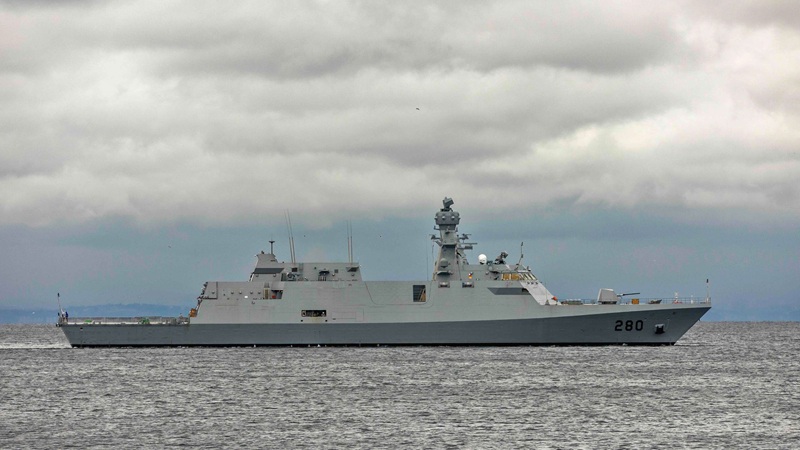
PNS BADR’s commencement of Sea Acceptance Trials represents a watershed moment in Pakistan’s naval modernisation, signalling a decisive shift from platform acquisition to sovereign warship construction capability. As the first fully Pakistan-built MİLGEM-class corvette, constructed at Karachi Shipyard & Engineering Works (KSEW), the vessel embodies the maturation of Pakistan’s defence-industrial ecosystem and the deepening of its strategic partnership with Türkiye .
Unlike earlier licensed production efforts, PNS BADR was entirely constructed in Pakistan under the technical oversight of Türkiye’s defence firm ASFAT, transforming the Pakistan Navy’s MİLGEM programme into a demonstrable indigenous capability. This evolution aligns fleet modernisation with long-term industrial autonomy, skilled workforce development, and reduced external dependency in high-end surface combatant production .
Türkiye’s Ministry of National Defence publicly confirmed the milestone, stating that the BADR corvette, built in Karachi, has begun Sea Acceptance Tests, a declaration that underscores Pakistan’s transition from assembly to full systems integration under real maritime conditions . Sea trials represent the most demanding validation phase, assessing propulsion, navigation, sensors, combat systems, and survivability in operational sea states rather than controlled harbour environments.
MSB: “Pakistan MİLGEM Projesi kapsamında Pakistan Karaçi Tersanesinde inşa edilen iki gemiden ilki olan BADR korvetinin Deniz Kabul Testleri 19 Ocak’ta Karaçi’de başlamıştır.” @MSB_ASFAT pic.twitter.com/y3IfgX7ahM
— Defence Turkey Magazine (@DefenceTurkey) January 22, 2026
Strategic Context: Indian Ocean Competition
The significance of PNS BADR extends beyond shipbuilding. In the increasingly contested Indian Ocean Region (IOR), Pakistan’s ability to independently construct and certify modern multi-mission surface combatants directly enhances its capacity for sea-denial, maritime security, and escort operations, particularly amid expanding Indian blue-water naval deployments and congested sea lines of communication .
The programme is anchored in a USD 1.5 billion defence-industrial contract between ASFAT and Pakistan’s Ministry of Defence Production, designed not merely to induct four corvettes, but to permanently elevate Pakistan’s naval industrial base. Two vessels were built in Türkiye, while two—including PNS BADR—were constructed in Karachi, ensuring irreversible transfer of shipbuilding and systems-integration expertise .
Rear Admiral Ather Saleem, Managing Director of KSEW, has previously described the MİLGEM corvettes as the most technologically advanced platforms of the Pakistan Navy, framing them as foundational assets of a next-generation maritime combat architecture rather than incremental fleet additions .
From Turkish Concept to Pakistani Doctrine
Originally launched by Türkiye in the early 2000s, the MİLGEM project was designed to reduce foreign dependence through stealth shaping, modular combat systems, and strong anti-submarine warfare credentials. Pakistan’s 2018 decision to adopt and localise the design was driven by fleet obsolescence, widening regional naval asymmetries, and the need for sustained blue-water endurance in the Arabian Sea .
The Pakistan Navy’s variant, designated the Babur-class, displaces roughly 2,900–3,000 tonnes, features a CODAD propulsion system, exceeds 26 knots in speed, and offers a range of approximately 3,500 nautical miles. The class is optimised for multi-domain operations, from escort missions and anti-submarine warfare to maritime security and sea-lane protection .
PNS BADR: Industrial Sovereignty in Action
Named after the historic Battle of Badr, PNS BADR represents the programme’s most consequential phase. Its keel was laid in October 2020, launched in May 2022, and fitted out entirely at KSEW, testing Pakistan’s growing competence in complex naval integration. The start of Sea Acceptance Trials on January 19, 2026, marks the final validation step before commissioning, expected by mid-2026 .
Equipped with HAVELSAN’s ADVENT combat management system, ASELSAN sensors, a 76mm naval gun, anti-ship missiles, lightweight torpedoes, a 16-cell vertical launch system for surface-to-air missiles, and aviation facilities for helicopters and UAVs, the Babur-class offers layered defence and network-centric warfare capability .
Broader Implications
ASFAT’s simultaneous sea trials of another combat vessel in Turkish waters highlight industrial scalability and sustainment confidence, reinforcing Pakistan’s long-term assurance in upgrades and future joint programmes. As PNS BADR advances toward commissioning, the Pakistan MİLGEM programme stands as a case study in how deep technology transfer—rather than off-the-shelf procurement—can reshape naval power and deterrence credibility.
In strategic terms, the Sea Acceptance Trials of PNS BADR confirm that Pakistan has crossed a threshold: from naval modernisation to sustained naval power generation, with industrial sovereignty now firmly embedded in its maritime doctrine .
Discover more from Defence Talks | Defense News Hub, Military Updates, Security Insights
Subscribe to get the latest posts sent to your email.