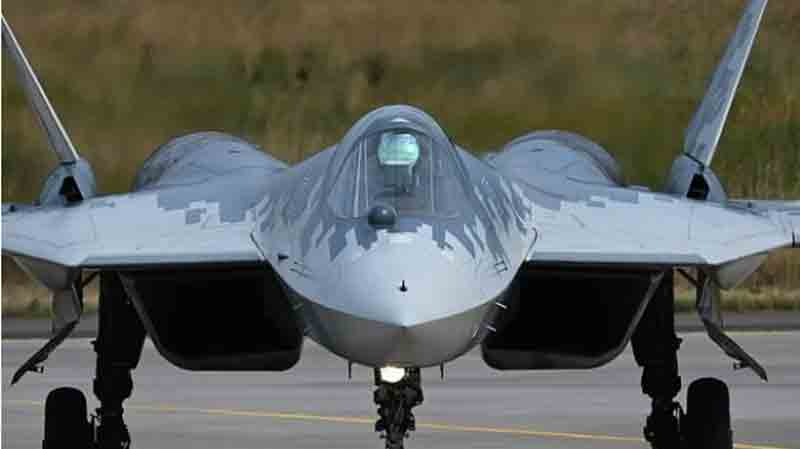
Russia has confirmed that it has secured export contracts for its fifth-generation Sukhoi Su-57 fighter in the Middle East, marking a notable development for the country’s defence aviation industry amid continued geopolitical and industrial pressure.
The announcement was made by Anton Alikhanov, Russia’s Minister of Industry and Trade, during the Innoprom industrial exhibition held in Saudi Arabia in February 2026. While Alikhanov confirmed that agreements had been reached, he did not disclose the identities of the customer states or the number of aircraft involved.
Export Momentum Under Constraints
The confirmation comes at a time when Russia’s defence sector faces constraints related to sanctions, supply chains, and production capacity. Against this backdrop, securing export contracts for a fifth-generation combat aircraft carries both symbolic and practical significance. It suggests that Moscow continues to find markets willing to engage despite political risk and that the Su-57 programme has reached a level of maturity sufficient to attract foreign interest.
Russia is offering the export configuration known as the Su-57E, which has been promoted as a multirole platform combining reduced observability, long range, high payload capacity, and advanced sensor integration. Russian officials have repeatedly highlighted the aircraft’s “combat-tested” status, referring to limited operational use in Syria and stand-off roles during the conflict in Ukraine.
Positioning in the Middle Eastern Market
The Middle East has traditionally been dominated by U.S. and European fighter aircraft, including the F-15, F-16, Dassault Rafale, Eurofighter Typhoon, and, more recently, the F-35. In this context, the entry of the Su-57 represents an attempt by Russia to position itself as an alternative supplier for states seeking diversification, political leverage, or fewer export restrictions.
Although no countries were named, analysts note that interest in advanced Russian combat aircraft in the region has periodically surfaced among states facing limitations on Western acquisitions. Any confirmed deliveries would therefore have implications not only for air force modernisation but also for regional defence relationships.
Technical and Programmatic Context
The Su-57 was developed as Russia’s answer to Western fifth-generation fighters, prioritising a balance of speed, manoeuvrability, range, and weapons capacity. Unlike some Western designs that emphasise stealth above all else, the Su-57 adopts a broader survivability concept that combines reduced radar signature with electronic warfare, kinematic performance, and long-range missiles.
Current production aircraft are powered by the AL-41F1 engine, with the more advanced AL-51F (Izdeliye-30) engine still in development. The aircraft features the N036 Byelka AESA radar suite and a distributed electro-optical system intended to support multi-target engagement and situational awareness.
Strategic Significance
From a strategic perspective, confirmed export contracts strengthen Russia’s claim that the Su-57 is transitioning from a limited domestic programme into an internationally marketable system. They also provide Moscow with an additional tool of defence diplomacy at a time when arms exports remain one of the few sectors capable of generating foreign revenue and political influence.
At the same time, the long-term impact of these deals will depend on production rates, engine maturity, after-sales support, and the operational experience of export customers. Without sustained output and clear performance data from foreign operators, the Su-57’s role in reshaping regional airpower balances is likely to remain incremental rather than transformative.