On 16 February 2026, Russia’s Baltic Fleet conducted a coastal missile exercise in the Kaliningrad region using the Bal coastal defense system, simulating strikes against hostile surface vessels in the Baltic Sea. While framed as routine combat training, the drill underscores Moscow’s sustained focus on shore-based anti-ship capabilities in one of Europe’s most strategically sensitive maritime theaters.
According to official fleet statements, the exercise involved full deployment procedures, electronic missile launches, rapid relocation after simulated strikes, and the use of unmanned aerial vehicles for surveillance and force protection. Together, these elements highlight how Russia envisions coastal missile units operating in a high-threat, intelligence-saturated environment.
Mobility and “Shoot-and-Scoot” Emphasis
During the drill, missile units redeployed from permanent bases to designated firing areas along the Kaliningrad coast. Crews practiced transitioning from march to combat readiness, opening firing positions, conducting pre-launch checks, and executing simulated engagements. Following these notional strikes, units rapidly changed positions, reinforcing a “shoot-and-scoot” concept designed to reduce exposure to counter-fire and aerial reconnaissance.
Camouflage, concealment, and movement in difficult terrain were emphasized throughout the exercise, reflecting the assumption that coastal missile forces would operate under continuous observation by NATO intelligence, surveillance, and reconnaissance assets in the Baltic region.
The Bal System and Its Role
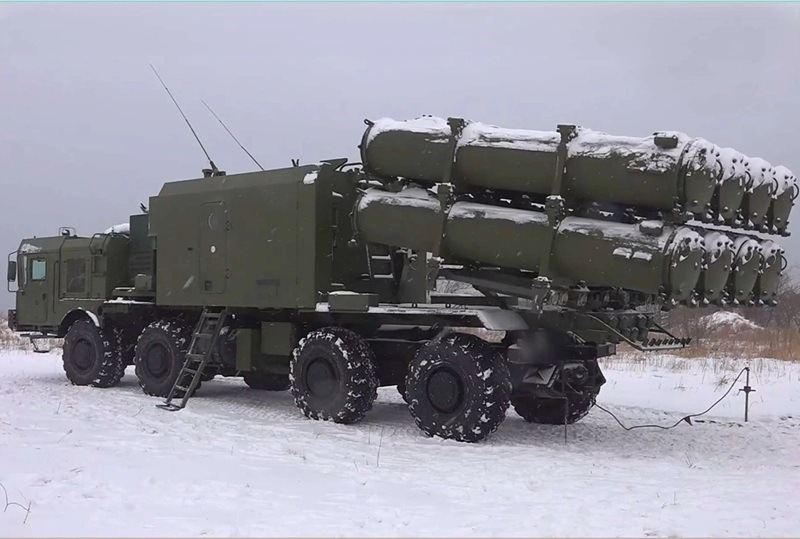
The Bal coastal missile system (Russian designation 3K60, NATO code SSC-6 Sennight) is a core element of Russia’s shore-based anti-ship arsenal. Mounted on high-mobility 8×8 chassis, a typical Bal battery includes command and control vehicles with surface-search radar and multiple transporter-erector-launchers, each capable of carrying eight Kh-35 family anti-ship cruise missiles.
The subsonic Kh-35 is a sea-skimming missile guided by inertial navigation with active radar homing in its terminal phase. Depending on the variant and targeting support, reported ranges extend from roughly 120 kilometers to over 250 kilometers. From positions along the Kaliningrad coastline, this allows Bal units to cover significant portions of the central and southern Baltic Sea, including key sea lines of communication.
Layered Coastal Defense in Kaliningrad
Bal does not operate in isolation. In Kaliningrad, it is typically integrated into a broader coastal defense architecture that includes surveillance radars, air-defense systems, and other missile assets such as the Bastion-P system armed with longer-range and higher-speed anti-ship missiles. This layered approach enables Russian forces to threaten a spectrum of surface targets, from logistic shipping to high-value naval combatants, at varying ranges.
The combination of mobility, salvo-firing capability, and overlapping coverage is intended to complicate any adversary’s ability to operate freely near the Russian coastline, particularly in confined waters such as the Baltic Sea.
Drones and Networked Protection
A notable feature of the February exercise was the explicit integration of unmanned aerial vehicles. Drones were used for surveillance and positional security, reflecting a growing emphasis on networked protection of high-value missile assets. By enhancing situational awareness and detecting potential reconnaissance or special-forces threats, UAVs are becoming an increasingly important component of coastal missile unit survivability.
This focus mirrors broader trends in modern warfare, where even traditionally static or ground-based systems are now embedded in sensor and information networks to counter precision strike and loitering munition threats.
Strategic Signaling in the Baltic
Kaliningrad’s geographic position—separated from mainland Russia and bordered by NATO members Poland and Lithuania—gives any military activity there an inherent signaling dimension. Bal batteries deployed along its coast can threaten shipping routes leading to Polish and Lithuanian ports and influence maritime access used to reinforce NATO’s eastern flank.
In this context, exercises like the February drill serve a dual purpose. On one level, they are routine training events focused on readiness, deployment discipline, and coordination. On another, they signal that Russia continues to prioritize the combat readiness of its coastal missile forces in the Baltic, even as its armed forces remain heavily engaged elsewhere.
Routine Training, Enduring Message
The latest Bal exercise illustrates how standard training cycles and strategic messaging intersect in the Baltic security environment. While no live missiles were fired, the rehearsal of the full kill chain—from movement and deployment to simulated engagement and rapid relocation—reinforces the credibility of Russia’s coastal deterrent posture.
For regional observers, the drill is a reminder that any future crisis in the Baltic Sea would unfold under the shadow of mobile, radar-guided anti-ship missiles based in Kaliningrad, capable of shaping access to one of Europe’s most contested maritime frontiers.