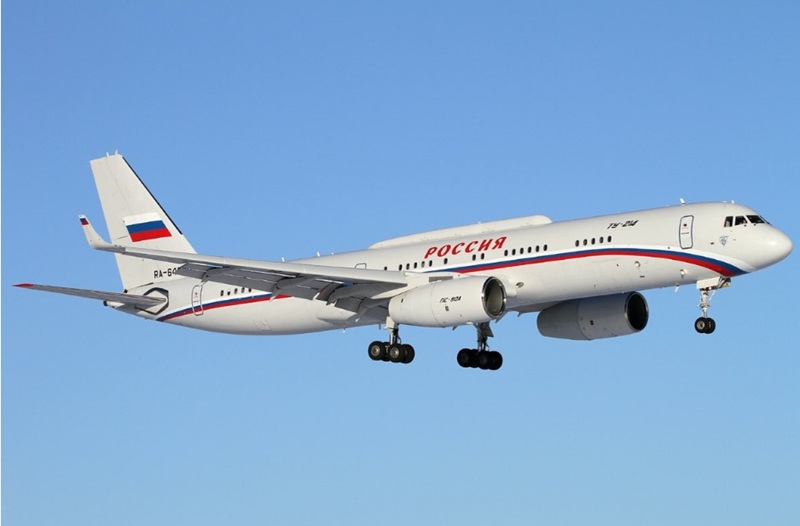
The departure of flight RSD420, a Tupolev Tu-214PU airborne command post operated by Russia’s elite Rossiya Special Flight Squadron, from Moscow to Tehran on 16 February has drawn attention across diplomatic and security circles. The flight originated from Vnukovo International Airport and landed at Imam Khomeini International Airport, a route and aircraft choice that suggest a deliberate geopolitical signal rather than a routine transport movement.
Why the Aircraft Choice Matters
The Tu-214PU is not a conventional VIP aircraft. Designed as a Punkt Upravleniya (command post), it functions as a hardened airborne headquarters, capable of sustaining executive-level command, control, and communications during national emergencies. Its use for the Moscow–Tehran flight immediately elevates the significance of the mission beyond standard diplomatic engagement.
Analysts note that such platforms are typically reserved for moments of heightened strategic sensitivity, when secure communications, survivability, and continuity-of-government capabilities are essential.
Strategic Context: Moscow–Tehran Alignment
The flight comes amid deepening Russia–Iran coordination following the signing of a 20-year Comprehensive Strategic Partnership Treaty in January 2025. While the agreement stops short of a formal mutual defense clause, it institutionalizes cooperation across military-technical, intelligence, and economic domains.
Within this context, the dispatch of a flying command post to Tehran reinforces perceptions that bilateral engagement has moved beyond transactional wartime necessity toward structured, long-term strategic alignment.
Capabilities of the Tu-214PU
The Tu-214PU is engineered to operate as a mobile command-and-control node in contested environments. Its configuration includes encrypted satellite communications, secure data links, electromagnetic shielding, and redundancy designed to function even under high-intensity conflict conditions, including nuclear contingencies.
Powered by twin PS-90A turbofan engines, the aircraft offers a range exceeding 7,000 kilometers, allowing it to support extended missions while acting as an airborne relay for strategic messaging across multiple theaters.
Flight Path and Operational Signals
The aircraft’s routing over the Caspian Sea—avoiding potentially hostile or congested airspace—underscores the sensitive nature of the mission. Open-source tracking data shows the flight cruising at high altitude with stable speed, consistent with government and military special-mission profiles rather than civilian or commercial traffic.
Such routing choices are common for flights involving senior officials, intelligence chiefs, or presidential envoys, reinforcing the assessment that the visit involved high-level consultations.
Regional and Global Implications
The arrival of a Russian airborne command post in Tehran coincides with intensified regional military posturing, including expanded U.S. deployments in the broader Middle East. Against this backdrop, the flight serves both practical and symbolic functions: enabling secure consultations while signaling executive-level commitment to coordination.
For Washington and allied capitals, the move highlights ongoing concerns about technology transfer, intelligence cooperation, and the strategic depth of the Moscow–Tehran relationship. For regional actors, it reinforces the perception of an emerging Eurasian alignment operating within a multipolar security framework.
A Signal, Not a Declaration
While the facts confirm the aircraft type, route, and timing, the precise agenda of the visit remains undisclosed. As with similar movements, analytical caution is warranted in separating verifiable data from inferred intent.
Nonetheless, the use of a Tu-214PU—rather than a standard diplomatic transport—suggests that the engagement carried weight at the highest levels of state decision-making.
Outlook
The RSD420 mission is best understood as part of a broader pattern of calibrated signaling rather than an isolated event. It reflects a partnership that is deepening but remains pragmatic, shaped by shared interests, external pressure, and strategic hedging on both sides.
As regional tensions persist, such high-visibility yet low-disclosure deployments will continue to play an outsized role in shaping perceptions of alignment and intent across the Middle East and beyond.