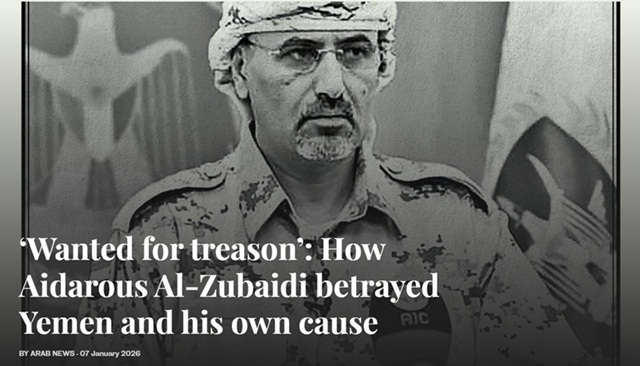
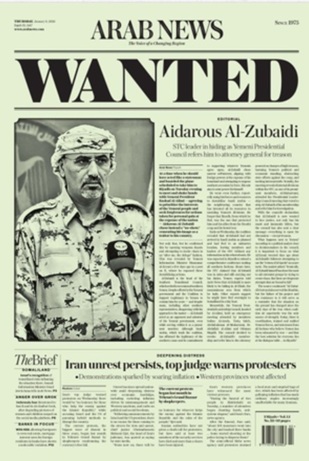
Saudi Arabia’s English-language daily Arab News sent an unusually blunt political signal by publishing a front-page headline branding Yemeni leader Aidarous Al-Zubaidi as “Wanted,” accompanied by a large photograph. The language and imagery marked a sharp departure from Riyadh’s traditionally cautious media tone on Yemen, reflecting deep frustration within Saudi decision-making circles.
A Diplomatic Snub With Strategic Consequences
At the center of the controversy is Al-Zubaidi’s failure to travel to Riyadh for a scheduled meeting with Yemeni President Rashad Al-Alimi. The meeting was intended to advance dialogue among southern factions and reaffirm commitment to Yemen’s unity framework. Saudi media framed Al-Zubaidi’s absence not as a logistical issue, but as a deliberate political rejection of Saudi mediation.
From Riyadh’s perspective, the “no-show” symbolized defiance of the very state that had previously provided Al-Zubaidi political cover and protection during the conflict with the Houthis.
From Political Actor to Security Liability
The Arab News report methodically recasts Al-Zubaidi from separatist leader to destabilizing force. Allegations that he distributed weapons in Aden, attempted to incite unrest, and aligned with foreign interests are presented as evidence that he crossed a critical red line—from political dissent into actions threatening state security.
This narrative directly supports the decision by Yemen’s Presidential Leadership Council to revoke his membership and refer him to prosecution on charges including high treason and undermining national stability.
Message to the Southern Transitional Council
As head of the Southern Transitional Council, Al-Zubaidi’s targeting carries implications far beyond one individual. Saudi Arabia appears keen to separate the legitimacy of southern grievances from the actions of leaders who pursue them through force.
By highlighting internal divisions within the STC and cooperation between other southern figures and the central government, Saudi-aligned media signals a readiness to support alternative leadership that aligns with a negotiated political process.
Saudi Arabia’s Red Lines in Yemen
The strongest warning embedded in the coverage concerns security. The suggestion that Al-Zubaidi’s supporters could exploit fears of extremist resurgence places him firmly outside acceptable political conduct in Saudi eyes. Any action that risks empowering militant groups or destabilizing neighboring states is portrayed as intolerable.
In this sense, the “Wanted” headline functions as a declaration that political immunity ends where regional security begins.
Strategic Implications
The publication serves multiple purposes:
- Delegitimization of Al-Zubaidi as a political partner
- Deterrence for other Yemeni actors considering unilateral escalation
- Justification for firmer measures in southern Yemen
- Narrative control, framing the conflict as a struggle between order and chaos
Conclusion
Arab News’ headline is not merely editorial rhetoric; it is state signaling. Saudi Arabia is communicating that while political disagreements over Yemen’s future remain negotiable, actions deemed treasonous or destabilizing are not. The message to Yemeni factions is clear: Riyadh’s patience has limits, and crossing them carries consequences.