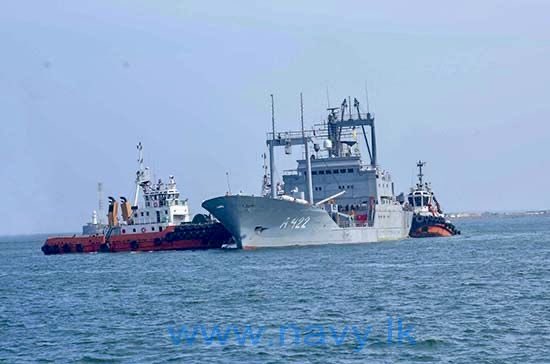
Sri Lanka has taken a major geopolitical step by granting permission for the Iranian naval vessel IRINS Bushehr to dock at Trincomalee, one of the most strategically important natural harbors in the Indian Ocean.
The decision comes just 48 hours after a U.S. submarine sank the Iranian naval vessel IRIS Dena near Sri Lanka’s southern coast in what American officials described as the first torpedo kill since World War II.
Sri Lanka’s President Anura Kumara Dissanayake says the crew of the Iranian naval ship IRIS Bushehr near Sri Lanka’s territorial waters will be disembarked at Colombo Port.
He said the vessel will then be taken to Trincomalee Harbour, while the Sri Lanka Navy is making…
— Azzam Ameen (@AzzamAmeen) March 5, 2026
The move places Sri Lanka at the center of a rapidly expanding maritime crisis involving the United States, Iran, and regional powers across the Indian Ocean.
Why Trincomalee Is Strategically Important

Trincomalee is widely considered one of the best deep-water natural harbors in the world.
Historically, it has been a major strategic naval location:
- The British Empire used Trincomalee as a key naval base in the Indian Ocean.
- During World War II, Japanese forces bombed the harbor in April 1942 during the same raid that sank HMS Hermes.
- Military planners often describe Trincomalee as one of the most valuable naval anchorages in Asia, second only to Singapore.
Control or access to Trincomalee allows naval forces to project power across:
- The Bay of Bengal
- Major Indian Ocean shipping routes
- Strategic sea lanes linking Asia, the Middle East, and Africa
The Timing of the Iranian Warship’s Arrival
Sri Lanka’s decision comes at a sensitive moment.
Just days earlier, a U.S. submarine torpedoed and sank the Iranian naval vessel IRIS Dena about 40 kilometers off the coast of Galle, Sri Lanka.
The incident marked the first confirmed submarine torpedo kill of a warship since World War II, according to American officials.
The surviving crew members were reportedly rescued and brought ashore in Sri Lanka.
Sri Lanka’s Conditions for Docking
Colombo approved the docking of IRINS Bushehr, but with strict conditions designed to limit the military implications.
According to reports:
- The crew and passengers will be transferred to Colombo first.
- Only after that transfer will the warship proceed to Trincomalee harbor.
This sequencing suggests Sri Lanka is attempting to frame the move as a humanitarian action rather than a military alignment.
By separating the crew evacuation from the warship’s docking, Sri Lanka appears to be trying to avoid the perception that it is hosting an Iranian naval operation.
Political Pressure Inside Sri Lanka
The decision followed intense political pressure inside the country.
Sri Lankan lawmakers revealed that there had been an 11-hour delay in responding to the distress call from IRIS Dena before the ship sank.
Opposition members raised the issue in Parliament, while the Foreign Minister acknowledged the timeline of the emergency call.
Refusing docking permission for another Iranian vessel after the earlier incident could have been interpreted as a second failure to assist Iranian sailors.
A Difficult Strategic Choice
Sri Lanka’s government faced a difficult calculation.
Allowing an Iranian naval vessel into Trincomalee during an active U.S. military campaign against Iran risks angering Washington and its allies.
At the same time, denying the request could have damaged relations with Iran and other countries observing the conflict.
The decision suggests Colombo determined that the political and humanitarian costs of refusal were greater than the diplomatic risks of approval.
A New Dimension in Indian Ocean Geopolitics


Sri Lanka sits at the crossroads of several major strategic interests in the Indian Ocean.
Different global powers already have significant stakes in the region:
- India has long sought closer strategic cooperation around Trincomalee.
- The United States uses Sri Lankan waters as part of its broader Indian Ocean naval transit network.
- China has invested heavily in infrastructure at Colombo Port.
Allowing an Iranian naval vessel into one of the region’s most strategic harbors therefore carries significant geopolitical implications.
Sri Lanka’s Neutrality Under Pressure
For decades Sri Lanka has tried to maintain a carefully balanced foreign policy, avoiding alignment with major geopolitical blocs.
However, the current conflict is placing increasing pressure on neutral states across the region.
What was once a distant war is now unfolding directly in the Indian Ocean maritime theater.
A Turning Point for the Indian Ocean
Just days ago, Sri Lanka was largely a bystander to the escalating confrontation between the United States and Iran.
By allowing an Iranian naval vessel access to Trincomalee, one of the most strategically important ports in the Indian Ocean, Colombo has moved into a far more complex diplomatic position.
The Indian Ocean theater is now becoming an active geopolitical arena in the wider conflict.
And Sri Lanka may be the first neutral state forced to navigate the consequences of that reality.